
Cutlery Holders for Restaurant Tables: Buying Guide
Choose a restaurant cutlery holder by service model, utensil-protection workflow, cleaning method, filled stability, table footprint and measured refill labour.

One holder on one table is a sample. A room-wide order is a service workflow, a utensil-protection decision, a cleaning task, a storage plan and a recurring replacement cost.
Begin by observing how clean cutlery reaches a guest now. A holder is useful only if it removes a real service step without exposing unused utensils, crowding the smallest table or creating a harder reset.
This guide runs the decision in the right order: service model, then hygiene, then material and weight, then the labour the caddy adds and removes, then how to make it look like it belongs. Which fork sits where is a different subject and lives in our restaurant table setting guide. This is about the object itself, bought in quantity.
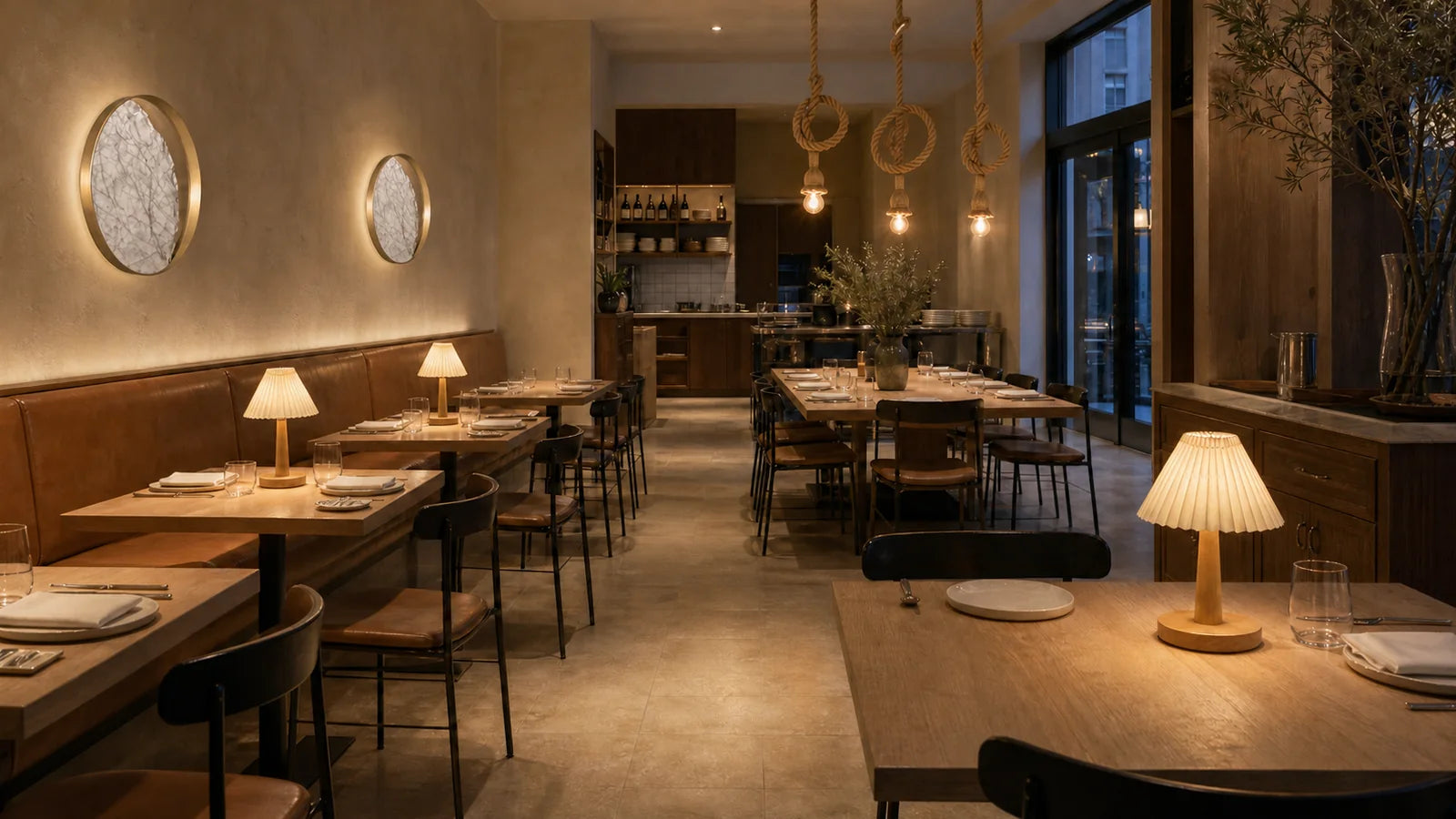
First decide the service model, then buy the holder
There are four ways cutlery reaches a guest, and only two of them involve a caddy on the table. Work out which one you are before you look at a single product.
| Service model | Where cutlery lives | What to buy | The trade-off |
|---|---|---|---|
| Pre-set covers (full service, bistro, fine dining) | Laid before the guest sits | Station trays and protected holding back of house | Measure setup time; protect exposed, unused settings under the adopted food code |
| Table caddy (family, brunch, all-day casual) | On the table | Stable, cleanable holder sized to the approved wrapped or protected format | May remove a delivery step; adds loading, cleaning, table footprint and guest-contact questions |
| Napkin roll with the order (fast casual with runners) | Delivered with the food | Roll station and protected holding bin | Moves work into prep; keeps the table clear until food arrives |
| Central self-serve station (counter service, food halls) | One monitored station | Station holders or bins sized to the packaged utensil format | Consolidates stock; adds guest travel, replenishment and station-cleaning work |
If lunch and dinner use different models, test the changeover as part of the sample trial. Record where the holders live off-table, how many fit in a washable crate, and how long the full room takes to switch. Buy only after both states work on the smallest two-top and the largest joined-table layout.

Control guest handling and cleaning
An open caddy of loose cutlery allows guests to handle pieces they do not use. Whether that setup is acceptable depends on the local rules and the handling process, so decide the process before choosing the container.
The design task is to protect clean utensils and define what happens to unused pieces:
- Use wrapping or another accepted protection method. Individual bundles can reduce guest contact with unused pieces. Prepare, store and discard or reprocess them under the procedure accepted by the local health authority.
- Define the unused-utensil rule. Section 4-904.13 of the FDA Food Code 2022 addresses preset tableware exposed to a customer: it must be protected, or exposed unused settings must be removed and cleaned and sanitized before further use. Confirm how the locally adopted rule applies to the proposed caddy.
- Specify a cleanable complete holder. Ask for the material, joints, feet, liner, approved chemicals and dishwasher limits. Reject any sample whose interior or base cannot be inspected and reached by the documented method.
- Protect food- and lip-contact surfaces during handling. Section 4-904.11 addresses that principle; train staff to grasp and present utensils by their handles.
- Keep open caddies out of the splash and traffic lines — not against the pass, not on the first table inside a swinging door, not under a ceiling vent.
The FDA Food Code is a model that jurisdictions adopt and modify. Ask the local health authority whether table-level storage is acceptable, what protection is required, and how the holder must be cleaned. Put the approved process into training and the opening/reset checklists.
Check before you buy: Is the holder approved for the actual warewashing or manual-cleaning process? Can every interior corner, seam and foot be reached and dried? Does the base retain moisture? Can the filled holder be lifted safely with the intended hand position?
Materials compared
Stability is one of the first specs to test. A light, narrow caddy can slide or tip during service. Test the filled sample on the smallest table, then evaluate cleanability, noise, edge condition, and replacement availability alongside its weight.
| Material family | Sample test | Documentation to request | Common inspection point | Visual candidate |
|---|---|---|---|---|
| Glazed ceramic / porcelain | Filled tip test; set-down noise; one-hand lift | Warewashing limits, glaze care, replacement availability | Chips, cracks, rough exposed edges and wet feet | Warm bistro or dinner room |
| Cast stone / resin composite | Filled stability; cleaner spot test | Exact resin/coating, approved chemicals, immersion limits | Crazing, stains, rough mould lines and retained moisture | Matte contemporary room |
| Stainless steel | Base stability; seam access; noise on the real tabletop | Alloy/finish, cleaner and warewashing compatibility | Dents, sharp deformation, corrosion and inaccessible seams | Counter-service or bright café room |
| Wood or bamboo | Moisture-cycle sample; joint and liner inspection | Finish system, cleaning method, drying and re-treatment | Swelling, splits, open joints and finish wear | Protected, low-moisture tabletop only if approved |
| Glass | Tip and impact-consequence review | Glass type, warewashing limits and replacement policy | Chips, cracks and sharp edges | Protected bright room after risk review |
| Melamine or other plastic | Filled stability; heat and chemical sample test | Food-zone suitability, warewashing temperature and chemical limits | Warping, cracks, deep scoring and unstable base | High-replacement or back-of-house use if documented |
Noise and appearance both need a sample test. Set the filled holder down repeatedly on the real tabletop during a sound check, then inspect the finish under the actual night scene after staff have handled and cleaned it. Matte and gloss show fingerprints, scuffs and water spots differently; neither is universally easier.
Sizing and capacity
Sightline first. A caddy that sits above seated eye level across a two-top puts an object between two people who came to look at each other. Keep it low and wide rather than tall and narrow, and judge it from the chair — the view from a host's height is not the view a guest gets.
Footprint next. Measure your smallest table, not your average one. A caddy that works on a four-top can eat a quarter of a small two-top once two covers, two glasses and a bread plate arrive. The honest test is not the empty table; it is the table at the busiest moment of the meal, which is the same test our table decor guide applies to everything else competing for that surface.
Set capacity from observed demand. During the trial, record pieces used between reliable refill opportunities, add an operating margin, and check the holder at both full and refill-trigger levels. Include its entire footprint in the busiest table mock-up rather than letting it overlap linen, menus or shared plates.
The refill-labour math
A caddy removes some per-cover setup and adds loading, top-up, washing, and close-down tasks. The timing matters: work that lands during the rush may be more disruptive than the same number of minutes before opening.
The method matters more than the numbers, so run it with your own. Time three staff doing each task on a normal Tuesday and put your figures in place of these:
Record one normal service with this worksheet:
- Caddy minutes per day = opening load + all top-ups + washing + close count and storage.
- Pre-set minutes per day = covers laid × measured seconds per cover + station replenishment.
- Central-station minutes per day = opening load + all restocks + cleaning + close count.
Time at least three staff members and use the median result so one unusually fast or slow person does not set the model. Record when each task happens as well as its duration. Then compare the result with breakage, missing pieces, guest requests, and the amount of usable table area each option consumes.
Styling: the caddy is a decor object whether you like it or not
Because the holder sits close to the guest and repeats across the room, its scale, finish and wear become part of the tabletop system. Approve it beside the real linen, glassware, condiments and night lighting.
Two useful mock-ups are finish against light and finish against the immediate tabletop. Compare dark ceramic, stone or matte resin under the warm scenes in Warm & Intimate, and stainless or pale ceramic under the brighter scenes in Bright & Social. Then photograph the sample on the actual cloth or bare top; the nearest materials matter more than a mood-board swatch.
A tray can group the holder with condiments or a lamp, but it earns the space only if the full cluster remains stable, cleanable and light enough for the intended lift. Time the reset with and without it; do not assume fewer loose pieces automatically means less labour.
When a seasonal swap makes operational sense
Changing a holder updates every table without altering furniture or fixed finishes. It makes sense only when the seasonal version meets the same handling, cleaning, capacity, and storage requirements as the everyday one.
Run the swap after close rather than table by table during service. Store the everyday holders in the labeled crate the seasonal set came from, and record the count so the return swap is predictable.
Hold a seasonal holder to the same handling, protection, cleaning and stability criteria as the everyday one. Set the order date from the supplier's current lead time plus a receiving and sample-test window, not a generic holiday-stock assumption.
Translate the spec into a shortlist
For table-caddy rooms—family dining, brunch and all-day casual—shortlist samples that pass the filled stability, utensil-protection, cleaning, reach and table-footprint tests. Glazed ceramic, a documented composite or a wide-base metal holder may qualify; the exact product evidence decides. Compare finishes under Warm & Intimate evening scenes and Bright & Social daytime scenes.
For the Q4 swap, our Santa Claus pocket cutlery holder is the seasonal object built for the job: a sleeve-style holder sized to a knife-and-fork set, so it works as a per-cover presentation rather than an open communal pot. Plan quantities per cover, not per table.
For a grouped setup, the black organic accent tray can collect a caddy and condiments into one lift. It is decorative only and is not represented as food-contact safe or heat resistant, so keep food and hot serviceware off it. Confirm the current dimensions, weight, and care instructions on the live listing before ordering. Underneath the group, the cotton-linen tassel tablecloth gives a warmer visual treatment than a bare hard surface.
To see both ends of that range on real tables, compare the counter-service styling in The Common Current Café with the linen-and-lamp treatment in The Parchment Bistro. Fitting out twenty tables or more? Send it through trade projects — volume tabletop orders are worth quoting properly.
Restaurant cutlery holder FAQ
Should restaurants leave silverware on the table?
It depends entirely on your service model. Pre-set covers suit bistro and full-service rooms where the laid table is part of the welcome. Table caddies suit family, brunch and all-day casual rooms where guests seat themselves and turnover is quick. If you are running a counter-service or runner-delivered model, cutlery on the table is an object you have to maintain for no service gain.
Is it sanitary to have cutlery caddies on tables?
It can be when the locally approved process protects clean utensils and defines what happens to exposed unused pieces. Wrapping may be one option. Specify how the holder is cleaned, inspected and stored, and confirm the complete workflow with the local health authority before rollout.
What is a cutlery caddy called in a restaurant?
You will hear cutlery caddy, flatware caddy, silverware holder, cutlery organiser and — in the US supply trade — flatware organiser or flatware cylinder for the taller station version. On a spec sheet or a supplier quote, "flatware caddy" and "cutlery holder" are the terms most likely to return what you actually want.
How do you set up cutlery for fast casual service?
Two options work. Either roll sets in napkins during prep and deliver them with the food, which keeps tables clear and guests seated, or run a single central station with tall holders and a tray, which cuts per-table labour but sends guests up mid-meal. Choose based on whether your bottleneck is prep time or floor staff.
What material is best for a restaurant cutlery holder?
There is no best material without the exact cleaning and service model. Compare filled stability, interior access, approved chemicals, warewashing limits, edge condition, set-down noise and replacement availability. A documented ceramic, composite, stainless or plastic product can work; reject any sample that fails the actual process regardless of material label.
Further reading: Restaurant Table Setting Design for how a cover is laid, Restaurant Table Decor for everything else competing for the same surface, and WebstaurantStore's restaurant table settings guide for labelled place-setting diagrams by service style.
Keep reading

guest-experience
Restaurant Restroom Cleaning Checklist and Inspection Log
Use this restaurant restroom cleaning checklist for opening, service inspections, supplies, fixtures, floors, waste, incidents, and closing records.

dining-room-operations
Restaurant Dining Room Cleaning Checklist: Turn to Close
Use this restaurant dining room cleaning checklist for table turns, high-touch points, spills, service stations, floors, opening, and close.

food-safety
Restaurant Kitchen Cleaning Checklist for Every Shift
Use this restaurant kitchen cleaning checklist to control opening, between-task, four-hour, closing, and weekly work without vague assignments.