
Top 10 Patio Lighting Ideas Before Summer Ends (August 2026)
Audit late-summer restaurant patio lighting by arrival, routes, tables, perimeter and close-down—then verify exposure, glare, power and controls.

By Kamrul Hasan Rayhan · Published 3 August 2026 · Last updated 3 August 2026
Late-summer patio lighting starts with a different question from spring installation: which tables, routes, and boundaries stop working as dinner shifts into darkness?
Walk the patio after dark and record the failures before buying anything. Portable lamps may solve table-level problems without a permanent wiring run, but the exact products still need suitable exposure ratings, stable placement, a charging plan, and any approvals required locally. Confirm availability and lead time with the supplier rather than inferring them from seasonal search interest.
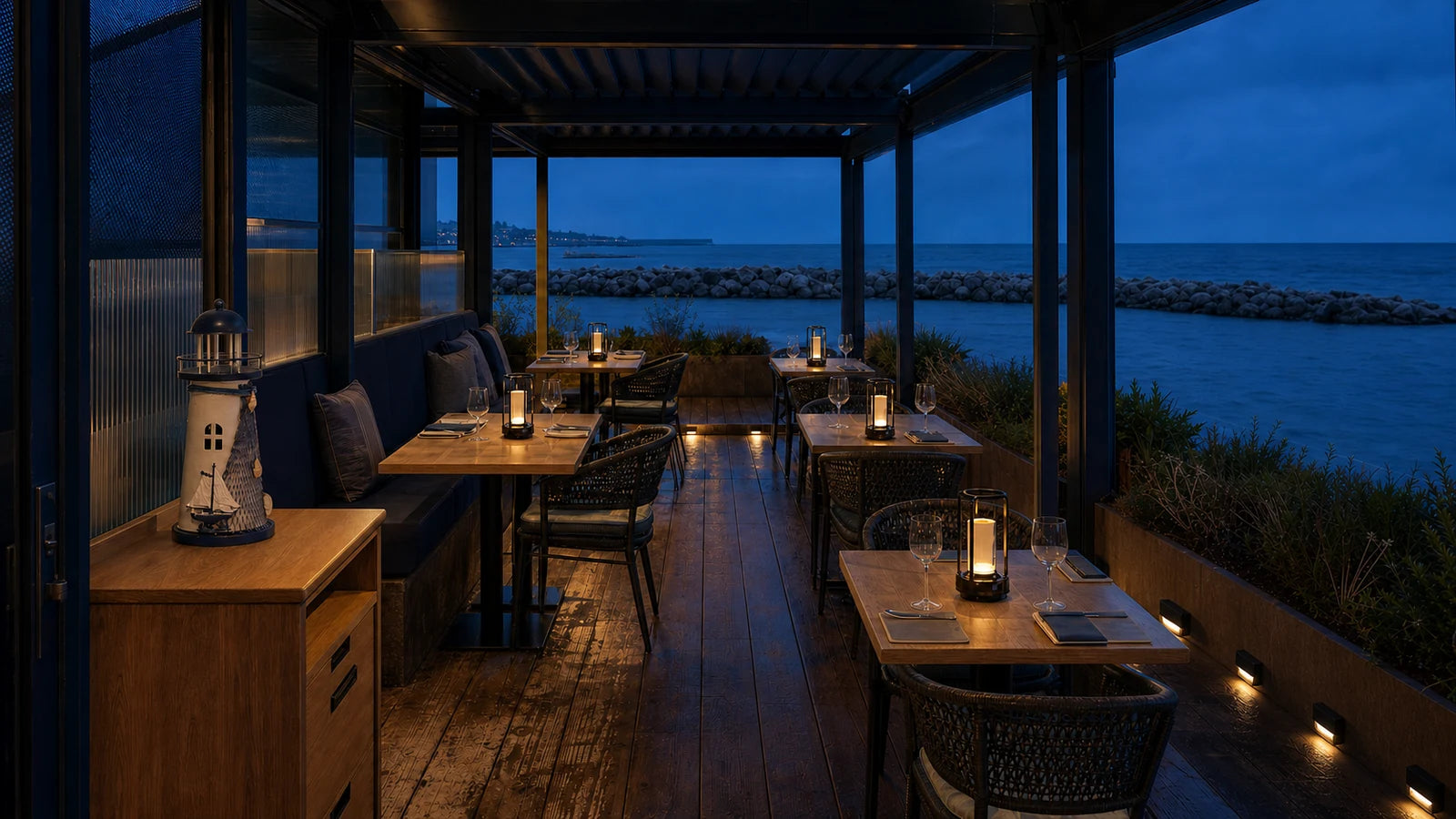
The 10 ideas at a glance
- Drop the light to table height with rechargeable touch table lamps.
- Put a hand-sweep induction lamp where nothing can mount — rails, ledges, low walls.
- Swap the bulbs before you swap the run — warmer, matched, filament-forward.
- Light the perimeter, not the middle — a lit boundary makes a patio feel larger.
- Wash the planters, not the guests — aim light at greenery and texture.
- Finish the covered bay with a ceiling fan that carries light.
- Audit every step, threshold and level change with the qualified lighting team.
- Build a golden-hour → blue-hour control plan with named states and one owner per shift.
- Give the patio one lit focal point that photographs from your best tables.
- Pack the take-indoors kit now, while you can still see what is worth keeping.
The method behind the list—layers, mounting, seated glare and exposure zones—belongs to the restaurant patio lighting guide. This article applies it to a late-summer audit.
1. Drop the light to table height with rechargeable touch table lamps
A table lamp moves light closer to menus and food instead of trying to raise the whole patio from overhead. Test one sample after dark, and confirm outdoor suitability, stability, glare, run time, and local requirements before buying a fleet.
Run portable lamps as a fleet. Define a ventilated charging location allowed by the manufacturer, deployment and return counts, cleaning method, damaged-battery isolation and a tested brightness setting for each lighting state. Do not leave lithium-powered lamps charging or baking in direct sun contrary to their instructions.
Log tested run time at the selected output rather than trusting an old fleet by appearance. Retire swollen, damaged, overheating or unreliable units under the manufacturer's battery procedure. Specs and fleet sizing are covered in our rechargeable restaurant table lamps guide; browse formats in table lamps.
2. Put a hand-sweep induction lamp where nothing can mount
Every patio has surfaces that need light and cannot take a fixture: the bar rail, a planter ledge, the top of a divider, a low boundary wall, the service station wedged against the building. No junction box, no room for a cord run, nowhere to drill.
A hand-sweep induction lamp may suit a non-safety-critical spot when the product is listed for the exposure and can be restrained securely. Test the sensor, charging routine and manual override in place; it must not be the only light for a route, step or working task.
Observe false triggers and missed activations during a trial shift. If several units form a run, mock a consistent mounting line and include their full projection in the route-clearance review.
3. Swap the bulbs before you swap the run
Before adding a new overhead run, inspect the lamps already installed. A compatible lamp change may solve colour mismatch or failed output, but only after you confirm base, voltage, wattage limit, dimmer compatibility, enclosure suitability, and the fixture's outdoor rating.
Replace failed or visibly inconsistent lamps only after documenting the intended colour, output, beam and control behaviour. Decorative or "fireworks" bulbs are visual candidates for an arrival point or bar only when the fixture, enclosure and exposure permit them; approve a sample under dusk and full-dark conditions.
Document colour temperature and lamp reference by zone so maintenance does not introduce accidental mismatch. Intentional contrast may be part of a design, but test it; otherwise buy labelled spares with the approved batch. The temperature logic is in our lighting colour temperature guide. Resto Glow sells bulbs and fixtures, not string-light runs themselves.
4. Light the perimeter, not the middle
Compare a flat central wash with layered table, boundary and background light. The layered option can improve visual orientation and depth, but code-required illumination and uniformity still need to be verified separately.
For wall sconces on a building face, have the qualified team confirm rating, mounting, supply, controls and required approvals. Then run a seated glare check from every table, especially the closest and lowest sightlines.
Where you have no wall, the boundary can be carried by lit planters, a run of induction lamps along a rail, or a marked threshold. What matters is that the eye finds an edge. Browse wall lights; The Breakwater Terrace is the reference room for a lit perimeter.
5. Wash the planters, not the guests
Accent light can reveal greenery and textured surfaces without aiming a narrow beam at a guest. It is supplementary, not a substitute for route, task or emergency lighting.
Test a low grazing angle on one planter or wall sample, checking glare, plant heat, cable protection, drainage and maintenance access. At tables, keep any greenery or arrangement low, stable and approved for the exposure; it should not block sightlines or plate space.
If planting has deteriorated, repair or replace it before adding accent light, which can make damage more visible. Our guide to low-maintenance restaurant plants covers the plant-selection questions.
6. Finish the covered bay with a ceiling fan that carries light
A covered bay may have a longer operating season, so evaluate it separately. A permanent fan/light is a structural and electrical project, not a decorative late-summer shortcut.
A ceiling fan with integrated light is only a candidate after a qualified professional reviews the structure, mounting system, clearances, wind, controls, circuit and actual wet/damp exposure. “Covered” does not establish product suitability, and an existing box or downrod does not establish support for a new fan.
Model the expected operating dates and revenue before authorising permanent work. The Courtyard Supper Club is a visual concept, not an installation specification.
7. Audit every step, threshold and level change
Walk the arrival and service routes after dark with the designer or qualified lighting professional. Record every step, threshold, ramp, edge and material change, then compare the current condition with applicable code and accessibility requirements.
Specify permanent step or path lighting for the actual location where required. Decorative LED touch atmosphere lights may be tested as supplementary accents only; do not use portable consumer lights as required life-safety, egress or accessibility lighting.
Put required lighting on the approved control and maintenance system, then add a function check to the opening and dusk walk. Isolate the route and escalate any required light failure under the venue's safety procedure.
8. Build a golden-hour → blue-hour dimming plan
A written control plan can often use existing dimmers and switching, but confirm the equipment and required light levels before changing settings.
Name three states and assign one owner per shift. Daylight service keeps only the lights required for safety and tasks. Dusk transition brings up the approved perimeter, table and route layers before daylight is lost. Full dark uses the tested scene. Record the trigger by observed light level, astronomical control or current local sunset data, and review it as the season moves.
Order matters as much as level. Light the edges before the middle, and the tables before the sky. The underlying method is in our restaurant mood lighting guide.
9. Give the patio one lit focal point
One composed wall or corner that photographs. Not a feature wall, not a mural — a single spot where the light, the object and the background have been thought about together.
For metal wall decor or canvas art, ask for the exact product's exposure, finish, cleaning and fixing evidence. A covered bay is not automatically suitable for indoor-only art. Choose the position by testing the background from occupied tables and the entrance.
The test is the same as the whole patio's: from the entrance at 8 p.m., does the far end read as somewhere to go? If the eye stops at the last lit table, the patio effectively ends there.
10. Pack the take-indoors kit now
Write the close-down plan before weather or demand forces a rushed closure. Inventory portable lamps, chargers, vessels, linens and spare lamps by zone and condition.
Use dry, suitable storage and the manufacturer's battery/storage instructions. Quarantine damaged electrical products, chipped vessels and damp or stained textiles rather than packing them with serviceable stock. Record repair, disposal or replacement decisions and next-season par.
Then hand the inventory to the venue's written autumn changeover plan.

What to skip in August
Separate reversible operational fixes from capital work. A permit, trench, circuit or structural attachment needs a business case, design, approvals and a realistic programme; do not force it into the current season merely because the evenings are getting darker.
Move any capital item that cannot be designed, approved, delivered, installed and commissioned safely within the useful operating window into the next planned project. Set dates from the actual authority, contractor and supplier—not a generic Q1 rule.
Reversible work may include testing suitably rated portable lamps, correcting compatible lamps in existing fixtures, documenting control states and improving the close-down routine. Permanent sconces and marker lights still require the appropriate design and installation review.
The late-summer patio kit
One shoppable block, in the order you should buy it.
Table height first. Use the after-dark audit to decide which tables need rechargeable touch table lamps, then size the charging rotation and spares from service length, tested run time, and failure history. Add a hand-sweep induction lamp only where the exposure and sensor test succeed.
Then the existing runs and edges. Audit compatibility and condition before choosing decorative or "fireworks" bulbs and labelled spares. Treat wall sconces and permanent step/route lighting as professional specifications, not plug-in décor.
Then the covered bay. Put any ceiling fan with light through the structural, electrical and exposure review. Test low, stable greenery or arrangements only after verifying their product exposure and table clearance.
Browse the full range in restaurant lighting, or see the finished rooms at The Breakwater Terrace and The Courtyard Supper Club. Lighting several patios at once? Start at trade projects.
Late-summer patio lighting FAQ
How do you light a restaurant patio?
Start with the required route and task lighting, then test overhead, perimeter and table layers for the room. Portable lamps belong only on tables where their rating, stability, glare and charging plan pass. Audit every step and threshold with the qualified team, and use documented control states. Our patio lighting guide covers mounting, glare and exposure.
What colour temperature is best for outdoor restaurant lighting?
Choose colour temperature with the menu, materials and existing sources under dusk and full-dark conditions. Document it by zone and buy labelled compatible spares so maintenance does not create accidental mismatch. See our colour temperature guide for the visual trade-offs.
How do you light a patio table with no outlet nearby?
Test a suitably rated rechargeable table lamp as part of a controlled fleet, with an approved charging location, cleaning method, tested run time and close count. A restrained hand-sweep lamp may suit a non-safety-critical ledge after its sensor and exposure test. Neither replaces required permanent route, task or emergency lighting.
Do outdoor restaurant lights need to be wet rated?
Match every fixture to the exposure of its actual position, not to the patio as a whole. A covered bay is not automatically an outdoor location — wind-driven rain reaches further under an awning than operators expect. Check each product listing for its stated suitability and confirm with your electrician or local authority before installing anything on a permanent circuit.
When does patio season end for restaurants?
There is no universal date. Use booking demand, local weather, staffing, daylight, comfort, operating cost and permit conditions to define the season for each zone. Write the close-down triggers and storage plan before demand changes.
Next step: convert the audit into a dated autumn changeover and close-down checklist owned by one person per shift.
Keep reading

guest-experience
Restaurant Restroom Cleaning Checklist and Inspection Log
Use this restaurant restroom cleaning checklist for opening, service inspections, supplies, fixtures, floors, waste, incidents, and closing records.

dining-room-operations
Restaurant Dining Room Cleaning Checklist: Turn to Close
Use this restaurant dining room cleaning checklist for table turns, high-touch points, spills, service stations, floors, opening, and close.

food-safety
Restaurant Kitchen Cleaning Checklist for Every Shift
Use this restaurant kitchen cleaning checklist to control opening, between-task, four-hour, closing, and weekly work without vague assignments.