

The maintenance problem usually begins with a harmless sentence: “This corner needs a plant.” A pot arrives, then another. Nobody records the species. Watering becomes a kindness performed by whoever notices first. Two people water the same soil, a saucer marks the floor, leaves reach into a service path, and the darkest corner gets blamed when the plant declines.
The answer is not a list of allegedly indestructible plants. It is a smaller, zoned plan with a named owner, suitable light, protected surfaces, and a route that can be completed when the restaurant is closed to guests.
Begin with the route, not the mood board
Walk the room with a tray or bus tub before choosing a species. Mark the places where a person can stop, kneel, lift a pot, wipe a surface, and leave without moving guest furniture or entering food preparation during service.
For every proposed plant, write down:
- the zone and the job it performs;
- the available daylight or plant-light source;
- who checks it and on which shift;
- how it is watered, drained, cleaned, and isolated;
- what sits below it if water escapes;
- what happens when it outgrows the location or declines.
If one of those answers is “we will work it out later,” the location is not ready for living greenery.
Four zones are usually enough
Entrance: one large object can soften the threshold and make the host point feel intentional. Keep it outside the door swing, accessible route, queue, sign, payment point, and host sightline.
Window or daylight edge: group a few compatible living plants where the light is genuinely useful and maintenance access is easy. A cluster is easier to inspect than pots scattered around the room.
Dining and tabletop: use the smallest amount of greenery here. Check conversation sightlines, plates, shared dishes, condensation, pollen or fragrance concerns, and one-lift clearing. A low vessel on selected large tables is more workable than a compulsory plant on every two-top.
Protected wall or shelf: reserve this for a carefully mounted planter, a rotation plant, or sparse artificial greenery where guests and trays will not brush it. Confirm wall loading, projection, water management, cleaning, and removal access.
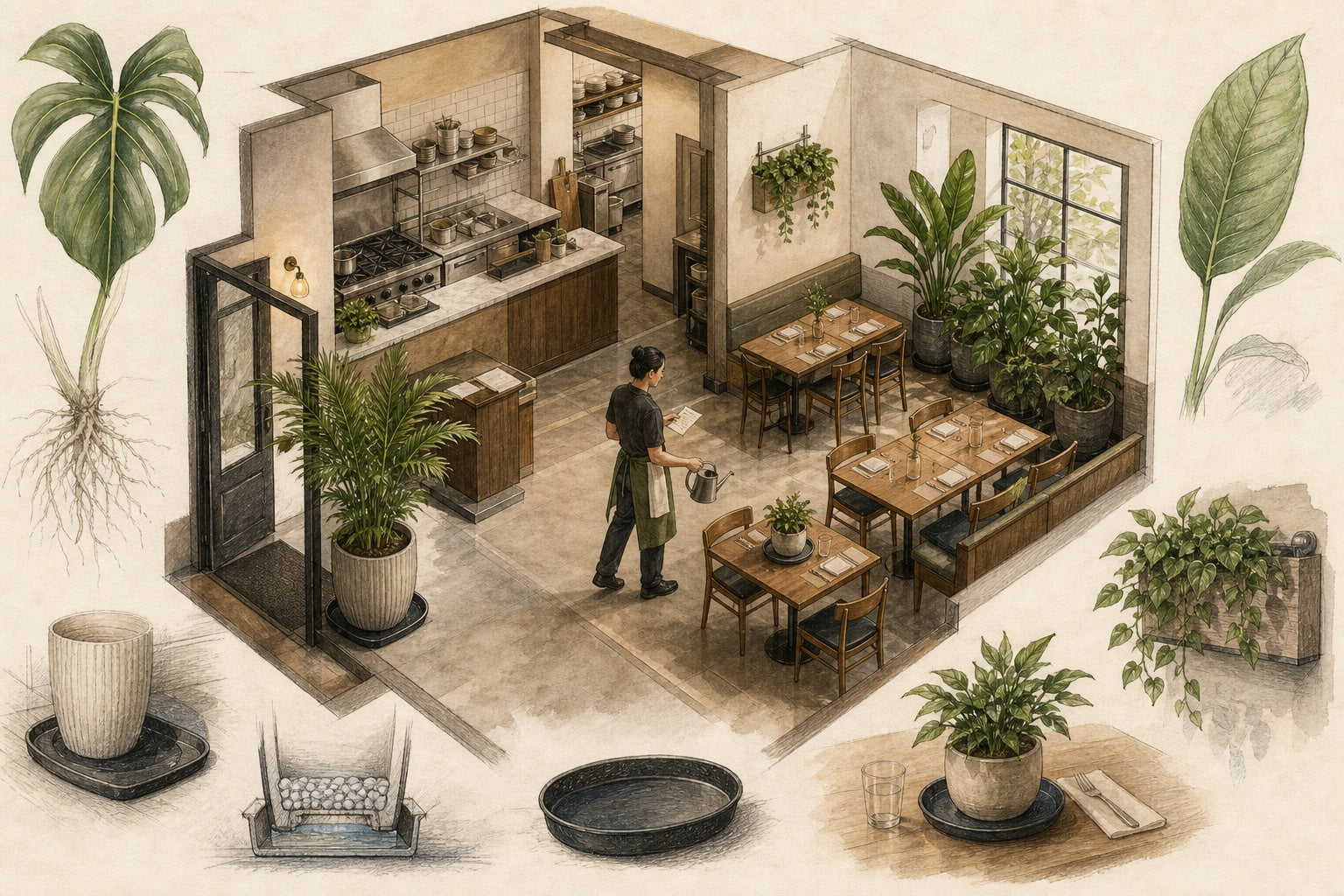
The Terracotta Conservatory is useful as a concept study because the greenery appears in controlled zones instead of becoming wallpaper. Treat the imagery as a prompt for scale and material, not proof that a shown species or planter suits the real room.
Choose living, artificial, hybrid—or no plant—by location
“Real or faux?” is too broad. The right answer may change between the window, entrance, back bar, washroom, and table.
Living plants: only where the room supports them
Living plants can add seasonal change and material depth. They also create recurring work. Choose them where you can verify suitable light, temperature, humidity, access, drainage, pest inspection, and plant-specific care.
The phrase “low-light plant” is often misread as “no-light plant.” The University of Minnesota Extension’s indoor-plant lighting guide explains that plants have different light requirements and that foliage plants still need suitable conditions. Measure or observe the actual location across the trading day; do not select from a generic low-light list alone.
Artificial greenery: useful in a genuinely difficult zone
Artificial greenery can work where natural light is poor, the pot cannot be reached safely, or the room needs a stable seasonal set. It still requires cleaning, inspection, fire and material review, secure mounting, and an exit plan when fading or damage makes it look neglected.
Use it sparingly. One convincing leaf shape in a difficult wall zone usually works better than a dense plastic canopy. Keep it away from hot sources, food preparation, contamination risk, and places where grease or dust will accumulate faster than the maintenance schedule can handle.
Hybrid: the practical restaurant answer
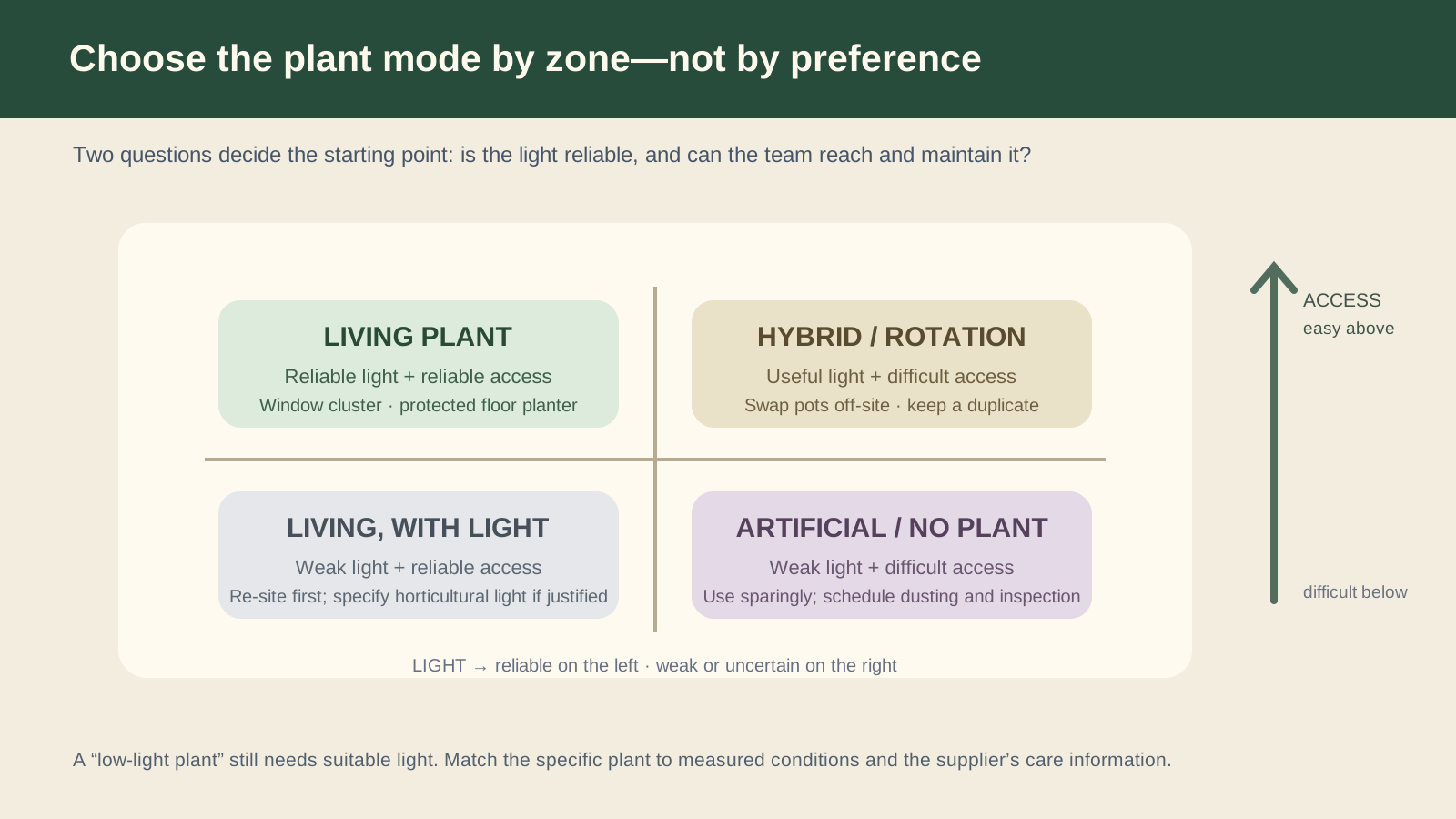
A hybrid plan keeps living plants in two or three supportable zones and uses artificial foliage, rotation stock, or no plant at all elsewhere. It allows the team to concentrate care instead of pretending every decorative location has the same conditions.
Use the selector below for each proposed zone. “No plant” is a valid design decision when both light and access are poor.
Do not sell plants as an air-quality system
Greenery can make a room feel visually softer, but it should not be used to promise cleaner indoor air. The US Environmental Protection Agency says on its indoor-air-quality guidance that a reasonable number of houseplants has not been shown to remove significant pollutant quantities in homes and offices, and it warns against overly damp soil.
Ventilation, source control, filtration, cleaning, moisture management, and professional building systems do the air-quality work. Let plants be a design and hospitality choice, then manage the soil and water honestly.
Match plant scale to the job
One large floor planter can mark an entrance more calmly than seven small pots. Before buying, mock up the mature width and height—not only the nursery size.
Check the object from these views:
- approaching the door and host;
- seated at the nearest table;
- carrying a tray through the narrowest route;
- reaching the fire extinguisher, control, sign, or service cabinet nearby;
- cleaning behind and beneath the planter.
Give the pot enough visual weight that it does not look temporary, but do not make it too heavy to inspect or move safely. A wheeled concealed platform may help a large pot only if it is stable, appropriate to the floor, locked or controlled, and compatible with the venue’s procedures.
Keep tabletop greenery low, dry, and easy to reset
The smallest table is the truth test. Set it for the largest normal order: menus, water, shared plates, condiments, payment device, and the intended lamp. Then add the plant.
Reject or revise the arrangement if it:
- blocks the other guest’s eyes or the server’s approach;
- requires moving before food can land;
- leaves soil, leaves, water, or a wet ring on the table;
- has a strong fragrance, unstable base, sharp leaf, or shedding material;
- cannot be cleared safely in one lift;
- makes the reset slower than the team can repeat.
If a living tabletop plant survives those checks, keep a duplicate off the floor so a declining specimen can leave immediately. If artificial greenery is used, put dusting and damage inspection on the same reset standard.
One restrained artificial greenery and vase arrangement can be a mock-up candidate, not an automatic table answer. Confirm its current dimensions and materials, then test the complete object on the real surface.
Plan drainage before choosing the decorative pot
The display vessel and the growing pot solve different problems. A decorative cachepot can hide a nursery container, but it can also hide standing water.
For every living plant, document:
- whether water leaves the inner pot and where it collects;
- how the inner pot is lifted without spilling or damaging roots;
- how the saucer, liner, cachepot, floor, shelf, or wall is dried;
- whether the surface below tolerates moisture and weight;
- how overflow, leaks, or a cracked pot are handled;
- where the plant goes while maintenance occurs.
Watering at the table during setup is tempting and often messy. Move manageable plants to a protected off-service station, or protect the zone and use a controlled volume based on the plant’s actual needs. Allow drainage to finish before the pot returns.
Wall planters need a complete load and water plan. If round iron wall planters are being considered, verify the product’s current dimensions, intended use, installed weight, liner, fixing, projection, and removal access. The product photograph cannot confirm the real wall or drainage method.
Light plants and tables as different tasks
A plant can look dull even when the nearby table is bright, and raising the dining scene may create glare without helping the foliage. Decide whether the plant is a background mass, a feature object, or a living specimen that needs horticultural support.
Use the restaurant lighting layers guide to separate guest, route, and accent jobs. Do not aim a decorative spotlight at living foliage and assume it meets the plant’s needs. Where supplemental plant lighting is justified, involve a knowledgeable supplier or professional and consider appearance, spectrum, duration, heat, controls, glare, and the room’s night scene.
Green leaves also change reflections and shadows. View the mock-up from the banquette, the entrance, and the darkest table. If foliage turns into a black silhouette or throws distracting moving shadows across faces, adjust its location or the accent layer before adding more fixtures.
Build a care loop the team can finish off-service
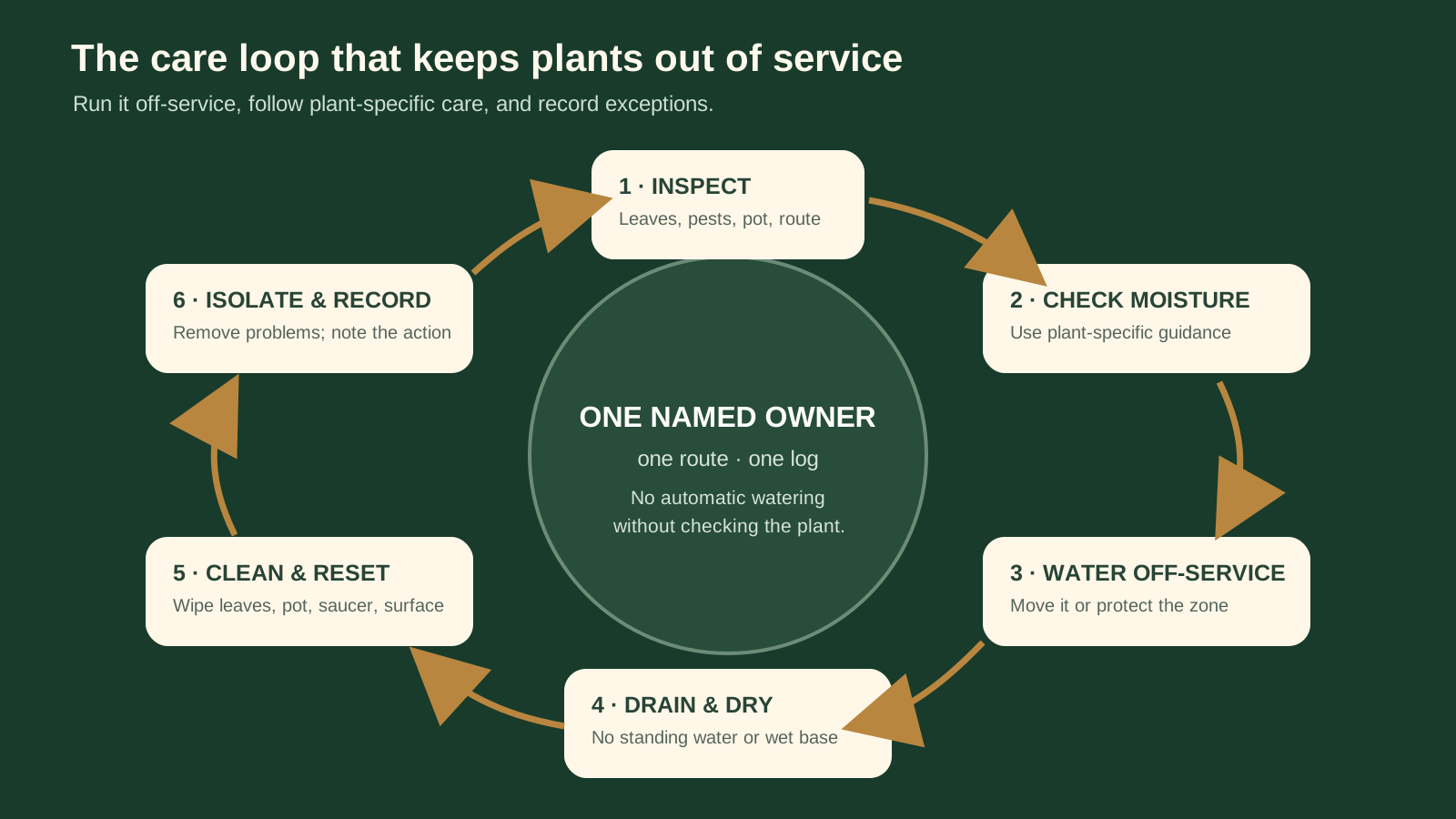
The maintenance schedule should be small enough to survive a busy week. It must also follow the specific plant’s care information—never water every pot simply because the calendar says Tuesday.
- Inspect. Look at leaves, stems, soil surface, saucer, pot, mounting, and the route around it.
- Check moisture and plant condition. Use the supplier’s method and the plant’s needs, not a universal finger test or fixed volume.
- Water off-service. Move manageable plants or protect the zone. Keep water away from food, table settings, electrical equipment, and guest routes.
- Drain and dry. Empty standing water where appropriate, dry the pot and base, and inspect the surface below.
- Clean and reset. Wipe the allowed surfaces, remove debris, rotate or prune only as the plant’s care permits, and return it to its marked position.
- Isolate and record. Remove a plant with pests, disease symptoms, leakage, instability, or unexplained decline. Record the observation and next action.
The University of Minnesota Extension’s guide to managing insects on indoor plants is a useful reference for inspection and isolation. It notes that poor conditions and overwatering can contribute to pest problems. The restaurant still needs a venue-specific response that protects food, guests, staff, and surfaces; do not improvise pesticide use in a dining or food environment.
Keep food safety and the local regulator in the loop
Plants, soil, water, artificial foliage, and maintenance tools do not belong wherever they might contaminate food, clean equipment, utensils, linens, or food-contact surfaces. Keep plant work out of food preparation and active service, and include the venue’s food-safety lead in placement and care decisions.
The FDA Food Code is a US model that jurisdictions may adopt or adapt; it is not a permit for a specific plant placement. The local health authority, adopted rules, venue procedures, and actual conditions govern. When in doubt, move the greenery away from the food zone and ask the responsible authority.
A one-page plant register
Use a simple register rather than relying on memory.
| Field | What to write |
|---|---|
| Plant ID and zone | Window-01, Entrance-01, Banquette-faux-02 |
| Type | Living, artificial, or rotation stock; species or supplier description |
| Job | Threshold marker, background mass, tabletop accent, or wall feature |
| Conditions | Light notes, temperature concern, access, and nearby service activity |
| Container | Inner pot, liner, saucer, cachepot, wall fixing, and surface protection |
| Care owner | Named role and inspection trigger |
| Exception rule | When to isolate, replace, re-site, or escalate |
| Reference photo | Approved placement and clear route after reset |
The register turns a styling idea into an operating object. It also makes the right response obvious when a plant disappears, moves, leaks, or declines.
The smallest complete greenery plan wins
A convincing restaurant does not need a plant in every corner. It needs a few zones where the greenery has enough light, can be reached, does not compete with food or service, and looks intentional from the guest’s eye level.
Start with one entrance object, one window cluster, and one dining-table test. Run the route for two weeks. Record the real time, watering, drainage, cleaning, pest, and reset issues. Add another zone only when the first plan remains healthy and repeatable.
That is what “low maintenance” means in a restaurant: not a magic species, but a smaller system the team can actually maintain.
Keep reading

guest-experience
Restaurant Restroom Cleaning Checklist and Inspection Log
Use this restaurant restroom cleaning checklist for opening, service inspections, supplies, fixtures, floors, waste, incidents, and closing records.

dining-room-operations
Restaurant Dining Room Cleaning Checklist: Turn to Close
Use this restaurant dining room cleaning checklist for table turns, high-touch points, spills, service stations, floors, opening, and close.

food-safety
Restaurant Kitchen Cleaning Checklist for Every Shift
Use this restaurant kitchen cleaning checklist to control opening, between-task, four-hour, closing, and weekly work without vague assignments.