
Restaurant Table Lamps: Rechargeable or Plug-In?
Rechargeable or plug-in restaurant table lamps? Four questions asked at the real table settle it — cord routes, table moves, nightly labour and who owns it.

Most rooms decide this backwards. Someone sees a cordless lamp on a terrace, orders thirty, and discovers in week three that the real question was never which lamp — it was which tables can take a cord, and nobody had walked the room to find out.
Our rechargeable restaurant table lamps guide is the long-form operating manual for the cordless side: commissioning, runtime testing, charging capacity, spares, cleaning, the whole programme. It assumes you have already chosen cordless.
This post sits one step earlier, and owns one question only: should this table have a battery in the lamp or a cable to the wall? It ends where the parent guide begins. If the answer comes out cordless, go there next. If it comes out corded, you have just avoided buying a nightly routine you did not need.
The comparison nobody actually runs
Ask an operator why they chose cordless and the answer is usually "flexibility." Ask which tables needed flexibility and the answer is usually "all of them," which is almost never true.
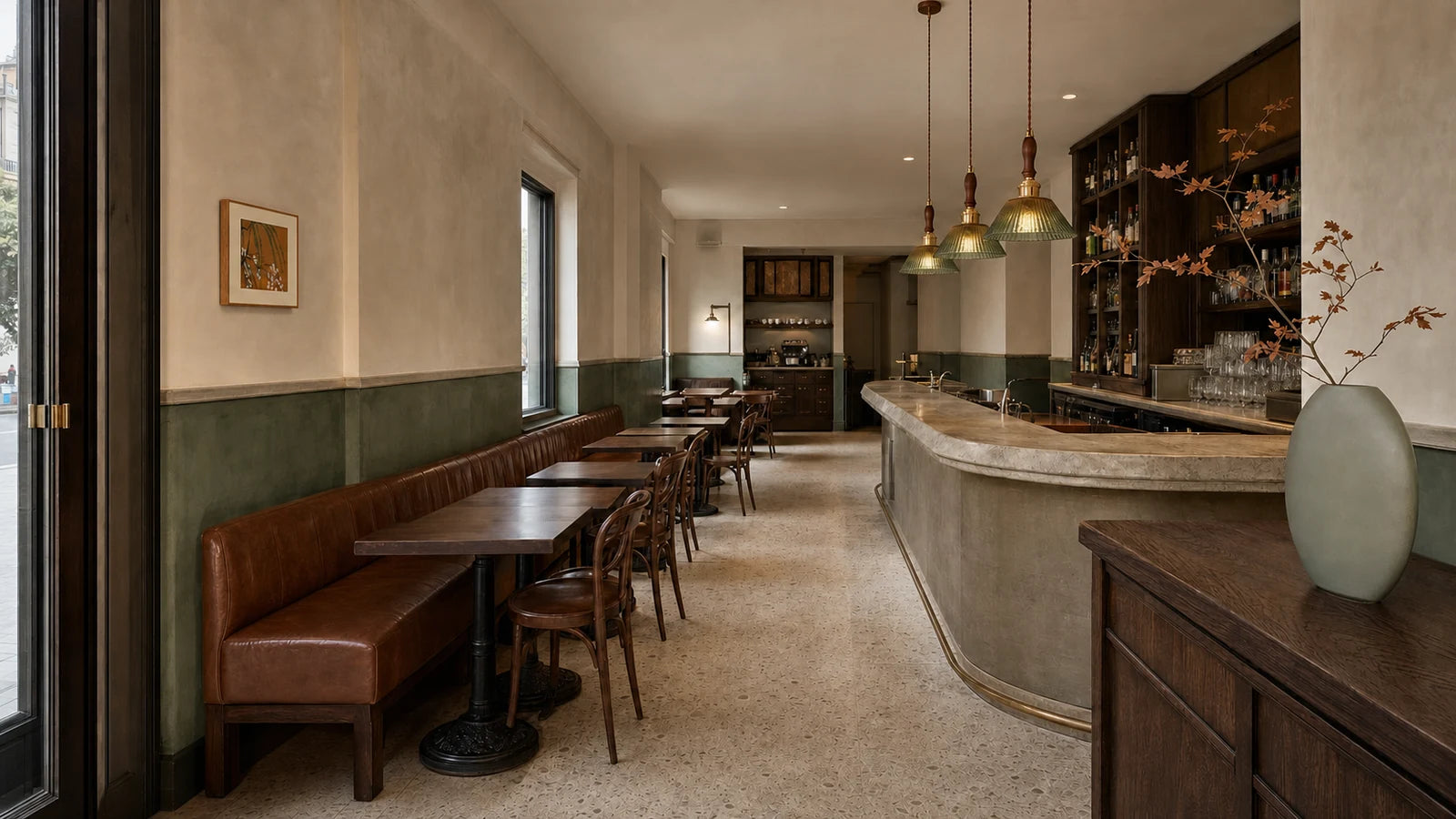
A dining room is not one lighting problem. It is a banquette run that has not moved since the fit-out, four window two-tops that get pushed together for birthdays, a bar counter with its own service logic, and a terrace that exists for five months of the year. Those are four different answers.
So the useful comparison is not rechargeable versus plug-in as a philosophy. It is a table-by-table sort, done once, with a tape measure and a chair. Most rooms come out mixed. Mixed is a plan, not a failure of nerve.
Four gates, asked in the room
Walk the floor at the hour the lamps would actually be on. Ask each question at each table type, and write the answer down.

1. Power reach. Is there already a floor box, skirting outlet or banquette conduit serving this table? Not "could there be" — is there. New wiring is a capital job and a landlord conversation, and it is the single most common reason a corded scheme quietly becomes a cordless one.
2. The cord route. If power exists, can the cable reach the lamp without crossing a guest route, a tray path or a chair leg? Tape does not turn a bad route into a good one. Walk it holding a tray.
3. Table movement. Do these tables get joined, turned, pushed to the wall for a private party, or carried outside on a good day? A cord fixes furniture in place. Sometimes that is fine — a banquette is not going anywhere. Sometimes it quietly removes the flexibility the room was designed for.
4. Who charges. If the answer is cordless, is there a named person, a named place and a named hour for the nightly turnaround? Not "the closer." A name. If you cannot supply one today, you are choosing a system that will fail in month six rather than week one, which is worse.
Two clear yeses on the first pair and a no on movement, and corded is the honest answer for that table. Anything else and you are looking at a battery.
Where plug-in genuinely wins
Corded lamps get dismissed as old-fashioned, which is a styling argument dressed up as an operational one. On the right table they are the lower-maintenance choice by a wide margin.
The wins are concrete. The light does not run down. There is no collection, no docking, no counting, no spare pool, no charging bay, no cable inventory. One approved setting stays approved. Staff turnover does not degrade the scheme, because there is no routine to forget. A corded lamp on a fixed banquette is close to a fixed fitting that happens to sit on the table.
The cost is the route, and the route is not negotiable.

Routes that work run down the back of a banquette, into a floor box under a table that never moves, or inside a fixed console, plinth or window ledge. Routes that do not work cross an aisle, pass under a chair that moves, run out to a table you join for large parties, or cross a doorway or a step. All of them — including the good ones — need a qualified person to review the circuit, the outlet condition and the local requirements before anything is switched on.
Cord length is a real spec, not a detail. Our Modern Gold & White Globe Table Lamp lists a polarised cord of a stated length and an inline switch — both numbers you should read off the live listing and hold against the measured distance from the table to the outlet, on the route you actually approved. An inline switch also raises a question worth settling before rollout: who is allowed to touch it, and what happens when a guest does.
There is a second kind of plug-in lamp worth knowing about, because it solves a different problem entirely. The 15W Wireless Charging Desk Lamp is mains-powered with no internal battery — it cannot run cordless — but it doubles as a phone charging pad. In a café, a co-working-adjacent room or a hotel lobby bar, that combination can justify a cable that a purely decorative lamp could not.
Where rechargeable genuinely wins
Cordless earns its keep in four situations, and they are worth naming precisely because "flexibility" is too vague to buy against.
Tables that float. Any table that moves for large parties, gets turned for a two-top service, or migrates between an inside and outside section. A cord makes that table a fixed asset.
Terraces and courtyards. Outdoor and semi-outdoor service where a cable is either impossible or a hazard, and where the light has to arrive with the dusk rather than with an electrician. Our restaurant patio lighting guide covers the exposure and ratings side; the power question is usually settled before you get there.
Leases that forbid new wiring. A common and unglamorous constraint. If you cannot core a floor or chase a wall, the decision has been made for you.
Rooms that change. Seasonal layouts, event weeks, a private room that becomes six two-tops. Cordless lets the table plan change on a Friday afternoon instead of in a fit-out.
A lamp like the Cordless 5000mAh Touch Table Lamp is built for exactly this — its listing describes cordless operation, touch control and multiple colour modes. Read the runtime figure on that page carefully, though, and note the setting it was measured at. A runtime quoted at the lowest brightness is not a promise about the brightness you will actually commission for service, and the gap between those two numbers is where cordless schemes usually come unstuck. Test the sample at your setting, across a real shift, before you order the room. The parent guide walks that test in detail.
The third option, and the one rule around it
Somewhere in every one of these conversations, someone says: why not just use candles?
Because open flame is not a lighting decision — it is a life-safety decision that belongs to your fire marshal and the requirements adopted where you trade. Whether a real flame is permitted in your room, on your tables, near your linen and your decor, is a question you take to that authority before you take it to a supplier. No product page settles it, and this one will not either.
For most rooms the practical answer is flameless: a battery pillar or a rechargeable lamp, which is why the comparison is really three-way rather than two.

One rule holds across all of it, and it holds regardless of what you choose: do not treat any lamp, cordless or corded, as safe to place near a live flame. Heat, wax, spill and knock-over risk are not covered by a decorative product's specification, and nothing on this site is represented as flame-rated. If your room does run permitted open flame, keep it physically separated from electrical and battery-powered objects, and get the arrangement reviewed rather than eyeballed.
You are buying a system, not a lamp
The comparison collapses the moment you price the object instead of the column it sits in.

A plug-in scheme commits you to a permitted outlet, cable management, an electrical sign-off, and a table plan that is now partly frozen. Its ongoing labour is close to zero, which is precisely the point.
A cordless scheme commits you to a spare pool, a dry ventilated charging bay outside guest circulation, one approved cable per numbered position, and a nightly routine with an owner. The lamp is cheap to move and expensive to forget. That whole operating side is what post 218 — the cordless charging routine — exists to make survivable.
Neither column is more virtuous. But comparing a lamp against a lamp, rather than a column against a column, is how rooms end up with thirty beautiful cordless fixtures and no bay to charge them in.
Running the comparison honestly
Buy one of each and test them in the same week, on the same tables, at the same brightness. Not in the office. On the smallest, busiest table you have.
Set both to the level you would actually commission and leave them through a full service. Watch the corded one for cable behaviour — does it stay seated when a guest shifts the table, does it stay invisible, does anyone touch the inline switch. Watch the cordless one for the second seating, not the first; that is where output decisions live.
Then sit in each chair. Check the source against a seated eye level, with menus and glassware present, and with older and younger readers. Our colour temperature guide covers how the light itself should read once the power question is settled, and small restaurant lighting zones covers how a table lamp fits the layers around it.
Finally, ask the closing team to run one night of the cordless routine — collect, wipe, dock, count — and time it honestly. That single hour tells you more than any spec sheet.
Compare finishes in the light they will live in: the evening scenes in Warm & Intimate and After Dark read very differently from a product photograph, and the whole table lamps range sits inside the wider restaurant lighting collection. Fitting out a full room? Trade projects is the right route for a quantity like that.
Rechargeable vs plug-in restaurant table lamps FAQ
Are rechargeable table lamps worth it for restaurants?
They are worth it where a cord genuinely cannot go — floating tables, terraces, joined layouts, and leases that forbid new wiring. They are not worth it on a fixed banquette that already has power behind it, because you would be buying a nightly collection-and-charging routine to solve a problem the wall had already solved.
Can you use a plug-in lamp on a restaurant dining table?
Yes, when the cable route is safe and permitted. That means running down a banquette back, into a floor box under a table that never moves, or inside fixed furniture — never across an aisle, under a movable chair, or out to a table you join for parties. Have a qualified person review the circuit and outlet before service.
How many cordless lamps does a restaurant need?
More than the number of tables. You need the units in service plus a spare pool sized to your failure history, event length, charging turnaround and replacement lead time. Spares should be charged, commissioned to the same setting and rotated through service rather than left boxed. The parent rechargeable guide covers how to size that pool.
Do USB table lamps always run on battery?
No. "USB" describes a connector, not a power source. Some USB lamps are rechargeable, some are permanently mains-powered through the cable, and some include USB purely to charge other devices. Confirm cordless operation on the live listing for your exact variant before you plan the table around it.
Are candles or lamps better on restaurant tables?
Open flame is a question for your fire marshal and the requirements adopted where you trade, not a styling preference — ask them first. Where flame is restricted or unwanted, flameless is the practical answer: a rechargeable lamp gives more usable light for reading a menu, and a battery pillar gives a smaller footprint with less output.
Can a rechargeable lamp be the only light on a table?
Rarely, and never as the room's only layer. Portable lamps are a local decorative and task layer. Routes, steps, exits, payment points, service stations and cleaning still need fixed and emergency lighting coordinated by qualified professionals against the requirements that apply to your venue.
Further reading: Rechargeable Restaurant Table Lamps for the full cordless operating programme, the cordless charging routine for what nightly ownership actually looks like, and Restaurant Lighting Colour Temperature for choosing the light itself once the power question is closed. To see fixed and portable light working together on real tables, walk The Juniper Brasserie and the rest of the restaurant looks.
Keep reading

guest-experience
Restaurant Restroom Cleaning Checklist and Inspection Log
Use this restaurant restroom cleaning checklist for opening, service inspections, supplies, fixtures, floors, waste, incidents, and closing records.

dining-room-operations
Restaurant Dining Room Cleaning Checklist: Turn to Close
Use this restaurant dining room cleaning checklist for table turns, high-touch points, spills, service stations, floors, opening, and close.

food-safety
Restaurant Kitchen Cleaning Checklist for Every Shift
Use this restaurant kitchen cleaning checklist to control opening, between-task, four-hour, closing, and weekly work without vague assignments.