
2700K vs 3000K Restaurant Lighting: How to Choose
2700K or 3000K for your restaurant? The four inputs that decide it, why both numbers are regions rather than points, and a two-lamp test you can run tonight.

By the Resto Glow Studio team · Published 5 August 2026 · Last reviewed 5 August 2026
Almost every restaurant lighting specification eventually narrows to these two numbers. Not 2200K against 4000K — that is a decision about what kind of business you are running, and the difference is obvious to anyone standing in the room. This is the close one. Three hundred Kelvin apart, invisible on a spec sheet, and argued about for weeks.
This post owns that single comparison. Our restaurant lighting colour temperature guide owns the full range — what 2200K is for, where 3500K and 4000K belong, how to build service scenes and how to mix temperatures across zones. If you have not chosen your general direction yet, read that first and come back when the shortlist is down to two.
If the shortlist is already down to two, here is how to settle it in one evening rather than one month.
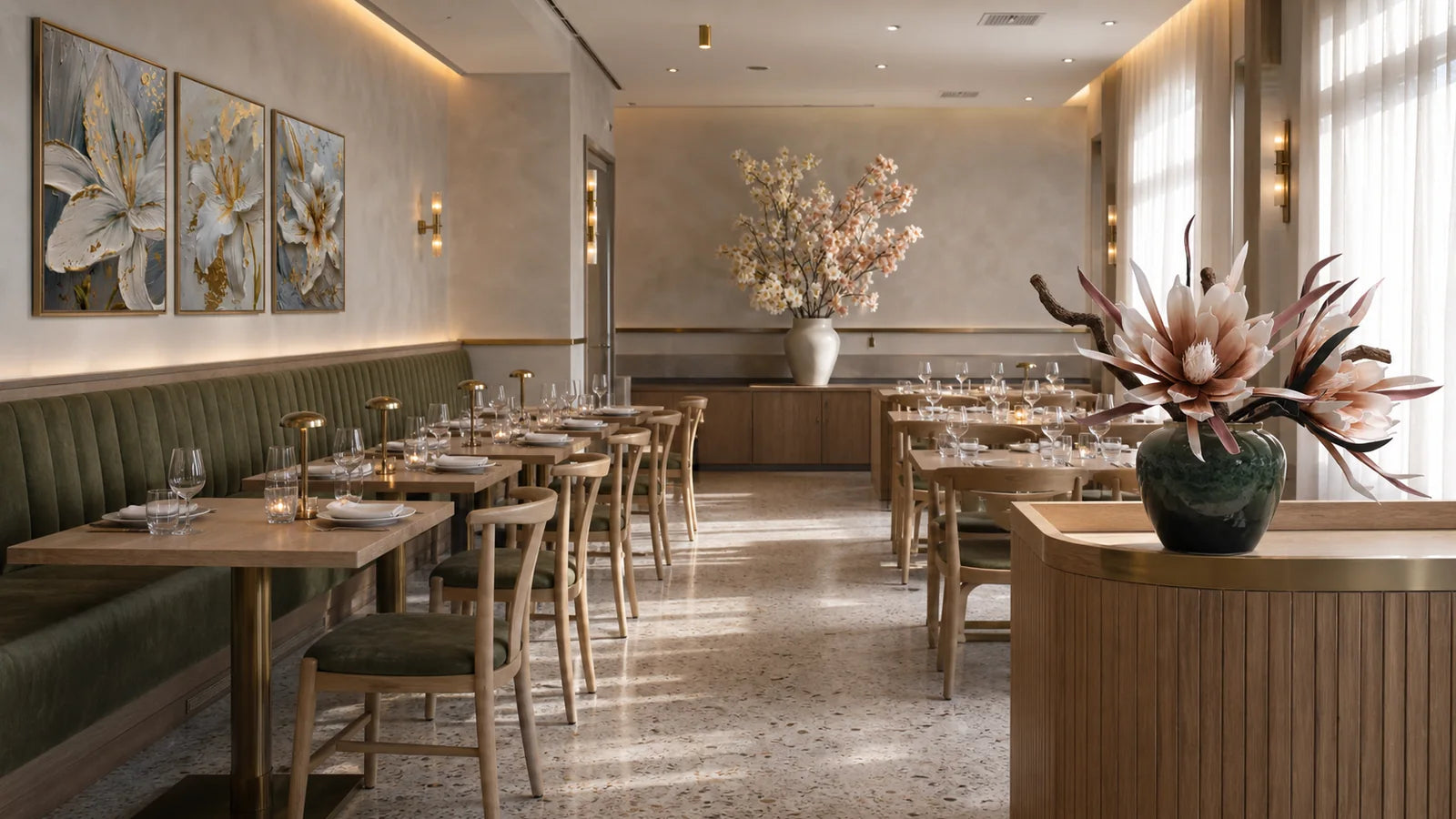
First, the honest part: the difference is small and it is real
Three hundred Kelvin is not much. On a wall, in an empty room, most people cannot pick it. Put a dressed table under it and the difference becomes legible, because the surfaces do the work.
The mechanism is worth stating properly, because it explains why the answer depends on your room rather than on a rule. As the DOE's solid-state lighting fact sheet puts it, "objects are not inherently colored, but rather reflect different proportions of radiant energy. Thus, if the light incident on a surface changes, the apparent color of the object may change" (LED Color Characteristics, PNNL-SA-84900, January 2012).
So the question is never "which is warmer". It is "what is in this room, and which of the two treats it better".

Six surfaces cover most restaurants. White linen is the most sensitive and the first place anyone notices a change. Timber gains under the warmer of the two. A white plate holds its whiteness better under the cooler of the two. Greens lift slightly. And skin — the surface nobody thinks to test and everybody reacts to — sits somewhere in between, which is why you judge it seated rather than standing.
Four questions that actually decide it
Work through these about the room you have, not the room in the moodboard.

What are the main finishes? Timber, brass, leather, terracotta and deep paint have warmth in them already, and the warmer source compounds it into something coherent. Concrete, pale stone, steel, cool greys and a lot of glass are working against that; a cooler warm-white keeps them reading as themselves rather than as slightly dirty versions of themselves.
When is the room busiest? A dinner-led room with long dwell is buying atmosphere and can afford to sit lower and warmer. An all-day room doing breakfast, lunch, brunch and counter trade is selling legibility and freshness for most of its trading hours, and a room specified purely for its own dinner service will look tired at eleven in the morning.
What is on most of the plates? Browned, roasted and charred food, bread and dark sauces have their own warmth. Raw fish, leaves, pastry, ice and pale plating do not, and they lose definition fastest when the light warms.
How does daylight reach the seats? This is the one operators underweight. A room with large glazing has daylight in it until late, and a very warm electric layer sitting alongside strong daylight can read as yellow rather than as warm. A room with little or no daylight is making its own night from opening, and has no such constraint.
Three or four answers on the same side, and you are done. Stop testing and order.
A genuinely split answer usually means something more useful than "compromise at 2850K": it means the room has two zones. A window bay and an inner banquette can legitimately hold different specifications, and our small restaurant lighting zones guide covers how to draw those boundaries in a tight footprint. The guide to mixing temperatures deliberately covers how to keep each one's territory clear.
The trap: neither number is a point
Here is the thing that ruins more specifications than a wrong choice between the two.
A nominal colour temperature is not a single co-ordinate. It is a defined area of chromaticity around the black body curve, and the DOE fact sheet footnotes ANSI C78.377 as the standard that specifies it. LED packages are then sorted — binned — after production on chromaticity, output and sometimes forward voltage, so that specifiers "receive a more consistent product". NEMA published a binning standard, SSL-3-2010, built on that ANSI work.

What follows is uncomfortable and worth internalising: two lamps can sit in different corners of the same nominal area, both be honestly labelled with the same Kelvin figure, and not match on your linen. The fact sheet states it directly — "two sources with the same CCT can look different, one appearing greenish and the other appearing pinkish" — and the metric for that distance is Duv, which measures how far a source sits from a black body radiator of equal CCT.
Which means the real risk in this decision is not choosing the wrong one of the two. It is choosing one of them loosely, buying it from three suppliers over four years, and ending up with a room that has no colour temperature at all.
The defence is boring and it works: pick a product family, pick a bin, write both on the order, and hold every replacement to them. Our warm white versus cool white post sets out the full six-line purchase specification.
Two things on the spec sheet that quietly favour 3000K
Two considerations sit outside the aesthetic question, and both should be named rather than assumed away.
Efficacy. The fact sheet notes that, due to differences in quantum efficiencies, higher-CCT LED sources tend to be more efficacious than lower-CCT alternatives within the same product family. That is a narrow claim and it deserves to stay narrow: it does not license comparing across manufacturers, and it is not a licence to invent an energy saving. But if you are choosing between two members of one family, the cooler of the two is likely to be the more efficacious.
Rendering comparisons get harder across temperatures. CRI is a reference-based metric, and the reference is black body radiation below 5000K. The fact sheet warns that "comparing the CRI for sources with different CCTs should only be done with great caution". So a 2700K lamp claiming CRI 90 and a 3000K lamp claiming CRI 90 are not making quite the same claim. Judge each against your own food, as our CRI post sets out.
Neither of these should overturn a clear aesthetic answer. Both should break a genuine tie.
The dimming question changes the answer
There is a third possibility that operators often do not know exists, and it makes the whole comparison conditional.
If you specify a warm-dim product, the number on the box is only the top of its range. DOE describes dim-to-warm products as "usually designed for 2700-3000K at full output with a decrease in correlated color temperature (CCT) as the output is reduced, down to as low as 1800K (the color of candlelight)" (Understanding LED Color-Tunable Products).
So a 3000K warm-dim fitting run at a dinner setting is not a 3000K room. It is somewhere else entirely, and where it lands depends on the product and the dimmer position. If that behaviour appeals — and in a dinner-led room it usually does — the comparison you are actually running is between two starting points on a curve, not two fixed states. Our dim-to-warm post covers what that means for controls, wiring and commissioning.
If it does not appeal, say so on the order. A fixed-colour LED that holds roughly the same appearance as it dims is a different product, and you have to ask for it by behaviour rather than by Kelvin.
Settle it in one evening
You do not need a consultant to choose between two numbers. You need two lamps, one evening and the discipline to change only one thing.

Build two identical bays. Same fixture, same shade, same mounting height, same dimmer, same driver — the lamp is the only variable you are allowed. Dress both tables the way you actually dress them, with your linen, your plates, your glassware, your menu card and real food from the pass. A colour chart will not tell you anything you need to know.
Then isolate each bay. Two whites bleeding into each other tell you nothing about either. Switch off or shield the neighbouring fittings.
Sit down to judge it. Guest side, seated eye height, plate in front of you. A specification judged standing up, from three metres away, with the pendant in your field of view, is a specification judged wrong.
Run the whole dimmer range — opening, dinner, last seating, cleaning. A lamp that wins at full output can lose badly at the setting you will actually trade at.
Then decide, photograph both bays from the same seat with the same camera settings, and file the frames with the order. The photographs are how you win the argument in two years when someone asks why the replacement looks off.
If you want the test to cost nothing at all, run it with a cordless lamp first. Our rechargeable restaurant table lamps guide covers how those behave in service — and note that a portable lamp holds its own colour regardless of what the room's dimmer is doing, so it is a good sampling tool and a poor way to judge a whole scheme.
Where to look
Once the number is settled, the fixture decision follows the layer.
Pendants put the chosen colour closest to the plate, and shade geometry decides how much of it lands on the cloth — see the pendant height guide for that trade-off. Browse pendant lights; the Nordic Retro Restaurant Chandelier is a walnut-and-brass example of the warm-finish family that leans 2700K.
Wall lights set perceived brightness at the perimeter without lifting the tables, and they are where a mismatched white is most visible along a long wall. Browse wall lights.
Chandeliers do ambient and decorative work at once in tall rooms. Browse chandeliers. For dinner-led rooms start in Warm & Intimate; for all-day rooms, Bright & Social. Everything sits under restaurant lighting, and if you are fitting out a whole site, send it through trade projects.
2700K vs 3000K FAQ
Is 2700K or 3000K better for a restaurant?
Neither is better in the abstract. 2700K suits dinner-led rooms with timber, brass, leather and warm-toned food. 3000K suits all-day rooms, cooler finishes, pale plating and spaces with strong daylight. Answer the four questions above about the room you have; if three or four land on one side, take that side and stop testing.
Can you see the difference between 2700K and 3000K?
On a bare wall, often not. On white linen, white plates and skin, usually yes — and side by side, almost always. That is why the test has to use dressed tables rather than swatches, and why it has to be judged from a seat rather than from the middle of the room.
Can I mix 2700K and 3000K in the same restaurant?
Yes, if each has a clear territory — a daylit window bay and an inner dining zone, for example. It goes wrong when the two meet inside one sightline with no transition, or when a relamp quietly introduces a second white into a zone that had one. Assign one specification per zone and record which zone gets which.
Does 3000K make food look worse than 2700K?
Not inherently. Colour appearance and colour rendering are separate properties, and rendering is what decides whether food looks appetising. A high-rendering 3000K source will beat a poor-rendering 2700K source on a plate every time. Check CRI, ask for R9, and look at your own menu under both.
Is 3000K more energy efficient than 2700K?
Within a single product family, higher-CCT LED sources tend to be more efficacious than lower-CCT ones, according to DOE's fact sheet. That is a real effect but a narrow one — it does not hold across different manufacturers or product lines, and it is not a reason to override a clear aesthetic answer. Treat it as a tie-breaker.
Further reading in this series: warm white vs cool white for what the labels mean and how to write the order, CRI and R9 for how food renders, and dim-to-warm lighting for what happens on the way down. The full Kelvin range lives in the restaurant lighting colour temperature guide. Primary sources: DOE's LED Color Characteristics fact sheet and Understanding LED Color-Tunable Products.
Keep reading

guest-experience
Restaurant Restroom Cleaning Checklist and Inspection Log
Use this restaurant restroom cleaning checklist for opening, service inspections, supplies, fixtures, floors, waste, incidents, and closing records.

dining-room-operations
Restaurant Dining Room Cleaning Checklist: Turn to Close
Use this restaurant dining room cleaning checklist for table turns, high-touch points, spills, service stations, floors, opening, and close.

food-safety
Restaurant Kitchen Cleaning Checklist for Every Shift
Use this restaurant kitchen cleaning checklist to control opening, between-task, four-hour, closing, and weekly work without vague assignments.