
Decorative Trays for Restaurant Tables: A Service-Ready System
Build a service-ready restaurant table tray by testing the complete cluster for plate space, sightlines, cleaning, loaded lift, stability and measured reset time.

By Resto Glow Studio · Published 3 August 2026 · Last updated 3 August 2026
A tray can give condiments, a table number and one decorative object a repeatable home. It can also create a new problem if it crowds plates, adds a difficult-to-clean surface or becomes too heavy to clear safely.
This guide treats the tray as service equipment: define what it holds, test the complete cluster on the smallest table, check the care instructions and time the reset before ordering the room count. For everything else competing for the tabletop, see our restaurant table decor guide.
Why a tray works: the containment principle
Grouping loose items inside one border can make the centre of the table easier to read and reset. The tray does not reduce the physical footprint, so it must still earn its space during a full meal.
The tray does two more things that have nothing to do with looks.
It gives the team a home position. Mark or photograph where each approved item sits, so different people can rebuild the cluster consistently without memorising distances between loose objects.
It can also make the cluster liftable in one motion. That benefit only counts if the loaded tray has secure hand clearance, stable objects and a manageable total weight. Test the exact load with the staff who clear it.
The four-object formula
Trays fail when they become storage. Start with up to four roles, then remove anything that does not help the concept or service model.
One height. A bud vase, a candle or a small table lamp. Something with vertical presence, kept below seated eye level so two people across a two-top can still see each other.
One function. The thing the guest actually needs — salt and pepper, a sauce, a cutlery holder. This is the object that justifies the tray's existence to anyone who asks what it is for.
One texture. A stone, metal or small sculptural piece, included only if there is room after the functional items.
One paper item. The menu card, the table number, the QR holder. Contained rather than floating, which is the difference between a table setting and a noticeboard.
Three variations on the same formula:
- Café, daytime: a small greenery vase, a sugar caddy, a stone ornament, the table number.
- Bistro, dinner: a candle or rechargeable lamp, a cutlery holder, a marble piece, the menu card.
- Cocktail bar: a low lamp, a coaster stack, a sculptural object, the drinks list.
The roles stay stable while the objects change. On a small table, two or three roles may be the correct limit; the formula is a starting point rather than a required count.

Sizing: the cluster cannot own the table
Start with the service envelope: plates, glasses and shared dishes must land and clear safely. A tray that works only on an empty table has not passed the test.
Judge it three ways, in this order. Measure your smallest table, not your average one — the two-top by the door is the one that decides your tray size, because a tray bought for a four-top will crowd it. Sit down and look across. The tallest object on the tray should sit below the sightline between two seated guests; the view from standing height is not the view a guest gets. Set the table fully, at the busiest moment of the meal, and see whether the tray still has its own clear space or has been shunted to the edge.
Give the tray a defined position rather than letting it drift across a runner, mat or place setting. On a long communal table, compare several small clusters with one large one and observe reach, serving and cleaning during a trial. The rest of the surface competition is covered in our table setting design guide.
Materials compared: verify the finish, not just the family
Trays are lifted, wiped, stacked and knocked. Favour a geometry the cleaning cloth can reach: open hand clearance, a low lip and radiused internal corners. Then test the exact finish with the actual cleaning product. Material names alone do not establish chemical resistance, food-contact suitability, dishwasher safety or heat tolerance.
| Material | Weight & slide resistance | Cleaning | Chips & wear | Noise on a hard top | Pick this if |
|---|---|---|---|---|---|
| Stone or mineral composite | Often heavy; verify loaded lift | Product-specific; acids and chemicals may mark some finishes | Chips and stains may be difficult to repair | Usually a muted contact sound | Stability is useful and staff can lift the loaded tray safely |
| Glazed ceramic | Often heavy and stable | Verify glaze, cleaner and dishwasher status | Inspect rims for chips; retire damaged pieces | Hard contact unless footed | Colour and stability matter more than low weight |
| Brushed or powder-coated metal | Weight and slide vary with gauge and feet | Verify coating compatibility with the actual cleaner | Scratches and coating damage expose wear | Can ring on a hard top | A thin, rigid format suits the table and the finish is documented |
| Lacquer | Product-dependent | Prolonged wet contact may affect some finishes | Gloss can reveal scratches and water marks | Usually softer than bare metal | It passes the cleaning and abrasion sample test |
| Wood or bamboo | Light to medium | Depends on sealer, joints and cleaning limits | Water and impact can mark the finish | Usually quiet | The exact sealed product has a documented care routine |
| Resin or melamine | Often light; add non-slip feet if needed | Product-specific; verify heat and chemical limits | Scuffs may alter sheen | Can sound hollow | Low replacement cost matters and the sample survives service |
Weight affects both stability and safe handling. A non-slip base may solve movement without making the tray uncomfortably heavy. Review matte and gloss samples under service lighting and after a fingerprint test; either finish can fail if it exposes marks or glare.
Do not place food directly on a decorative tray unless the supplier documents it for that use and the operating procedure meets local requirements. Otherwise use it only to group separate containers and objects.
Twelve tray clusters worth stealing
- Café condiment cluster — sugar, salt, a small greenery vase, the table number.
- Bistro dinner cluster — candle or rechargeable lamp, cutlery holder, marble piece, menu card.
- Cocktail bar tray — low lamp, coaster stack, one sculptural object, the drinks list.
- Brunch sauce flight — three closed sauce containers, one low vase, nothing else.
- Raw bar tray — deliberately near-empty: one stone object and the sauce, nothing tall.
- Chef's counter tray — one sculptural object on matte black, no function object at all.
- Communal run — several small trays at intervals rather than one long one.
- Patio cluster — weighted objects only, nothing that lifts in wind.
- Breakfast room — packaged or covered jam and butter service, one small vase, one paper item.
- QR and table number tray — the paper-management version, for counter-order rooms.
- Seasonal cluster — the everyday tray with one holiday object swapped in.
- The empty tray — a single dark tray with nothing on it, which in a minimal room is a statement rather than an oversight.
The café tray
Daytime rooms can carry more colour and more function, because the light is bright and the table turns fast. Keep the height object low and living — greenery rather than a candle — and let the paper item be legible from standing, since guests often order at the counter and return.
The bistro tray
This is the archetype: a light source, a cutlery holder, one texture object and the menu card. The light source is what makes it work after dark, and a cordless lamp does it without a flame, a wax pool or a nightly refill. See the treatment in The Amber Dining Room, where the table-level light is doing most of the atmospheric work.
The bar tray
Bar tops are wet, crowded and small. Test a tray with the coaster stack, closed service containers and drinks list only where it does not enter the bartender's food or drink-preparation surface. Confirm the loaded lift and cleaning method before rollout.
The chef's counter tray
The most restrained version and the most photographed. A single matte black tray, one sculptural object, nothing else — the composition is the restraint. The Onyx Chef's Counter is built on exactly this logic.
Bussing and reset: the operational payoff
Time your own room before claiming a labour saving. Run both setups through the same sequence: clear the centre, clean the tabletop, clean the objects or tray as required, rebuild the setting and carry any removed items to their destination.
Use the median of several normal resets for each setup, then calculate:
hours per period = median reset seconds × tables reset × resets per period ÷ 3,600
Include tray washing and restocking time. A tray saves labour only if the complete process is faster and the loaded lift is safe.
There are two places trays genuinely hurt. On very small two-tops where every square inch is plate space, a tray is an obstacle rather than a composition. And in high-volume counter service where guests carry their own food to the table, a tray is one more thing to move before they can put a plate down. Be honest about which room you are running.
Swap the contents, not the tray
A neutral tray can support seasonal changes without altering furniture or fixed finishes. Swap one approved object, then photograph the new reset and confirm that weight, sightline, fire, cleaning and storage requirements remain satisfied.
Run the swap in one planned pass outside service and store the everyday objects in labelled, lidded containers. Count the room set, approved spares and storage volume before ordering; confirm current availability and delivery timing with the supplier rather than assuming a seasonal lead time.
The picks we reach for
The black organic accent tray is a compact, low bowl-form candidate. Its live listing currently states 20 × 20 × 5 cm and 1,565 g; check the delivered item, then test the loaded lift and surface movement on site. It is a decorative stone piece and is not represented as food-contact safe, dishwasher safe or heat resistant, so use it only under separate objects unless the supplier documents otherwise.
For the texture object, the natural marble desk pieces and the copper globe ornament are the two we return to most. For statement clusters at a counter or host stand, the crystal swan and the half-body sculpture ornament carry a tray on their own.
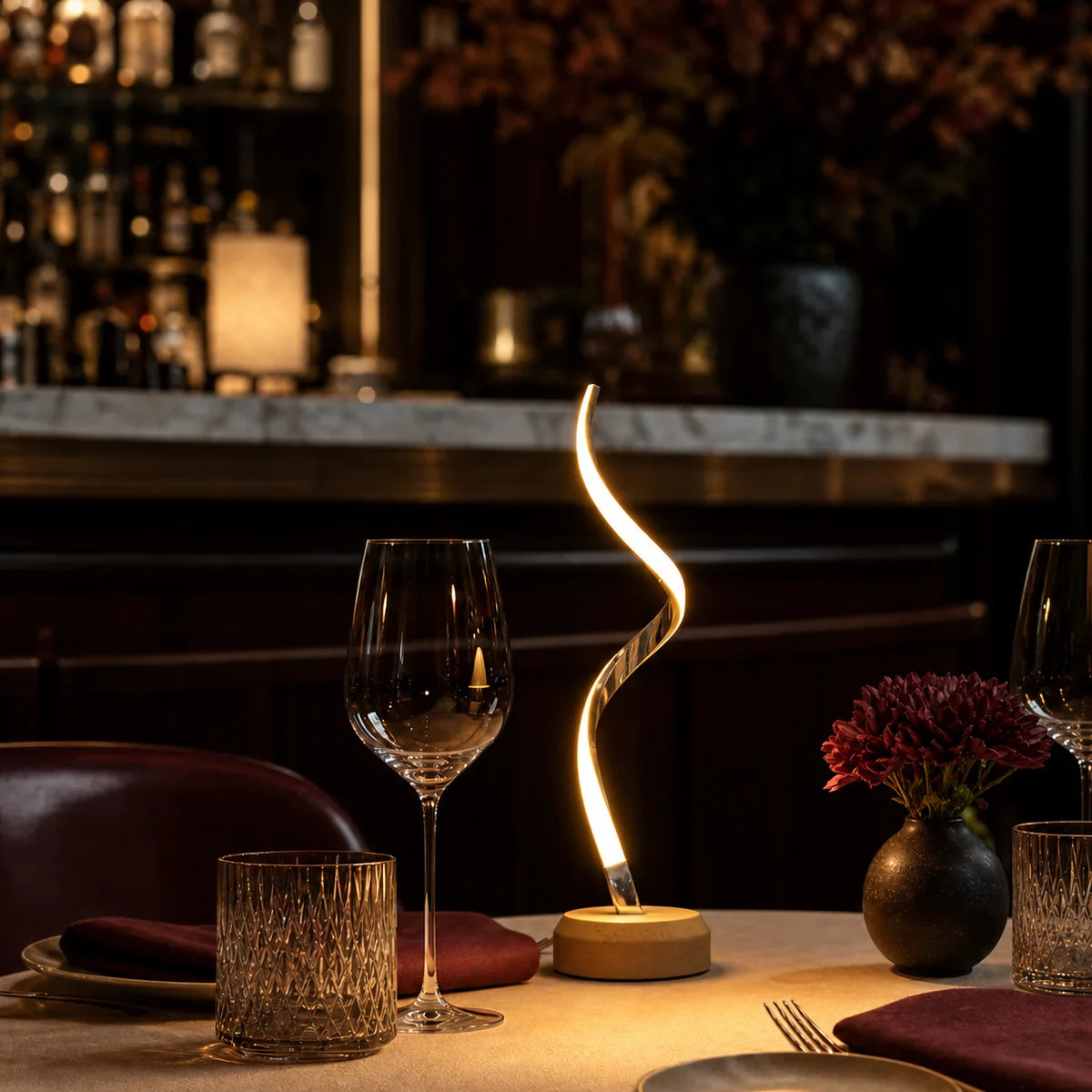
For the height object, a small vase like the Kutani-style table vase in daytime rooms, or the rechargeable LED bar table lamp after dark — cordless, so the tray stays liftable. The rest of the range is in Table Lamps.
For the function object, a cutlery holder chosen on weight and wipeability; our full guide to cutlery holders runs that decision properly, and the Santa Claus pocket holder is the Q4 version. For the paper item, the Nordic wood-and-acrylic display frame is the tidiest way to stop a menu card curling.
Underneath all of it, the surface layer matters: linen, a mat and bare timber change stability, noise and appearance. Test the complete cluster on the real surface rather than a mood board. Browse Soft & Sculptural to build a cluster, Warm & Intimate for evening rooms and Bright & Social for daytime ones. For a multi-table order, trade projects can work from the measured tray schedule.
Restaurant tray FAQ
What do you put on a decorative tray for a table?
Start with up to four roles: height, function, texture and paper. On a small table, function and paper may be all that fit. Set the full meal, remove anything that blocks plates, sightlines or hand clearance, then photograph the approved arrangement for the reset guide.
What size tray for a dining table centerpiece?
Size it to your smallest table rather than your average one, and test it with the table fully set at the busiest point of the meal — not empty. The cluster needs its own clear space with room for plates to land on every side. On long communal tables, several small trays spaced along the run work better than one large one.
How do restaurants keep condiments tidy on tables?
Give them a defined home and photograph the reset. A tray can allow one loaded lift, but only if it has safe hand clearance and the objects remain stable. Time the complete cleaning and reset process against loose items before claiming a labour saving.
Do trays make a table look bigger or smaller?
It can make the remaining surface look more ordered, but it always occupies real space. Test the complete tray on the smallest table with every plate, glass and shared dish in place. If staff or guests move it during the test meal, reduce it or remove it.
What material tray is best for restaurant tables?
There is no universal best. Compare the exact product's loaded weight, feet, edge geometry, approved cleaner, chip or scratch behaviour, heat limits and food-contact status. Test one unit through the real cleaning routine and a full service before ordering the room count.
Start with up to four roles, then remove whatever does not earn its footprint. Approve the loaded lift and full reset before ordering, and change only documented objects when the season turns. See visual concepts at The Onyx Chef's Counter and The Amber Dining Room.
Keep reading

guest-experience
Restaurant Restroom Cleaning Checklist and Inspection Log
Use this restaurant restroom cleaning checklist for opening, service inspections, supplies, fixtures, floors, waste, incidents, and closing records.

dining-room-operations
Restaurant Dining Room Cleaning Checklist: Turn to Close
Use this restaurant dining room cleaning checklist for table turns, high-touch points, spills, service stations, floors, opening, and close.

food-safety
Restaurant Kitchen Cleaning Checklist for Every Shift
Use this restaurant kitchen cleaning checklist to control opening, between-task, four-hour, closing, and weekly work without vague assignments.