
Metal Wall Art for Restaurants: Buying & Styling Guide
A practical framework for selecting restaurant metal wall art by finish, exposure, projection, installed weight, cleaning method, fixing and full-size mock-up.

By Resto Glow Studio · Published 3 August 2026 · Last updated 3 August 2026
A restaurant wall exposes artwork to cleaning, contact, humidity changes, and—in some zones—airborne grease. A residential frame may be difficult to clean or may introduce glazing where a safer format would do the same visual job.
Metal can be a practical option, but “metal wall art” covers very different products: printed aluminium panels, powder-coated cutwork, raw or patinated iron, and illuminated pieces. This guide helps you match the finish, projection, fixing, and scale to the wall rather than treating the category as one material.
Why metal can work in a restaurant
Restaurants are hostile to art in ways homes are not. Aerosolised cooking oil travels further than operators expect. Humidity spikes at every dish run. Chairs reverse into things. Cleaning happens fast, at night, by someone who did not choose the artwork.
For dye-sublimated metal prints, Lumaprints' material guide describes better moisture, scratch, and fade resistance than its canvas and paper alternatives. That comparison does not establish the performance of cut, welded, painted, or patinated sculpture. For those formats, ask the maker for the exact finish system and care instructions.
Metal also interacts with light. A cut or welded piece with real relief casts different shadows as daylight and electric light change. Test the intended piece under the room's actual night scene, because a flat studio product photograph cannot show how far it projects or how its finish reflects glare.
The two families: geometric modern and wrought iron classic
Most decorative metal pieces fall into two visual families. Choose by the room concept, then verify the finish and installation separately.
Geometric and abstract metal
Cut circles, radiating lines, layered discs, brushed or matte planes, asymmetric compositions with air inside them. This family reads contemporary and — critically — quiet. It adds shape without adding subject, which is what you want in a room where the food is the subject.
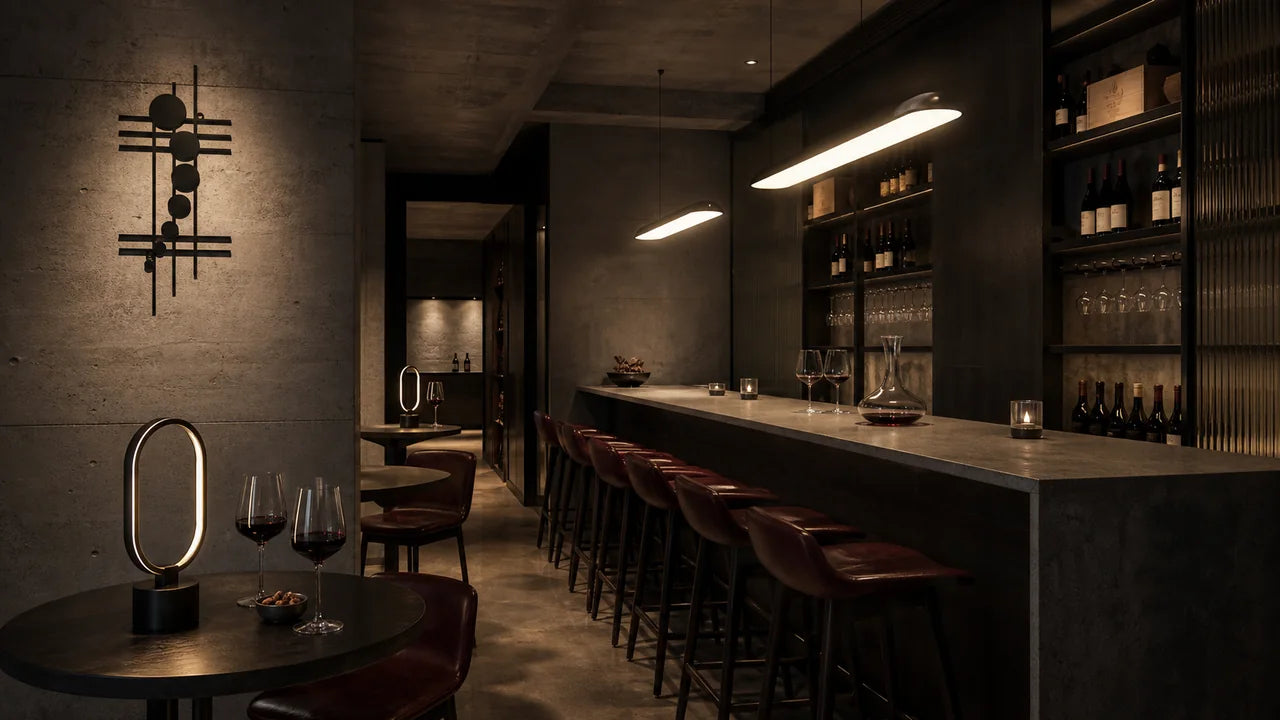
Where it belongs: modern bistros, wine bars, chef's counters, anywhere the palette is concrete, plaster, pale timber or black steel. Our artistic modern geometric metal wall decor and minimalist abstract art metal wall decor sit here — pieces that read as form rather than image, so they hang above seating without competing with the table. See the effect against a raw shell in The Concrete Wine Room, and at close range in The Onyx Chef's Counter.
Illuminated metal needs a separate electrical brief. Confirm the power route, controls, listing or certification required for the project, heat, maintenance access and what happens during emergency or cleaning modes before treating it as decorative art.
Wrought iron and classic ironwork
Scrollwork, silhouettes, foliate and figurative motifs, dark matte finishes with hand-worked edges. This family carries warmth and age, and it does something geometric metal cannot: it makes a new-build room feel like it has been there a while.
Where it belongs: trattorias, steakhouses, courtyard rooms, wine cellars, brasseries with dark timber. A piece like our wrought iron silhouette wall decor works best on a textured wall — brick, lime plaster, deep matte paint — where the outline has something to draw against. Against flat white it can look like a stencil.
One planning question: will the concept change while the fixing remains? An abstract piece may be easier to reuse across a refresh, but mock both options against the future material palette rather than treating one style as timeless.

Sizing: the formula that keeps big walls from swallowing art
Scale should be approved before drilling or commissioning a non-returnable piece.
Resto Glow's house starting point is for a piece, or a group treated as one piece, to span roughly 60–75% of the furniture beneath it. This is composition guidance, not a standard. Mock up the outline on the wall and judge it from the main seated and standing views before ordering.
On a blank run with nothing underneath, that rule has no anchor, so switch approach: divide the wall into visual bays of eight to twelve feet and size one piece to each bay. That is what stops a forty-foot corridor needing a forty-foot artwork.
| Furniture or wall bay below | Target art span | Format that works | Notes |
|---|---|---|---|
| 4 ft console or two-top wall | ~2.5–3 ft | One mid piece | Compare one piece with a closely spaced pair in the mock-up |
| 6 ft banquette section | ~3.5–4.5 ft | One large, or two mid hung as a pair | Treat a pair as one object: gap under 4 in |
| 8–10 ft banquette run | ~5–7.5 ft | One oversized piece, or a group of three | Groups need a shared axis — align centres, not tops |
| 12 ft+ blank feature wall | Bay it: one piece per 8–12 ft | Oversized, repeated with rhythm | Repetition of one motif reads more confident than variety |
| Bar back above the counter | Width of the bottle run or less | Horizontal composition | Keep it above working height, out of the bartender's reach zone |
Mock the piece in paper at full size using a finish-safe attachment method. View it from the entrance, seats and service route under day and night lighting. Our wall art size and height guide covers the hanging-height decision in more detail.
Finish and durability: the checklist before you buy
Not all metal is equally restaurant-ready. Ask these five questions of any piece before it goes in the basket.
What is the finish system? "Powder-coated," "painted" and "lacquered" describe broad families, not a chemical-resistance result. Ask for the substrate preparation, coating, edge treatment, approved cleaner and intended exposure. For raw, waxed or patinated work, request the maker's maintenance and change-in-appearance guidance.
Is the construction intended for the zone? Check cut edges, welds, dissimilar metals and hidden fixings as well as the visible face. For damp, exterior or dish-adjacent conditions, require a written exposure specification rather than the word "sealed."
How heavy is the complete assembly, and where are its fixing points? Record the artwork, frame, cleat or bracket weight together. The installer needs the centre of gravity, stand-off, fixing geometry and consequence of failure, not just a catalogue weight.
What is behind the finish? Have the installer identify the substrate and select rated hardware for that exact construction, edge distance, load direction and installation method. Do not infer capacity from the wall's appearance or use a generic anchor rule above seating.
Where is the daylight? Bare metal and coloured or printed coatings behave differently. Ask for light-exposure information for the exact finish; if none exists, record the starting colour and treat a storefront-facing piece as replaceable.
Placement that earns its keep
The wall opposite the entrance often becomes the room's first visual anchor. Photograph the entrance view at guest eye level, then mock one large piece and a smaller grouping. The better option is the one that remains legible without competing with the host stand, signage or circulation.
Above a banquette, projection matters as much as height. Check the piece and its stand-offs against the occupied seat envelope so heads, coats and cleaning tools cannot catch it. Keep the composition visually connected to the banquette, but let the installer and applicable access rules determine the final clearance.
Behind the bar is a special case: whatever goes up there competes with bottles, glassware and the bartender's own movement. Horizontal compositions work; tall ones lose their bottom third behind the speed rail.
Near an open kitchen or a patio door, treat it as an exposure zone. Give the maker the actual conditions—grease, condensation, direct sun or outdoor air—and get written confirmation that the complete finish system is suitable. Set the cleaning frequency from inspection rather than an arbitrary weekly schedule.
Then light it. Metal is genuinely transformed by a raking light — a wall light above and slightly to one side throws the relief into shadow and makes the piece three-dimensional after dark. Light it straight on and you flatten it, and bounce a hotspot into somebody's eyeline. Angle matters more than brightness.
Cleaning and maintenance, by finish
Powder coat. Start with the maker's care sheet. A soft dry cloth is a low-risk first step; use only the cleaner and dilution the coating supplier approves. Test it on a concealed area and dry around seams and edges.
Painted and lacquered. Ask whether the topcoat is washable and which chemicals it tolerates. Dust with a soft cloth, spot-test any damp-cleaning method, and inspect high points and cut edges for wear.
Raw, waxed or patinated steel and iron. These finishes can change with moisture and handling. Follow the maker's dry-cleaning and re-waxing instructions, and put those instructions on the venue's cleaning sheet so a general-purpose spray is not used by mistake.
Printed or coated aluminium panels. Use the print lab's care method for the specific coating. If a damp microfibre and mild detergent are approved, record the dilution and contact time; do not assume an aluminium substrate makes the printed face chemical-resistant.
What we would put on the wall
For modern rooms, start with sculptural metal and let it carry the wall alone. A single geometric or abstract piece, sized properly and lit from above, does more than a gallery wall and takes a fraction of the labour to keep clean. Soft & Sculptural is the range for statement pieces of this kind.
For heritage and warmer rooms, test wrought iron against textured plaster, brick or deep matte paint. A wooden accent can vary the material palette without adding another reflective finish; verify its coating and care needs just as you would the metal. Warm & Intimate collects pieces for these rooms.
For bars, vintage tin signs are the category's entry point: printed metal hung in numbers, doing at density what one sculpture does at scale. Pair them with the bar's own lighting from After Dark. And if you are still weighing metal against nine other wall treatments, our restaurant wall decor comparison sets them side by side.
Metal wall art FAQ
Is metal wall art durable enough for restaurants?
It can be, but the substrate alone does not answer the question. Check the finish, cut edges, joints, installed weight, projection, fixing system and approved cleaning chemicals for the exact product and zone. A coated aluminium print and a waxed iron sculpture have very different exposure limits.
How big should metal wall art be on a large dining wall?
Aim for roughly 60–75% of the width of the furniture beneath it. On a blank wall with nothing underneath, divide the run into visual bays of eight to twelve feet and size one piece to each bay. Mock the outline up in kraft paper at full size and view it from a seated position before ordering.
How do you clean metal wall decor in a restaurant?
Use the maker's care sheet for the complete finish, not a generic rule for metal. Start with a soft dry cloth, spot-test any approved cleaner, record its dilution, and inspect seams and cut edges after cleaning. Keep raw, waxed and patinated work out of wet-cleaning routines unless the maker specifies one.
Wrought iron or modern geometric — which fits my concept?
Geometric work can reinforce a contemporary room; scrollwork, silhouettes and patinated iron can reinforce a heritage-led one. Photograph both options in a full-size mock-up under the restaurant's night lighting. Choose the version that supports the existing materials and remains clear from the main guest views.
Can metal wall art go near an open kitchen or a patio door?
Possibly, if the maker approves the exact exposure and the installer specifies the fixing. Describe humidity, grease, direct sun, temperature change and cleaning chemicals when asking. A generic word such as "sealed" or "powder-coated" is not enough evidence for a demanding zone.
The practical sequence is simple: map the exposure, request the finish and care documents, mock the full-size outline, resolve the fixing, and test the piece under the real night scene. See a concept example against a raw concrete shell in The Concrete Wine Room, or browse Soft & Sculptural for forms to include in your mock-up.
Keep reading

guest-experience
Restaurant Restroom Cleaning Checklist and Inspection Log
Use this restaurant restroom cleaning checklist for opening, service inspections, supplies, fixtures, floors, waste, incidents, and closing records.

dining-room-operations
Restaurant Dining Room Cleaning Checklist: Turn to Close
Use this restaurant dining room cleaning checklist for table turns, high-touch points, spills, service stations, floors, opening, and close.

food-safety
Restaurant Kitchen Cleaning Checklist for Every Shift
Use this restaurant kitchen cleaning checklist to control opening, between-task, four-hour, closing, and weekly work without vague assignments.