
Artificial or Fresh Flowers? An Honest Restaurant Guide
Artificial or fresh flowers for a restaurant? The honest comparison: where each genuinely wins, where the labour actually lands, and what neither one fixes.

Both sides of this argument are usually made dishonestly.
The fresh-flower case tends to skip the sink, the bin, the delivery that arrives during prep, and the fact that the work cannot be moved to Monday. The artificial case tends to skip the part where a piece nobody has cleaned in four months makes an otherwise good room look tired — and the part where guests notice from about a metre away.
Our restaurant floral arrangements guide owns the complete floral brief: purpose, viewing distances, palette, maintenance routes, safety, storage, the busy-service mock-up. Our low-maintenance restaurant plants guide owns living greenery as a separate discipline.
This post owns one question sitting between them: fresh stems or artificial ones, and how to decide without lying to yourself. For how the arrangement should be sized once you have chosen, see flower arrangements by table size.
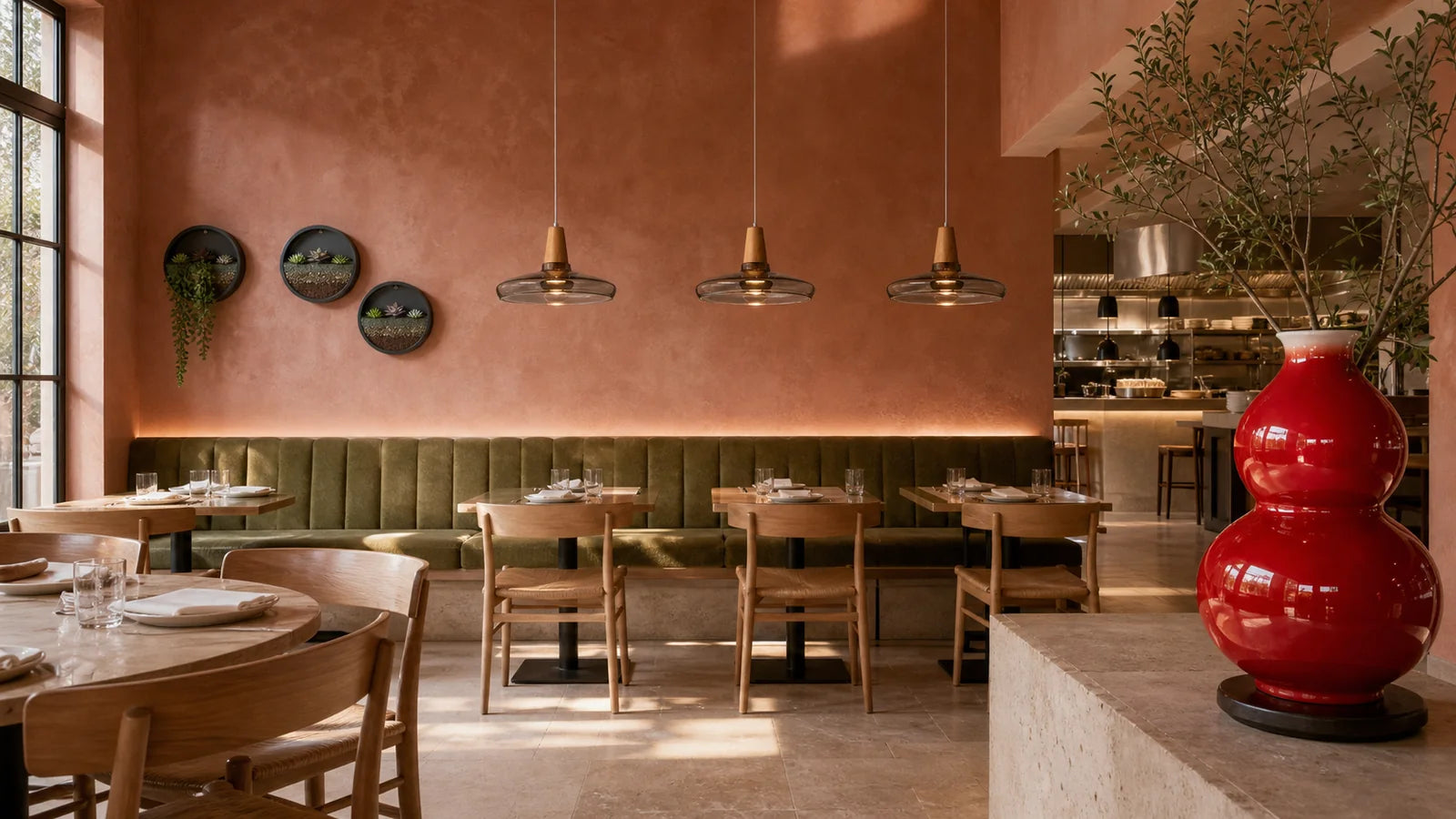
What each side genuinely wins
Strip out the aesthetics argument and the real trade-offs are surprisingly concrete.

Fresh wins on things artificial cannot fake. Movement in a draft. Light coming through a petal rather than off it. Scent, where you want it. The signal that today is not yesterday — which is a genuine hospitality cue, not a romantic one. Fresh also never looks cheap at close range, which matters enormously on a two-top where the guest is sitting an arm's length away. And it is disposable, so when a table needs the space, the flowers can simply go.
Artificial wins on consistency and conditions. It looks identical at every service, which means the room a guest photographs on Tuesday is the room they described to a friend. It survives draft, handling, and a corner with no daylight. It puts no water near linen, lamps or electrics. It sheds no petals and drops no pollen. And it works in rooms that have no floral prep point at all — which is most small restaurants.
Neither fixes the things people buy them to fix. A room that is too dim to read in. A table already carrying too many objects. A bare wall that needed art. A layout guests squeeze through. If the flowers are there to distract from one of those, they will not, and the honest test is to remove every stem for one service and see whether the room still works. If it does, you chose well. If it collapses, the flowers were compensation.
Where the work actually lands
The comparison that changes minds is not cost. It is the shape of the labour across a season, and specifically whether that labour can be deferred.

Fresh is flat and frequent. A delivery, conditioning, arranging, placing, then water checks and petal clearing between deliveries, then disposal, then it starts again. It never gets harder and it never gets easier. Crucially, none of it can be postponed — a vase of dead stems on table four is a visible failure within hours.
Artificial is front-loaded and deferrable. One large effort to buy, unpack, shape and approve, then a low periodic cleaning cadence, then a single retirement decision at the end. And deferrable is exactly the problem. Because nothing goes visibly wrong on any given night, the cleaning slides. It slides for a month, then a quarter, and one day a regular mentions the dust.
Fresh flowers punish you immediately. Artificial flowers punish you slowly, which is why they need a scheduled review rather than a judgement call.
Neither of those patterns is better. But they demand different kinds of restaurant. A kitchen with a spare sink, a prep bench and someone who enjoys the job will run fresh well. A room with no back-of-house floor space and a manager who runs a good checklist will run artificial well. Match the pattern to the operation you actually have, not the one on the business plan.
Let the room answer it
Before either side of the argument gets a hearing, walk the room and check six conditions. Most of them are decided by the building, not by preference.

Direct sun. Watch the surface at the hour the sun actually lands on it, not at ten in the morning when you happened to look. Strong direct sun is hard on both — it fades fabric and it cooks stems. That position may want neither.
Heat, draft and doors. Run the ventilation at service speed and open the entrance repeatedly. Anything that moves constantly will be reshaped, weighted or relocated within a week. Persistent movement pushes toward a low, stable, artificial piece — or toward moving the idea off that surface entirely.
Prep space and a sink. Fresh needs a surface, a water source and a bin that are not the ones food passes through. If you do not have a separate point for that, either buy arranged and delivered, or go artificial.
Turnover and handling. Count how many times a vessel is lifted, shoved or relocated in one busy service. High handling and standing water are a poor combination near linen and electrics.
Proximity to food and to noses. Flowers sit closer to a plate than any other decor object in the building. Pollen, petals, scent and thorns are all live considerations, and fragrance that reads as subtle in a shop can compete with wine and food in an enclosed room — and affect sensitive guests and staff. Coordinate anything near food with your food-safety procedures and the requirements adopted by your local health authority.
Storage. Artificial schemes need protected, labelled storage between seasons. Crushed stems do not recover. If you have nowhere to keep them, either run a single permanent scheme year-round or stay with fresh.
When a condition rules out both, move the botanical idea off the table: framed botanical art on the banquette wall, a planted greenery vessel on a sideboard, or an honestly bare tabletop that needs no upkeep at all. The green restaurant interior guide covers the third route in more depth.
Artificial flowers still expire
This is the section that decides whether an artificial scheme is a good decision or a slow embarrassment.
They do not wilt, so nobody registers the moment they stop looking good. They degrade in front of you, gradually, in a room you see every day — which is the perfect recipe for not noticing.

Photograph every piece on day one, in the room's own light, from the guest seat, and date it. That photograph is the whole quality-control system.
Colour fade starts on the window side and at petal edges. Rotate a piece 180 degrees; if one side suddenly looks newer, you have your answer.
Dust load is worse in restaurants than anywhere else, because aerosolised cooking oil binds dust into a film that dry dusting will not lift. Wipe one petal with a clean cloth — if the cloth marks, the piece is overdue.
Stem relaxation is the one people miss. Wire memory goes, the silhouette sags, and the piece starts reading as sad rather than styled. Hold the day-one photo beside it and compare outline before colour; shape goes first.
Edges and adhesive show at close range. Fabric frays at the petal edge and glue lines yellow. Look from the seated distance, not from standing — guests see this at arm's length.
Once a quarter, take the photograph out, put the piece beside it, and decide: keep, deep clean, reshape, or retire. Write the answer down. And get the cleaning method, chemical tolerance and any heat or flame limitation from the supplier for the exact material you bought — never assume that one artificial stem behaves like another.
The realism question
There is a choice underneath the material choice that hardly anyone makes deliberately: how real is this meant to look?
Near-perfect botanical realism is expensive to maintain and unforgiving at close range, because every fault is measured against a real flower the guest can picture. It suits pieces that guests see from a distance — sideboards, entrances, high niches.
Sculptural or stylised pieces are judged as objects instead. A ceramic-and-dried composition or a strongly designed silk arrangement is not pretending to be a garden, so it does not fail the way a near-miss rose does. Our Restaurant-Style Artificial Greenery vase, which is supplied with its vessel, sits in that territory, as does the Artificial Flower Arrangement Restaurant Decor Ornament with its pre-arranged silk stems in an amber glass vase. Neither listing currently publishes dimensions or care instructions, so confirm the finished height, spread and cleaning method with the supplier before you order for a room.
The general rule holds well: the closer a guest sits to it, the less it should be pretending. Two-tops want either fresh or something frankly sculptural. Sideboards can carry the convincing imitation.
The mixed answer most rooms land on
Very few good rooms are purely one or the other, and the split usually falls along a single line: fresh where guests are close, artificial where conditions are hostile.
In practice that means fresh on the tables guests linger at and on the host counter people stand beside, and artificial in the draughty corner by the door, on the shelf above the pass, on the terrace, and anywhere a vessel gets handled six times a night. A good vessel — something like the Nordic Ceramic Restaurant Table Vase, whose opening size and water capacity are worth confirming with the supplier before you commit to fresh stems — can serve either side of that line, which keeps the room reading as one scheme rather than two.
Write the split down, by position, with the material and the maintenance owner named for each. Otherwise the line blurs within a season and you end up with fresh flowers in the draught and artificial ones under a guest's nose, which is precisely backwards.
Artificial vs fresh flowers FAQ
Are artificial flowers acceptable in a restaurant?
Yes, provided they are treated as maintained decor rather than a permanent fixture. They work particularly well where light, heat, draft, handling or a lack of prep space make fresh unrealistic. What makes them unacceptable is neglect — a dusty, faded, sagging arrangement reads worse to a guest than no flowers at all.
Do restaurants use real or fake flowers?
Most use both, and the split usually follows conditions rather than taste. Fresh tends to go where guests sit close and linger; artificial goes to draughty corners, terraces, high shelves and surfaces that get handled constantly. Deciding that split deliberately, position by position, is what separates a scheme from an accumulation.
Which is cheaper for a restaurant, fresh or artificial flowers?
That depends entirely on your room, your suppliers and your labour, so run it for one season with your own figures rather than trusting a general answer. Count deliveries, prep time, vessels, cleaning, replacement stems, storage and disposal on both sides. The pattern of the work often matters more than the total.
How often should artificial flowers be replaced in a restaurant?
There is no fixed interval, because sun exposure, kitchen aerosol and handling vary enormously. Photograph each piece on day one from the guest seat, then compare it against that photograph quarterly and decide to keep, deep clean, reshape or retire. Judging against a dated reference is far more reliable than judging from memory.
Are artificial flowers a fire risk in a restaurant?
Material fire performance varies, and no artificial arrangement should be assumed flame-retardant or heat-resistant. Request documentation from the supplier for the exact product, keep decorative material clear of heat sources and away from any permitted open flame, and confirm what is acceptable with your fire authority and the requirements adopted where you trade.
Can fresh flowers go near food in a restaurant?
Handle it as a food-safety question, not a styling one. Pollen, petals, soil, standing water and trimming debris all need controlling, and preparation and storage should stay separate from food-contact equipment. Confirm the arrangement and the routine with your local health authority before it goes into service.
Further reading: Restaurant Floral Arrangements for the complete floral brief, Flower Arrangements by Table Size for sizing the piece once the material is chosen, Low-Maintenance Restaurant Plants for living greenery as a separate programme, and Restaurant Table Decor for everything else on the surface. To see greenery designed into a room rather than added to it, walk The Terracotta Conservatory.
Keep reading

guest-experience
Restaurant Restroom Cleaning Checklist and Inspection Log
Use this restaurant restroom cleaning checklist for opening, service inspections, supplies, fixtures, floors, waste, incidents, and closing records.

dining-room-operations
Restaurant Dining Room Cleaning Checklist: Turn to Close
Use this restaurant dining room cleaning checklist for table turns, high-touch points, spills, service stations, floors, opening, and close.

food-safety
Restaurant Kitchen Cleaning Checklist for Every Shift
Use this restaurant kitchen cleaning checklist to control opening, between-task, four-hour, closing, and weekly work without vague assignments.