

A florist styles for a photograph. A restaurant has to live with the object for six hours a night, on a surface that is already carrying two covers, a lamp, a menu and somebody's phone.
That gap is why so many arrangements look wrong the moment a party sits down at them. Not because the flowers were bad — because they were sized for an empty table in an empty room.
Our restaurant floral arrangements guide owns the whole subject: what the floral programme is for, viewing distances, palette, maintenance routes, safety, storage and the mock-up that approves it all. It is the complete brief.
This post owns one narrow question inside it: how the arrangement changes shape as the table changes size. Two-top, four-top, communal, bar. Same room, same style, four different objects — and one test that applies to all of them.
One test, four answers
Sit down.
That is the whole test, and almost nobody does it. If two guests cannot see each other's faces over the arrangement, the arrangement is wrong — regardless of how it photographs, what it cost, or how good it looked on the pass at four in the afternoon.
The reason it needs re-testing at every table size is that the seated eye band does not move, but everything around it does. The distance between guests changes. The number of sightlines changes. On a bar, the cross-table sightline stops existing altogether and a completely different constraint takes over.

There is no universal safe height, and you should distrust any article that gives you one. Chair height, table height and guest height all vary, and so does what your guests are doing — a room where people read menus for twenty minutes has a different tolerance from a room where the food arrives in four. Measure your own band once, with two members of staff sitting in your own chairs, and write it on the order card.
The two-top: a bud vase or nothing
The two-top is the hardest table in the room and the one most schemes get wrong, because it is the table where the arrangement is closest to a guest's face and where the surface is scarcest.
Two people facing each other across a small top are sitting inside the tightest sightline in the building. Anything with vertical mass reads as a wall between them. The successful two-top arrangement is almost always a single narrow-necked vessel with very few stems, and it usually sits off-centre toward the wall side rather than dead centre, so it stops competing with the space between two people.
Then comes the harder conversation. On a two-top, the flowers compete with a lamp, a menu, condiments, a card machine and two full covers. Something has to lose, and it is worth deciding what before service rather than watching a server decide for you at the second course.
If your two-tops already carry a table lamp — and in most warm rooms they should — the honest answer is often that the flowers move to the wall, the sideboard or the window ledge instead. That is not a defeat: a strong arrangement on a sideboard is visible from every two-top in the room, and it takes nothing off any of them.
The four-top: the diagonals matter more
A four-top feels like it has more room, and it does, right up until the shared plates arrive.
The sightline problem also changes shape. On a two-top there is one view to protect. On a four-top there are six, and the ones that fail first are the diagonals — corner seat to opposite corner seat, across the exact spot where a centrepiece sits. Test from the corner seat, not from the head of the table.
The form that works here is low and wide rather than tall and narrow: a compote or shallow bowl with a wide opening, spreading horizontally under the eye band instead of standing up through it. A wide opening also carries more stems without crushing them, which is how you get visual weight without height.
The footprint question is sharper than it looks. A four-top with a shared-plates menu can lose its entire centre to a platter, and the vessel that fit beautifully at 4pm has nowhere to be at 8pm. Map the busiest version of your menu onto the table before you allocate a square inch to flowers — the same discipline our restaurant table decor guide applies to everything else fighting for that surface.
The communal table: a rhythm, not a centrepiece
A communal table is not a very large four-top. It is a shared surface with a service spine down its middle, and treating that spine as a stage for one big arrangement is the classic error.
One large piece in the centre of a communal table does something specific and unhelpful: it divides a table that was built to be joined. Guests on opposite sides stop being at the same table. Servers lose the passing lane. And the piece itself becomes the thing everyone has to reach around.
What works is repetition. One small vessel, repeated down the spine, with real gaps between them — gaps that shared dishes, water carafes and elbows can occupy. The rhythm reads as intentional from the doorway, which is where a communal table is most often seen, and it stays usable from every seat.
Keep every piece in the run identical and keep them all low. On a long table, one taller vessel does not read as a focal point; it reads as the one somebody forgot to swap. Our communal table design guide covers the seating and service logic those gaps have to serve.
The bar counter: height is allowed, but not there
The bar is the one place where the seated sightline test stops applying, because nobody is facing anybody. Guests sit shoulder to shoulder looking at the back bar, and the view you are protecting is the one past the bartender, not across the counter.
Which means height is permitted here in a way it is nowhere else. A taller vessel at the end of a bar run, or on the back bar itself, can carry the whole room's floral idea without touching a single dining table.
What is not permitted is anything inside the bartender's working length. The pour zone, the landing area, the rail where glassware lands — those are equipment, not decoration, and an arrangement there will be relocated within one shift to somewhere worse. Keep flowers to the ends of the run, or lift them onto the back bar where the back bar design guide puts the rest of the display logic.
What is actually left for the vase
Height is the test people remember. Footprint is the one that decides whether the scheme survives a full room.

Do this with tape rather than arithmetic. Lay a full cover on each table type — the busiest version, with shared plates, water, menus and the card machine — mark what is genuinely left, then seat a party inside it and watch what happens over one service.
Two things usually emerge. A bigger table does not give you a proportionally bigger block, because the extra surface goes to the extra covers and the shared dish. And the block is rarely where you expected it: on a two-top it drifts to one side, on a bar it collapses to a strip at the end of the run. Design to the block you measured.
The vessel decides the stems, not the other way round
Buy the container first. This sounds backwards and it is the single most useful sequencing decision in the whole exercise.

The opening governs how many stems can stand without crushing. The vessel's own height governs how tall the finished arrangement wants to be — a proportion worth establishing once with your own vessels and then holding your florist to, rather than treating as a rule that arrived from somewhere. A narrow-necked stem vase and a wide low bowl are not two styles of the same object; they are two different capacities.
Before you commit, get the real numbers off the listing. Our Nordic Ceramic Restaurant Table Vase lists several size variants — but at the time of writing it does not state the opening size or confirm water capacity, which is exactly the kind of gap to close with the supplier before you plan a fresh-stem programme around it. Record base width, widest point, height, opening, weight and water capacity for every vessel you shortlist. Two vessels with the same stated height can behave completely differently on a small table.
If a vessel is going to be handled, moved and reset several times a night, its stability matters more than its silhouette. Test it filled, on your actual tabletop, with someone pressing the table edge.
Not every table needs flowers
This is the part the category usually skips.
Concentrating the floral programme — entrance, bar ends, sideboards, the private room, selected tables — almost always reads better than distributing it thinly across every top. A repeated bud vase on thirty tables is a maintenance obligation on thirty tables. One considered arrangement where guests arrive, plus botanical art on the banquette wall, can carry more atmosphere for less nightly work.
Rooms with small tables, shared-plate menus, prominent table lamps or fast turnover are usually better served by clear surfaces and strong floral moments elsewhere. Decide which room you are before you decide what to buy.
For year-round consistency on the tables that do carry something, a maintained artificial piece such as the Restaurant-Style Artificial Greenery vase — supplied with its vessel — or the Artificial Flower Arrangement Restaurant Decor Ornament, which comes pre-arranged in an amber glass vase, removes the water question from the tabletop entirely. Neither of those listings currently publishes dimensions, so confirm the finished height and spread against your measured block before ordering quantity. Which route suits your room is the subject of artificial versus fresh flowers.
Turn it into an order card

Six answers per table size, filled in before anything is ordered: how many tables carry one, the vessel opening, the maximum finished height, the maximum spread, where the piece lands during a reset, and who checks and refills it.
Any blank cell is a decision your floor staff will end up making mid-service, usually by putting the vessel on the nearest windowsill and forgetting where.
Judge the result under the light it will live in. Vessels read very differently under the evening scenes in Warm & Intimate and the daytime scenes in Bright & Social, and a piece from Soft & Sculptural may carry a table with barely any stems in it at all.
Restaurant flower arrangement FAQ
How tall should a restaurant table flower arrangement be?
Lower than the seated eye level at your own tables, which you have to measure rather than look up — chair height, table height and guest height all move it. Sit two people at a set table, put the finished arrangement between them, and check that they can see each other's faces without leaning. That is the only height rule worth having.
What size flowers for a two-top restaurant table?
Small and narrow. A single-stem or bud vessel with very few stems, placed off-centre toward the wall side rather than dead centre. A two-top is already carrying two covers, a menu and often a lamp, so if the flowers are competing, move them to a sideboard or wall piece and leave the table clear.
Should communal tables have one big centrepiece?
No. One large piece divides a table built to be shared and blocks the passing lane down the middle. Repeat one small, low, identical vessel down the spine with real gaps between them for shared dishes and carafes. The rhythm reads well from the doorway and stays usable from every seat.
Can you put flowers on a bar counter?
At the ends of the run or on the back bar, yes — nobody is facing across a bar, so height is allowed there. Never inside the bartender's working length. The pour zone and the landing area are equipment, and anything decorative placed there will be relocated within one shift, usually somewhere worse.
How many tables should have flowers?
Fewer than you think. Concentrating arrangements at the entrance, the bar ends, sideboards and the private room usually reads stronger than one small vessel on every top, and it is a fraction of the nightly maintenance. Rooms with small tables, shared plates or table lamps are often better with clear surfaces.
What should I measure before buying restaurant vases?
Base width, widest point, height, opening size, empty weight and water capacity — plus the tabletop block that is genuinely free once a full cover is laid. Confirm all of it on the live listing or with the supplier; product photographs are not dimensions, and two vessels of the same stated height can behave very differently.
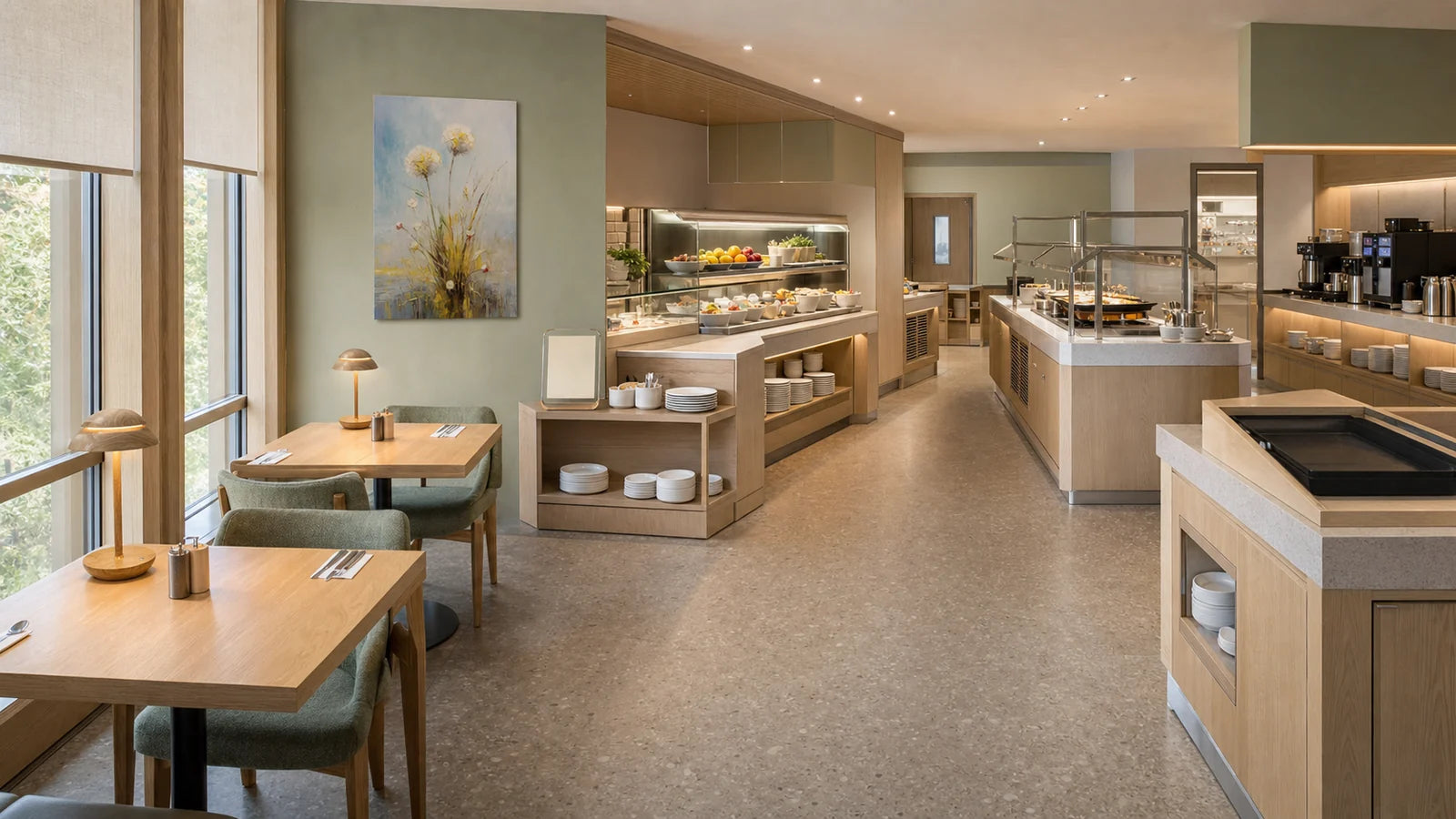
Further reading: Restaurant Floral Arrangements for the complete floral brief, Artificial vs Fresh Flowers for the material decision, Restaurant Table Decor for everything else competing for the same surface, and Restaurant Table Setting Design for how the cover itself is laid. To see palette and scale on real tables, walk The Orchard Breakfast Room and the rest of the restaurant looks.
Keep reading

guest-experience
Restaurant Restroom Cleaning Checklist and Inspection Log
Use this restaurant restroom cleaning checklist for opening, service inspections, supplies, fixtures, floors, waste, incidents, and closing records.

dining-room-operations
Restaurant Dining Room Cleaning Checklist: Turn to Close
Use this restaurant dining room cleaning checklist for table turns, high-touch points, spills, service stations, floors, opening, and close.

food-safety
Restaurant Kitchen Cleaning Checklist for Every Shift
Use this restaurant kitchen cleaning checklist to control opening, between-task, four-hour, closing, and weekly work without vague assignments.