
Fall Restaurant Ambiance Lighting: A 10-Point Audit (2026)
A practical fall lighting audit covering dusk conditions, lamp compatibility, glare, table-level layers, dimmer states and the nightly service check.

By Kamrul Hasan Rayhan · Published 3 August 2026 · Last updated 3 August 2026
Autumn changes the lighting condition during dinner. Before buying seasonal props, check whether window tables, menus, faces, and routes still work in the earlier darkness.
The ten ideas below use controls, portable light, lamping, perimeter light, and fixture finishes to build a repeatable fall scene. They are not a substitute for measuring the room, confirming product compatibility, or using a qualified professional for electrical changes.
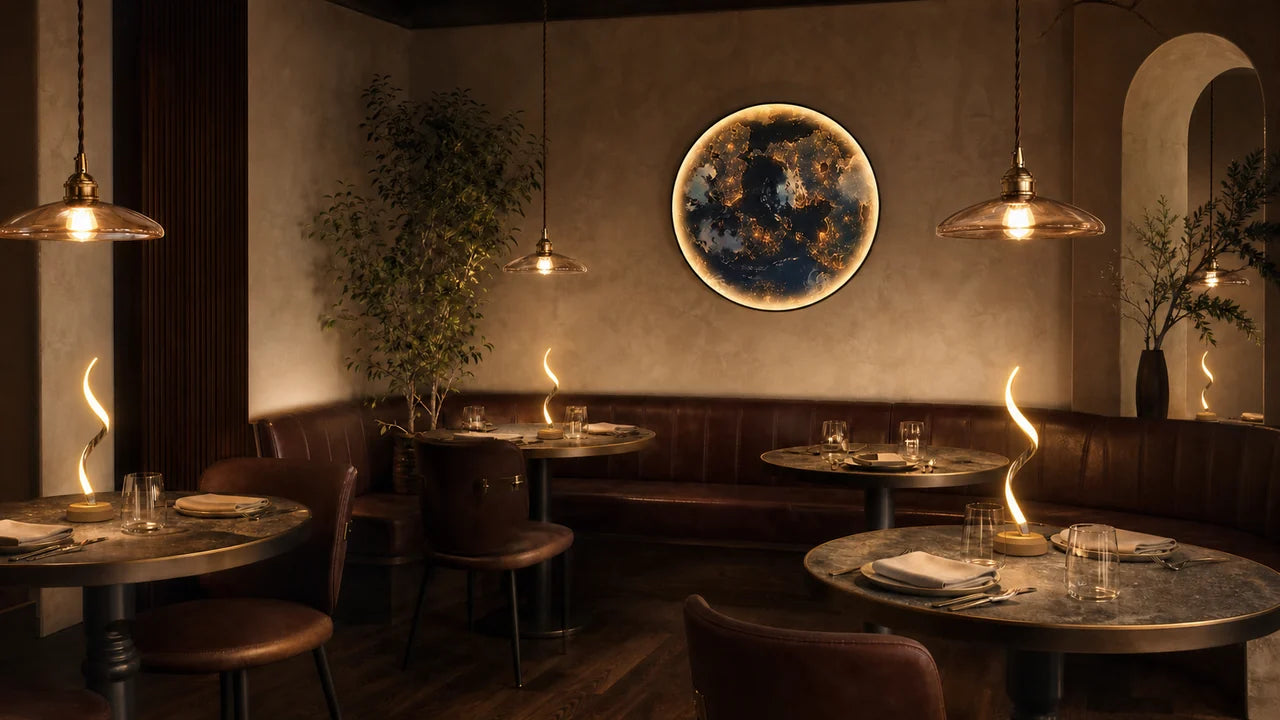
The 10 ideas at a glance
- Test warmer lamping before lowering the whole room.
- Test a table-level layer where it is needed.
- Add a second, dimmer state at dusk.
- Evaluate exposed decorative lamps without creating glare.
- Test accent light on the art.
- Compare fixture finishes as a long-term material choice.
- Work the window from the inside.
- Review open flame and flame-free options.
- Mock up focal light over priority tables.
- Run the nightly ambiance check.
This article is the room-lighting audit, not a universal buying list. Patio fixtures are covered in our end-of-summer patio lighting audit; changeover logistics are in the September swap plan; and the patio calendar is in our fall transition guide. The underlying methods live in our restaurant mood lighting guide and lighting colour temperature guide.
Why start with the lighting state
Seasonal props require storage, handling, and a removal date. Lighting controls and task-focused fixtures can continue to serve events and winter service, provided the products are compatible and the scene keeps food, menus, faces, and routes legible.
Photograph the room from the entrance at the same time on two service nights. Mark dark tables, glare, mismatched lamp colours, and bright service spill. That evidence gives you a more useful buying list than a generic set of fall objects.
1. Test warmer lamping before lowering the whole room
Colour appearance and light level are separate variables. If the room feels cold, test a compatible warmer lamp in one complete fixture zone before lowering the dimmer across the entire floor.
Compare food colour, skin tones, menu legibility, and finish appearance under the sample. Within one sightline, avoid accidental colour mismatch unless contrast is deliberate. Confirm base, voltage, wattage limit, output, colour rendering, and dimmer compatibility before a room-wide order.
The reasoning by room type is in our lighting colour temperature guide. Approve a sample before ordering the room quantity, then keep the exact product identifier and an appropriate spare plan. The execution schedule belongs in the September swap plan.
2. Test a table-level layer where it is needed
Table-level light changes faces, shadows, reflections and the amount of surface left for service. It should be evaluated separately from general illumination rather than assumed to improve every table.
Pilot a rechargeable touch table lamp on the darkest candidate tables. Check glare from each seat, stability, cleanability, usable runtime at the chosen setting, the maker's charging instructions and the space left for plates and shared dishes. A portable lamp avoids a hardwired installation, but it still needs a documented storage, charge and inspection routine.
Start with window seats and other tables whose readings or visual checks change materially as daylight fades. Specs, runtime verification and fleet sizing are in our rechargeable restaurant table lamps guide, and the range is in table lamps. The September swap plan covers inventory migration.

3. Add a documented transition state at dusk
If the room changes abruptly as daylight fades, test an intermediate control state. Reprogramming may still require facilities time or a controls professional, so record the work rather than treating it as cost-free.
Our editorial framework uses four operating labels: daylight service, dusk transition, full evening and close. Save the approved control positions, assign an owner and trigger the transition from the observed room condition rather than a universal clock time. Review the trigger as the season progresses.
Photograph representative views under each approved state and attach them to the pre-shift reference. The method behind daypart lighting is in our restaurant mood lighting guide; the paperwork belongs in the September swap plan.
4. Evaluate exposed decorative lamps without creating glare
An exposed decorative lamp may suit the intended fall palette, but its appearance and visual comfort need to be judged in the actual fixture.
Only consider a decorative "fireworks" bulb where the fixture is designed for an exposed source. Confirm base, voltage, wattage limit, enclosure restrictions, dimmer compatibility, output and manufacturer instructions. View the sample from seated and standing positions; if the source is uncomfortable in a normal sightline, change the lamp, shielding or location.
Record the exact lamp ID and decide which positions need on-site spares. Browse pendant lights and the evening-room mood in After Dark.
5. Test accent light on the art
Accent light can make a dark perimeter more legible without raising the whole room. Before changing a wall sconce or adjustable fixture, identify which wall surface or artwork should receive the light and check whether the fixture is designed to be aimed.
Mock up one canvas artwork or metal wall piece at the approved size and inspect it under all service states. Look for hot spots, reflections, colour shift and spill into guest sightlines. Reusing a hook is only appropriate when the anchor, substrate and load have been verified.
Sizing and mounting checks are covered in our wall art size and height guide; browse wall lights; and put rotation and storage in the September swap plan.
6. Compare fixture finishes as a long-term material choice
Brass, aged bronze, amber glass and clay-toned shades can support a warm palette, but a finish is a long-term material decision rather than a seasonal fact. Its appearance depends on the rest of the room and the light falling on it.
Compare a permanent fixture with a reusable seasonal kit on full cost: product, freight, professional installation, controls, cleaning, storage, repair and rollback. A fixture is only the better investment when it solves a year-round lighting or composition problem.
If the permanent option survives that test, mock it up at a priority view such as the main dining zone or bar. Browse Soft & Sculptural, Warm & Intimate and chandeliers. The Amber Dining Room is an AI-generated concept study, not evidence of performance in a real venue.
7. Work the window from the inside
As exterior light falls, glazing can shift from a view into the room to a mirror for guests inside. Inspect it from both sides during the actual service window.
Test a rechargeable table lamp or existing low fixture in the window zone and photograph the result from the guest seat and pavement. Keep bright sources out of direct sightlines, preserve plate space and check reflections rather than assuming that more light near the glass will help.
Repeat the outside view from the normal approach and confirm that the entrance and wayfinding remain clearer than decorative objects. The arrival sequence is in our restaurant entrance design guide.
8. Review open flame and flame-free options
The candle question comes up every autumn, and the honest answer is that it is not a decor question. Open flame on tables is governed by your local fire authority, and the rules vary by jurisdiction, occupancy and even by table configuration — so ask your fire marshal rather than a design blog, including ours.
If open flame is not approved or does not fit the operating plan, pilot LED touch atmosphere lights or flameless candles. Check product documentation, stability, cleanability, battery condition, light quality and permitted locations. Flame-free does not mean maintenance-free or automatically suitable for every surface.
Treat them like a managed fleet: charge or battery-check on a schedule, deploy to named positions, count at close and quarantine damaged units. Follow the maker's battery and disposal instructions.
9. Mock up focal light over priority tables
A lower apparent light plane can create a more focused table zone, but lowering or adding a pendant is a permanent installation decision with physical clearances, sightlines, load, controls and code implications.
Start with a scaled elevation and a lightweight full-size silhouette over one candidate table. Review it seated, standing and from the server route. If the location still works, have a qualified professional confirm the mounting, electrical supply, controls and applicable requirements before a fixture is ordered or moved.
Our restaurant pendant light height guide provides a measurement process, but the final height remains site- and fixture-specific. Browse pendant lights and chandeliers.
10. Run the nightly ambiance check
Lighting scenes drift in day-to-day use: a lamp misses its charge, a bulb fails, an adjustable fixture moves during cleaning or a transition state is skipped.
Make a short named walk on the pre-shift sheet. Check deployed table lamps, failed or mismatched sources, the transition-state owner, adjustable-fixture aim, the window view and exposed sources in seated sightlines. Add emergency and egress-lighting defects to the venue's required escalation process; decorative checks do not replace it.
Record defects by location and owner so the next shift can see what remains out of service. A reference photograph for each approved state makes the check faster and less subjective.
If you must do a prop
If the brand brief calls for a seasonal object, choose it through the same operational test as the lighting layer.
A reusable glazed ceramic vase with a documented stem recipe may work at the host stand or on a shelf. Check stability, sightlines, cleanability, accessible circulation and storage. On a dining table, the arrangement must also preserve place-setting space and the view between guests.
Score the object on brand fit, reuse, labour, storage volume, cleaning and disposal. Multi-season use is helpful, but it is not the only valid brief. Scale, placement and arrangement checks are in our restaurant floral arrangements guide.
Product picks from Resto Glow
The fall light kit, in the order it should be bought.
Test compatible lamps in the fixtures you already have. Use decorative "fireworks" bulbs only where the source is intended to be seen and the lamp meets the fixture and control requirements. Avoid accidental colour mismatch within the same sightline, and set the spare quantity from critical locations and replacement risk.
Add the table layer where the audit found a problem. Test rechargeable touch table lamps for glare, stability, and run time, then size the fleet and charging rotation. Use LED touch atmosphere lights only on stable, cleanable surfaces where their listed use and local rules allow them.
Then the walls and ceiling. Sample accent light on one approved artwork location. Mock up any new pendant or chandelier at full size and route permanent work through a qualified professional.
Shop the whole autumn mood in Warm & Intimate and After Dark, or start at restaurant lighting. See it assembled as finished rooms at The Amber Dining Room and The Courtyard Supper Club. Relighting several sites at once? Trade projects.
Let the audit decide whether the useful move is a control adjustment, a compatible relamp, a portable layer, a permanent fixture or no purchase at all.
Fall restaurant lighting FAQ
How do you make a restaurant feel cozy in the fall?
Treat colour appearance, level, distribution and glare as separate variables. Sample any warmer lamp in one complete zone, test table-level light only where needed and save an intermediate control state if the room changes abruptly at dusk. Judge the result at occupied seats.
What color temperature is warmest for restaurant lighting?
“Warmest” is not a useful restaurant specification on its own. Choose the colour appearance that works with the food, finishes and daypart, then confirm output, colour rendering, dimming and fixture compatibility for the specific lamp. See our colour temperature guide.
How do restaurants decorate for fall without looking cheap?
Start with the room's operating problem, then use a restrained material and colour brief. A compatible lamp sample, a documented dusk scene or one reusable arrangement can be enough. Avoid buying scattered objects without a placement, cleaning, storage and removal plan.
When should a restaurant start fall decorating?
Work backward from the date the room needs its fall scene. Allow time for a lamp and dimmer compatibility check, one-table test, full-quantity supplier confirmation, and staff briefing. The dated planning framework is in Top 10 September Decor Swaps to Prep in August.
What is the best lighting for a dark dining room?
Measure representative seats and identify whether the problem is low level, poor distribution, glare, contrast or a failed source. Test one corrective layer at a time and verify menus, faces, food and routes. There is no single fixture recipe for every dark dining room.
Next in this series: the patio lighting audit for outside, the patio fall transition for the changeover and the September swap plan for the run sheet.
Keep reading

guest-experience
Restaurant Restroom Cleaning Checklist and Inspection Log
Use this restaurant restroom cleaning checklist for opening, service inspections, supplies, fixtures, floors, waste, incidents, and closing records.

dining-room-operations
Restaurant Dining Room Cleaning Checklist: Turn to Close
Use this restaurant dining room cleaning checklist for table turns, high-touch points, spills, service stations, floors, opening, and close.

food-safety
Restaurant Kitchen Cleaning Checklist for Every Shift
Use this restaurant kitchen cleaning checklist to control opening, between-task, four-hour, closing, and weekly work without vague assignments.