
The 9 Types of Restaurant Lighting (And Where Each One Belongs)
Nine restaurant lighting types compared by job—not shopping category—with a zone matrix, selection flow, and field checks for glare, food, faces, routes, and controls.

The usual lighting guide starts with nine product categories and ends with nine reasons to buy something. A restaurant does not experience lighting that way. It experiences a shadow across the menu, a host standing against a bright door, a glossy bar reflecting every point source, or a table that feels disconnected from the rest of the room.
So this guide starts with the job. Each fixture type below can be useful, but none is a complete lighting plan. The goal is to identify the failing seat, task, route, object, or view; assign the right layer; and only then shortlist a fixture.
First, separate a lighting type from a lighting job
A type describes a form or mounting method: pendant, sconce, track head, table lamp. A job describes what the room needs: background visibility, light on a menu, a readable route, a revealed wall, or a point of atmosphere.
One type can do several jobs, and one job may need several types. A pendant can light a table and decorate the ceiling, but it may not help the server route behind the chair. A sconce can reveal a wall and soften the room, but it may put a bright source directly beside a guest’s eye.
Use four working layers to keep the conversation clear:
- Ambient: the background that lets the room hold together.
- Service: the light needed for hosting, payment, the pass, steps, labels, and routes.
- Focal: light for a plate, menu, face, counter, or feature table.
- Accent: light that edits attention across art, texture, plants, shelves, or architecture.
The restaurant lighting layers field guide shows how to test those layers one at a time. The matrix below maps common fixture types to their strongest jobs; it is a shortlist, not a specification.
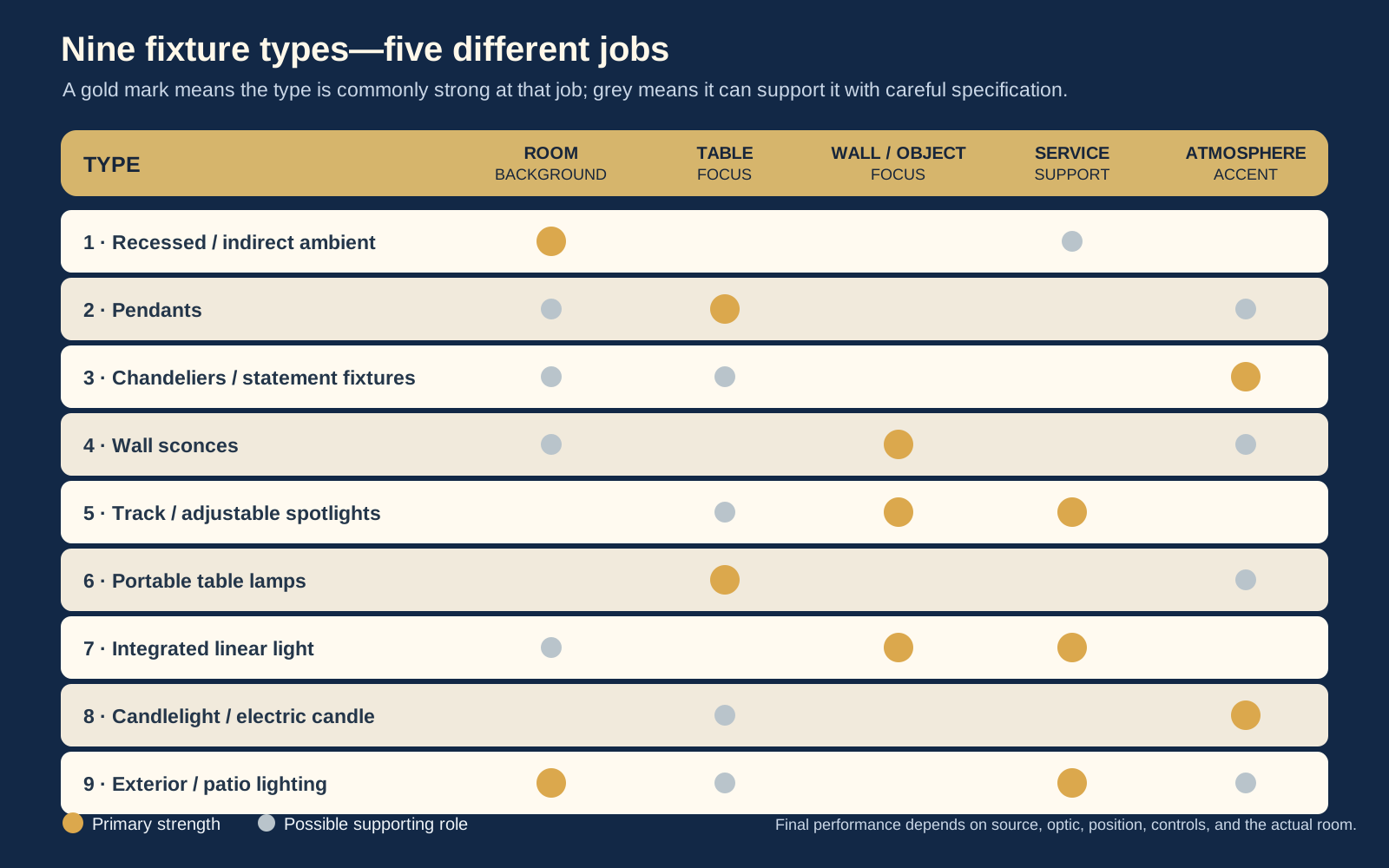
The nine restaurant lighting types, with their useful limits
1. Recessed and indirect ambient lighting
Recessed downlights, concealed coves, and other architectural sources can give the room background continuity without adding another visible object. They are useful along circulation, in low-ceiling zones, and where a decorative fixture would conflict with sprinklers, ducts, sightlines, or flexible furniture.
Their common failure is uniformity. A ceiling grid that treats every square metre equally can flatten the dining room while still leaving menus in shadow. Wide beams may create glare on polished tables; narrow beams can make a dotted floor.
Test: switch off decorative sources and walk from entrance to the darkest route. Look for abrupt gaps, visible lamps, harsh scallops, and light falling where nobody needs it. Keep required emergency and exit-route lighting outside mood changes. In the US, OSHA’s exit-route requirement is one baseline; the venue’s local building, fire, accessibility, and electrical requirements still govern.
2. Pendant lights
Pendants create a local relationship between ceiling and table, bar, counter, or booth. They work best when the furniture is fixed and the hanging point can align with the task below.
Their common failure is visible glare. A beautiful shade may expose the lamp to the lower seated guest, or a wide opening may reflect as a bright circle in glassware and stone. A pendant placed on the ceiling plan before the table plan often lands over a chair or aisle.
Test: mock up the full drop and shade with the lowest chair in place. Sit on every side, lean back, stand on the approach, and set the real menu and glassware. Use the restaurant pendant-height guide for the sightline method, then browse pendant lights only after the useful envelope is clear.
3. Chandeliers and statement fixtures
A chandelier is a destination marker. It can lower a tall volume visually, identify a communal table, create an arrival moment, or give a private dining room a centre.
Its common failure is being asked to illuminate the entire zone. Statement fixtures are often designed to be looked at first and to light work second. They can also compete with signage, sightlines, air movement, acoustic treatments, and maintenance access.
Test: tape or hang a full-size silhouette at the proposed height. Photograph it from the entrance, seated tables, and the route beneath it. Then assess the actual photometric and electrical information with the responsible professional. If the fixture is primarily atmospheric, give the table and route their own suitable sources.
4. Wall sconces
Sconces help reveal the perimeter, break up a long banquette wall, frame art, or make the far end of a narrow room feel present. They are especially useful when the ceiling is visually busy.
Their common failure is eye-level glare or an awkward projection into a route. The same fixture can look shielded from standing height and expose a bright lamp from a banquette.
Test: mock up the object’s complete width, height, and projection. Check from the lowest seat and from the passing shoulder line. Photograph glossy art and mirrors for hot spots. Browse wall lights with the wall material, mounting position, cleaning access, and intended aim already documented.
5. Track lighting and adjustable spotlights
Adjustable sources are useful when displays, art, plants, retail shelves, or furniture arrangements change. They can also support the pass or bar where precise aiming matters more than a decorative silhouette.
Their common failure is aim drift. A head moved during cleaning can land in a guest’s face. Tight beams create bright islands; poorly shielded sources become visible across the room.
Test: mark the approved target and photograph the finished aim. Look from every occupied direction, not only from beneath the track. Add an aim check to the pre-shift or maintenance routine. Where colour matters, compare the actual source on food, skin, wood, metal, and the intended artwork.
6. Portable and rechargeable table lamps
A compact table lamp can help one documented dark table without lifting the entire ceiling scene. It can also give a terrace table a sense of ownership after sunset.
Its common failure is operational. The lamp occupies place-setting space, moves into sightlines, gets carried to the wrong table, runs out during service, or becomes one more object to clean and charge.
Test: put the complete lamp on the smallest table with the largest normal order. Check stability, glare, touch controls, runtime at the intended setting, charging logistics, cleaning, storage, and the reset standard. The rechargeable restaurant table-lamp guide includes a fleet and service test. Browse table lamps only when the table problem and operating routine are both clear.
7. Integrated linear lighting
Linear sources hidden under shelves, bar lips, banquettes, coves, or handrails can reveal a surface or support a task without becoming a visual object. They are useful at the back bar, service shelf, display case, or along an architectural edge.
Their common failure is seeing the source or its reflection. A continuous bright line can dominate the room, mirror in bottles, highlight dust, or produce a scallop of individual LED points.
Test: build one complete section with the real extrusion, diffuser, setback, reflective materials, driver, and dimming state. View it from seated and standing positions. Confirm heat, access, cleaning, replacement, controls, and electrical details with qualified suppliers and installers. The restaurant bar-lighting guide shows how to separate guest-facing sparkle from staff task light.
8. Candlelight and electric candle accents
Candlelight can add small movement and intimacy at a table. A suitable electric alternative can create a similar visual cue without a flame. Neither should be treated as the source that makes a menu, route, or payment task usable.
The common failure is assuming the atmosphere outweighs the operating constraints. Open flame, wax, fuel, cleaning, handling, table stability, allergies, local fire rules, and the venue’s insurer all matter.
Test: treat the item as a tabletop object first. Check the smallest table, reach, spill and breakage risk, clearing method, storage, and approved local policy. Never infer that a decorative holder makes a flame acceptable. If open flame is not clearly permitted and managed, do not improvise.
9. Exterior and patio lighting
Outdoor lighting must make arrival, boundaries, steps, routes, tables, and closing tasks understandable after dark. Wall-mounted, overhead, portable, landscape, and architectural sources may all contribute.
Its common failure is choosing by indoor appearance. Weather exposure, ingress protection, corrosion, wind, cable routing, glare to neighbours, landscape shadows, local curfews, and temporary structures change the specification.
Test: walk the route after dark in representative weather. Photograph the approach, boundary, darkest table, steps, payment point, and close-down path. Verify the actual product rating and installation method for the site. The restaurant patio-lighting guide turns the route into a zone checklist.
A fixture is not a layer
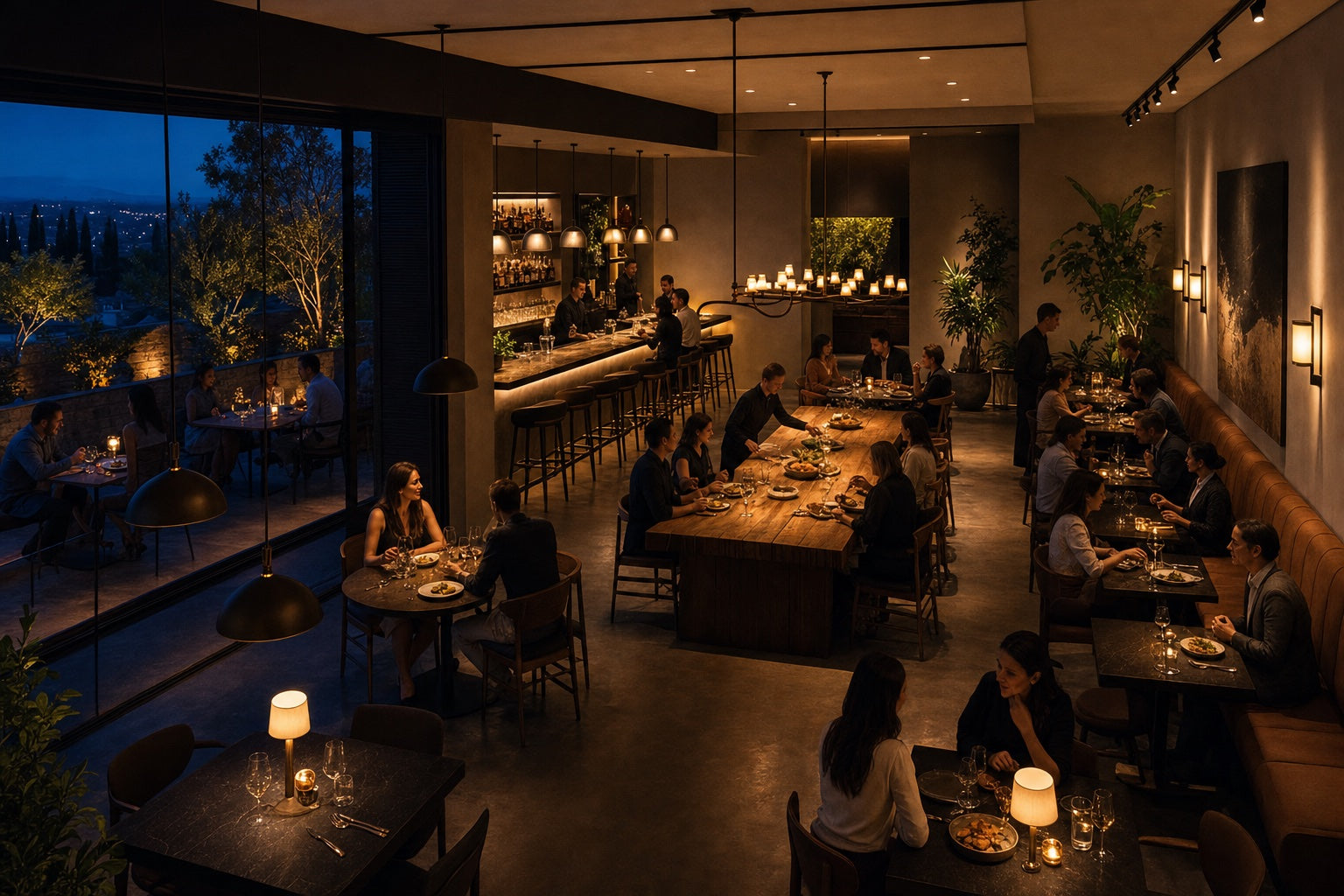
The cinematic room at the top works because each visible type has a limited job. Pendants belong to fixed tables and the bar. A chandelier gives the communal table a centre. Sconces reveal the banquette wall. Track heads address art and plants. Portable lamps help specific dark tables. The terrace has its own exterior answer.
Copying the fixture count would be meaningless. A smaller café may use one pendant line, indirect ambient light, and a carefully placed sconce to achieve the same four layers. A large restaurant may need several control zones within one fixture type.
The Illuminating Engineering Society’s article on restaurant lighting as a layered experience is a useful professional reference. The practical takeaway is that the table, its surface, perimeter light, and other sources interact; the fixture cannot be judged alone.
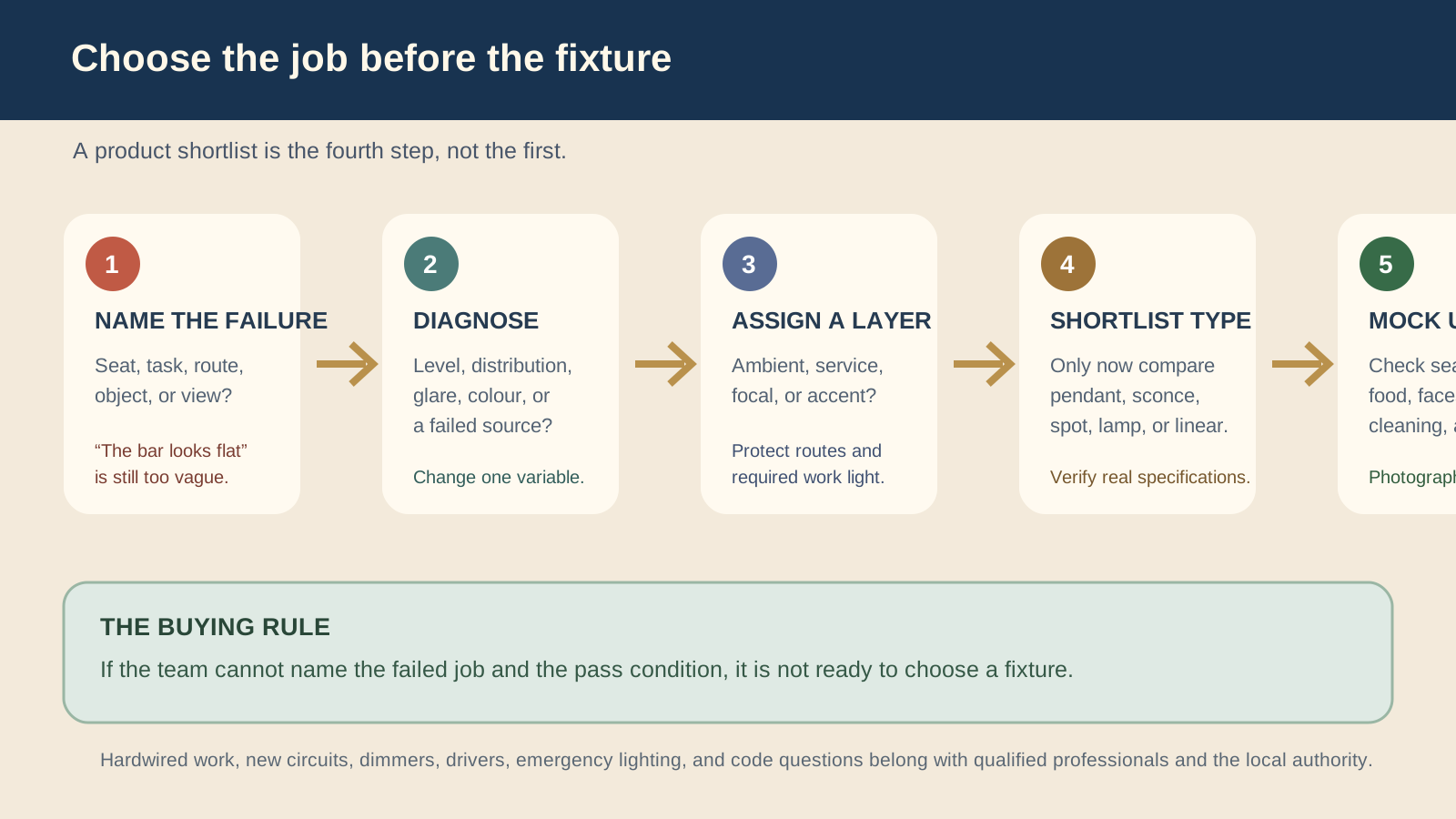
Use the problem-to-product flow
When a team starts with “we need sconces,” ask what will be better after sconces exist. If the answer is only “the wall will look nicer,” the idea is not yet testable.
- Name the failure. Identify the exact seat, task, route, object, or view.
- Diagnose the cause. Is it low level, poor distribution, visible glare, colour appearance, reflection, control, or a failed source?
- Assign a layer. Decide whether ambient, service, focal, or accent light owns the correction.
- Shortlist a type. Compare the types capable of that job in the real location.
- Mock up and save. Test, photograph, document, and name the approved service state.
Compare types with the same field record
Use one record for every mock-up so a dramatic first impression does not erase the practical checks.
| Field | What to record |
|---|---|
| Location and viewpoint | Exact table, wall, route, or task; seated and standing views |
| Failure being addressed | Shadow, glare, flatness, dark route, colour shift, or weak hierarchy |
| Type and configuration | Fixture category, source, optic or shade, mounting, and aim |
| Operating state | Daylight condition, dimmer scene, adjacent sources, and time |
| Guest check | Menu, food, face, reflected source, table space, and phone photo |
| Staff check | Service route, payment, labels, pass, cleaning, and reset |
| Ownership | Who activates, charges, aims, cleans, reports, and approves |
| Result | Pass, revise, or reject—with one next change |
If the field record has no failure or pass condition, the fixture is still a decoration proposal. That may be valid, but it should not be described as a lighting solution.
Colour quality, controls, and measurement
Colour temperature describes the appearance of nominally white light; it does not tell you how the source will render every food, skin tone, finish, or saturated colour. The US Department of Energy’s LED basics explains the distinction between colour appearance and colour fidelity, including the limits of relying on one metric.
Compare the actual source at the intended dimming state. Photograph representative dishes and people. Watch for flicker, abrupt low-end behaviour, colour shift, mismatched sources, and reflected points. A compatible control plan matters as much as the decorative shade.
When measurements are useful, the restaurant foot-candle field guide explains how to record repeatable points and conditions. Measurements help compare states; one number does not replace glare, distribution, colour, and viewpoint checks.
Questions restaurant teams usually ask
How many lighting types does a restaurant need?
There is no useful minimum fixture count. Start with the jobs and four working layers. A small room may cover them with three well-positioned types; a complex room may use several zones of the same type. Remove any source that has no job or competes with a more important one.
Can one pendant provide the ambient and table layer?
It can contribute to both if its distribution, shade, mounting, source, and surrounding surfaces allow it. Test the table and the spaces between tables. Do not assume a pendant that makes a good pool also gives a comfortable background.
Are rechargeable table lamps a substitute for hardwired lighting?
They are a local operational tool, not a substitute for required building, service, route, exit, or emergency lighting. Use them where a tested table-level gap remains and where the charging, cleaning, storage, and reset routine works.
Which type should light artwork?
Wall sconces, track heads, integrated linear sources, or architectural accents can all work. The artwork’s size, surface, reflectivity, conservation needs, wall construction, and viewing angles decide the answer. Mock up one complete sightline and coordinate specialist requirements where relevant.
Can the team install decorative lighting themselves?
Follow the product instructions, venue policy, and local rules. New circuits, hardwired fixtures, drivers, dimmers, emergency lighting, and uncertain compatibility belong with qualified professionals. Portable does not automatically mean risk-free; cords, charging, heat, stability, cleaning, and route placement still require a plan.
The decision that saves money
Do not ask which of the nine types is best. Ask which job is currently failing, which layer owns it, and what the smallest credible test looks like. A room becomes better through a series of verified corrections, not through a longer shopping list.
Name the problem seat. Choose one type capable of solving it. Mock it up with the real menu, food, faces, surfaces, controls, and service route. Then save the result so the room can repeat it tomorrow.
Keep reading

guest-experience
Restaurant Restroom Cleaning Checklist and Inspection Log
Use this restaurant restroom cleaning checklist for opening, service inspections, supplies, fixtures, floors, waste, incidents, and closing records.

dining-room-operations
Restaurant Dining Room Cleaning Checklist: Turn to Close
Use this restaurant dining room cleaning checklist for table turns, high-touch points, spills, service stations, floors, opening, and close.

food-safety
Restaurant Kitchen Cleaning Checklist for Every Shift
Use this restaurant kitchen cleaning checklist to control opening, between-task, four-hour, closing, and weekly work without vague assignments.