

Compiled by the Resto Glow Studio team · Last reviewed 5 August 2026
Fixture choice gets all the attention and layout does most of the work. You can hang the same well-chosen pendant three different ways over the same table and produce three different rooms — one calm, one rhythmic, one theatrical — and only one of them will still look right when it has been repeated thirty times.
This is the decision that sets the character of a ceiling. It is also the cheapest one to get right, because it happens on paper, with tape, before anything is ordered.
The three layouts, drawn to scale
Same four-top, same seats, same scale. The difference is entirely in what each arrangement does to the sightlines and to the ceiling above it.

Single is one fixture, one centre, one pool. It is the quiet answer and the one that survives repetition — a room of matched single pendants over matched tables reads as intentional even when the tables are ordinary. It fails on long tables, where one pool lights the middle and leaves both ends looking unfinished.
Row is a repeated fixture at even centres. It suits anything long and narrow: bars, counters, communal runs, a line of banquette tables. The spacing becomes the design, which is why the arithmetic in how many pendants over a restaurant bar matters more here than the fixture does. It fails when tables get joined and the row ends up sitting over the joins.
Cluster is several separate drops grouped and staggered. It is the only one of the three that reads as an object rather than as lighting, which is exactly why it belongs over one focal table and almost never over all of them. It fails the moment it is repeated: three clusters in a small dining room is not a scheme, it is a thicket.
Which one wins
Four questions, answered in order. The first one disqualifies more restaurants than the other three combined.

Does this table stay where it is, every service, all year? If not, hang nothing over it. A fixed drop above a table that gets joined for a party of nine ends up over an aisle, where a different set of clearance rules applies and where somebody eventually walks into it. Light those tables from the room instead: ambient, perimeter, and table-level. Our small restaurant lighting zones guide is written for exactly this constraint.
What shape is the surface? Long and narrow wants a row or a linear fixture. Roughly square or round wants a single — or a cluster, if the third question says so.
How much volume is above it? A tall ceiling over a square table is the one place a cluster genuinely earns its keep, because it gives the eye something at an intermediate height and stops the drop reading as a lonely cable in a void. An ordinary ceiling height over the same table wants the single.
Can a server clear this table without leaning around the fixture? This applies to every answer, and it is the one that fails late. Test it with a loaded tray, not with an empty hand.
Single: the default, and why that is a compliment
The single pendant is the layout to beat, and most rooms should not beat it.
It centres on the table, keeps its whole footprint inside the tabletop in plan, and repeats without visual noise. Because there is only one fixture per table, the height decision is simple, the sightline test is simple, the ladder trip is short, and a broken shade is one replacement rather than a set. A compact fixture like the Nordic Restaurant Minimalist Small Pendant Light or the Restaurant Pendant Light, Nordic Modern Minimalist is doing an unglamorous job extremely well.
Where a single starts to struggle is width. Once a table is long enough that one pool cannot cover it, you have three ways out: a wider shade (which puts more mass in the sightline), a multi-head fixture on one canopy, or a row. The multi-head option — a Nordic 3-Head Dining Table Pendant or a 41-Inch Matte Black Double Pendant — is worth knowing about because it is effectively a factory-set cluster: one outlet, one canopy, a spacing you cannot get wrong, and a spacing you also cannot change.
Row: when the spacing is the design
A row is the least fussy layout and the hardest to fake. Because every fixture is identical and the gaps are regular, any error in the setting-out is visible from the door.
Three things make a row work:
Repeat something small. Visual weight multiplies. A fixture that reads as a confident statement on its own reads as clutter five times over. The Retro Glass Restaurant Pendant Light and the Modern Black Wrought Iron Pendant both repeat comfortably; a large decorative globe generally does not.
Keep the gap legible. From across the room you should clearly see space between the shades. Two rims that nearly touch stop reading as two fixtures and start reading as one clumsy one.
Decide the ends deliberately. Half a gap of empty counter at each end, or a fixture pinned over the end seat — either is right, but the choice has to be made rather than inherited from a drawing.
Where the run is long and the ceiling plain, one linear pendant can do the whole job as a single object. It removes the counting and alignment problems in one move; it adds a coordination requirement around suspension points and distribution.
Cluster: four rules that keep it from looking like an accident
A cluster is the highest-risk layout in a restaurant, because the difference between composed and chaotic is small and entirely in the geometry.

One canopy, or several. A shared canopy needs one outlet, arrives as one piece, and fixes the relative positions for you. Separate canopies need separate points and separate holes in the ceiling, and give you freedom you then have to use well. On a first fit-out, the shared canopy is the lower-risk choice.
Set the lowest fixture first. The lowest drop is the one that blocks a face, so approve it against the sightline test before the other two exist. Everything else steps upward from a line you have already accepted.
Keep the spread inside the tabletop. In plan, the whole cluster should sit within the table. A drop that overhangs the edge is over a chair — and if the table is ever pushed, over an aisle.
Make the steps readable. Equal height steps read as intent. Near-equal steps read as a mistake, because the eye catches the difference and cannot decide whether it was meant. Commit to an obvious rhythm or to a level set; avoid the middle.
Then use it once. A cluster over the chef's table, the private room, the round six-top by the window, or a stairwell void is a focal point. A cluster over every table is visual noise. Where a room wants one decorative statement rather than a group, a chandelier does the same job with a single fixing — the Nordic Retro Restaurant Chandelier in walnut, brass and glass is the shape to compare against, and our restaurant ceiling lighting guide covers the ambient half of that decision.
Rhythm is decided at room scale, not table by table
Here is the failure mode nobody plans and almost everybody produces: each table gets a good decision, made separately, and the ceiling ends up speaking three languages at once.

The fix is a rule you set once and hold: one fixture family, applied by surface type. One pendant over every four-top. The same fixture, in a row, over the bar and the communal table. Nothing over the tables that move. Optionally, one deliberate exception at the room's focal point — and exactly one.
Draw the reflected ceiling plan before you shop. Put the fixtures, the tables, the structure, the ductwork and the sprinklers on the same sheet. It takes an hour, and it is where the conflicts are cheapest to find.
The fourth option: nothing overhead
Not every table wants a pendant, and saying so is not a failure of ambition.
Movable tables, flexible function rooms, low ceilings, and rooms where the tables are pushed together most weekends are all better served by a scheme built from ambient light, wall lights and light at the table itself. Perimeter light in particular is the most under-used fix in a dim dining room: lighting the walls lifts the room's perceived brightness a long way without raising the level at the covers. Browse wall lights and table lamps, and see The Stillpoint Dining Room for a version of that logic assembled.
Our guide to layering restaurant lighting is the right next read if the answer for most of your room turns out to be "not pendants".
Choosing by room type
Bistro or brasserie with repeated four-tops — single, repeated, one family. Compare warm finishes in Warm & Intimate and see The Juniper Brasserie.
Bar, counter or communal run — row, or one linear fixture. Mood reference: After Dark and The Midnight Bar.
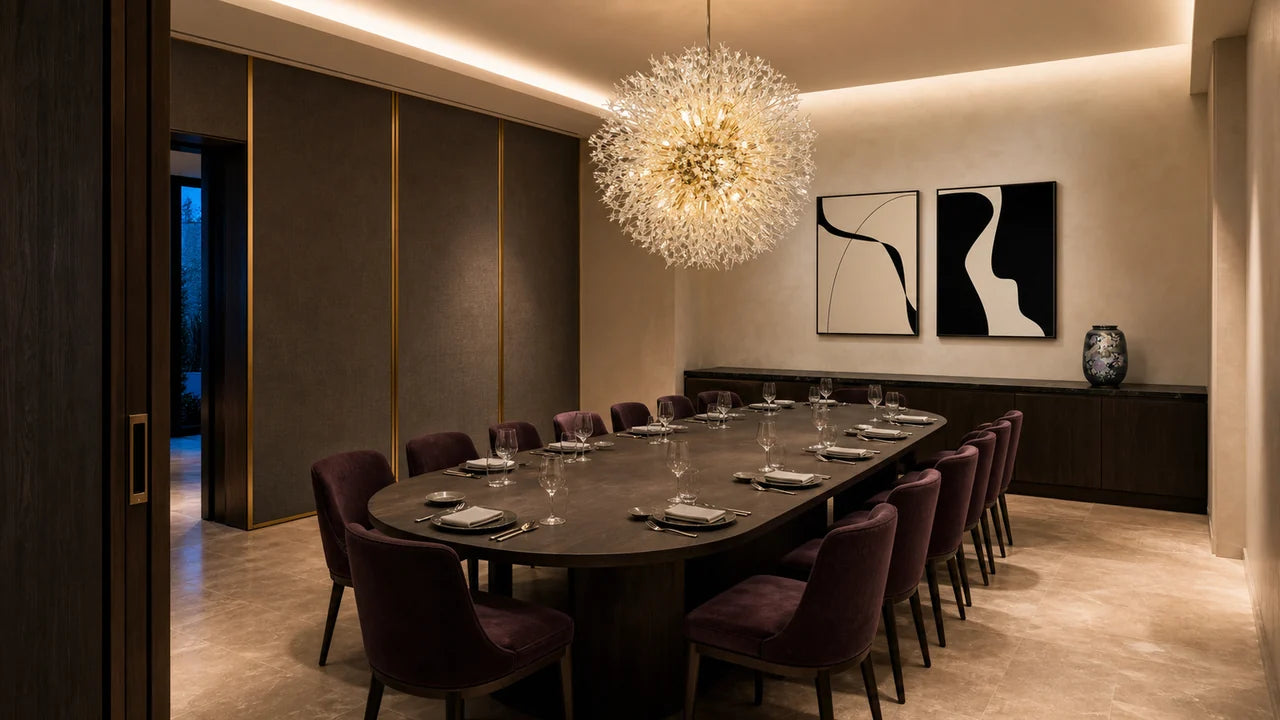
Private dining room or a tall focal table — cluster or chandelier, used once. See The Gilded Line Private Dining Room and the Soft & Sculptural edit, and our private dining room design guide.
Bright café or breakfast room — single or row in a pale finish; the 20-Inch Gold Pendant with Threaded Clear Glass Globe is the kind of shape to test. Browse Bright & Social.
Everything sits under pendant lights and restaurant lighting. Laying out a whole room, or several? Trade projects is the right door.
Restaurant pendant layout FAQ
Cluster or row of pendants — which is better?
They answer different shapes. A row suits anything long and narrow, because even spacing along a run is what makes a bar or communal table read as one composition. A cluster suits one square or round focal table with volume above it. The mistake is repeating a cluster: three of them in one room stop reading as a feature and start reading as clutter.
How many pendants should hang over one restaurant table?
Usually one. Move to two or three only when a single pool cannot cover the surface — long tables, communal runs, wide counters. When you do, either use a multi-head fixture on one canopy, which fixes the spacing for you, or set out a row from the table's centreline with the whole group sitting inside the tabletop in plan.
Can I mix pendant layouts in the same restaurant?
Yes, if the rule is by surface type rather than by table. Singles over four-tops, a row over the bar and the communal table, and one cluster at the focal point is a coherent scheme. Clusters over some four-tops and singles over others is not — the ceiling reads as unfinished, because it is.
When should a restaurant not use pendants at all?
When the tables move. A fixed drop over a table that gets joined or repositioned ends up over an aisle, which changes both the composition and the clearance question. Low ceilings and flexible function rooms are the other two cases. In all three, ambient light, wall lights and table-level light do the job better.
Do all the pendants in a row have to hang at the same height?
For a straight run over repeated tables or a bar, consistency almost always looks calmest, and small variations become glaring once the whole row is lit. A cluster is the exception: it should stagger deliberately, with the lowest fixture approved first and the steps between the others obviously even.
Further reading: Hanging Lamps for Restaurants for the buying decision that comes first, Restaurant Pendant Height and Spacing for setting out the drop, How Many Pendants Over a Restaurant Bar for the counting arithmetic, and our restaurant pendant light height guide for the underlying ranges. For colour, restaurant lighting colour temperature.
Keep reading

guest-experience
Restaurant Restroom Cleaning Checklist and Inspection Log
Use this restaurant restroom cleaning checklist for opening, service inspections, supplies, fixtures, floors, waste, incidents, and closing records.

dining-room-operations
Restaurant Dining Room Cleaning Checklist: Turn to Close
Use this restaurant dining room cleaning checklist for table turns, high-touch points, spills, service stations, floors, opening, and close.

food-safety
Restaurant Kitchen Cleaning Checklist for Every Shift
Use this restaurant kitchen cleaning checklist to control opening, between-task, four-hour, closing, and weekly work without vague assignments.