
Hanging Lamps for Restaurants: Buy Once, Hang Right
Choosing hanging lamps for restaurants in the order that stops you buying twice: fixture families, shade geometry, glare, sizing, dimming and durability.

Compiled by the Resto Glow Studio team · Last reviewed 5 August 2026
Ask an operator what they need and they say hanging lamps. Ask a lighting rep the same question and they say pendants. It is the same object described from two sides of a counter, and the gap between those two vocabularies is where a lot of money gets spent badly.
One hanging lamp is a purchase. Twenty of them, over twenty tables that turn four times on a Saturday, is a system — and that system touches sightlines, service routes, glare, cleaning schedules, and the ladder somebody has to carry through a full dining room at eleven at night.
This guide runs the decision in the order that stops you buying twice. It does not tell you which lamp is best, because that answer lives in your room. It tells you what to settle first, what to test with tape before you spend anything, and which questions a supplier has to answer before a room-wide order goes in.
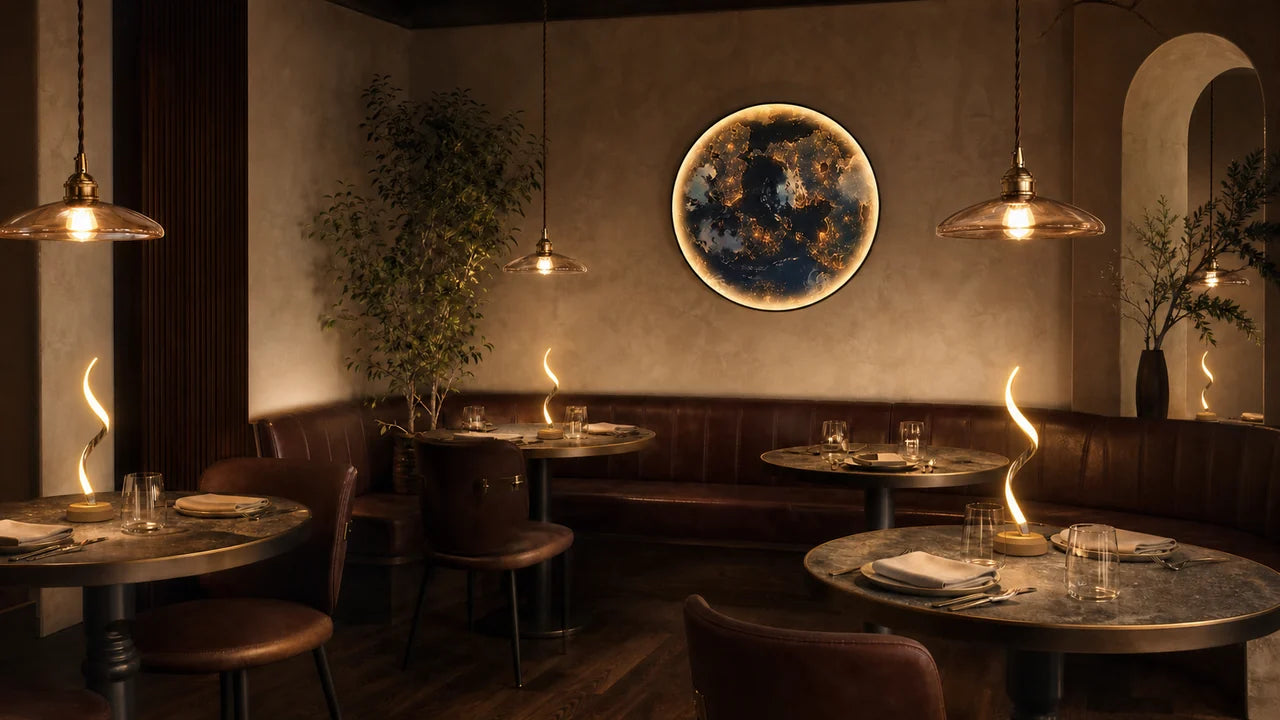
The five things a hanging lamp can be
"Hanging lamp" covers five different objects that solve five different problems. Naming yours correctly is the fastest way to stop looking at the wrong products.
| Family | What it is | Where it belongs | What it demands |
|---|---|---|---|
| Single pendant | One shade, one drop, one canopy | Two-tops, four-tops, round tables | A table that never moves |
| Multi-light pendant | Several heads from one canopy | One table that needs more than one pool | A single outlet, and a table wide enough |
| Linear pendant | One long suspended body, two or more drops | Bars, counters, communal runs | Confirmed suspension points |
| Cluster | Several separate drops, grouped and staggered | One focal table, tall rooms, private rooms | Ceiling height, and restraint |
| Chandelier | A single decorative body with many sources | Rooms with volume to fill above head height | An ambient job, not a table job |
The trap is buying a fixture from one family to do another family's job. A cluster over every four-top turns a dining room into a thicket. A single small pendant over a twelve-foot communal table lights a third of it and leaves the rest looking unfinished.

Start with the surface, not the ceiling
The most common mistake in restaurant pendant work is centring fixtures on the room. Rooms are symmetrical on drawings and almost never in service. Tables get moved for a party of nine, a column sits where the grid says a light should go, and the banquette runs to a wall that is not quite square.
So name the surface. Not "the dining room" — this table, this stretch of bar, this communal run. Then measure its finished height on site, after the top is installed. A drawing that assumed a standard tabletop can be several inches out once a thicker stone, a custom base, or a raised counter arrives, and every height decision downstream inherits that error.
If the surface moves, you have a different problem and probably a different answer. A table that gets joined into a long run on Friday nights should not carry a fixed drop over its centre; on Friday that drop lands between two settings or over an aisle. Rooms with flexible layouts are better served by an ambient layer and a perimeter layer, with pendants reserved for the tables that genuinely stay put. Our small restaurant lighting zones guide works through that trade-off in tight footprints.
The shade decides where the light goes
Two fixtures with identical lamps can produce completely different rooms. The variable is the shade, and it is worth understanding as geometry rather than style.

An open cone sends nearly everything downward into a tight, bright pool. It is the strongest tool for lifting the light at the table without lifting the room, which is exactly the shape of the problem in a dark dining room where guests are struggling with menus. The cost is that faces sit above the pool and can read as shadowed.
A dome or drum spreads wider with a softer edge and lets some glow escape sideways, which helps the room read as warmer rather than as a series of spotlights in the dark. The cost is visual mass: a wide shade at a small two-top puts an object exactly where two people are trying to look at each other.
A clear globe is the most decorative and the most demanding. It throws light in every direction, lifts the whole room a little and the tabletop not much, and puts the source on display. That last part is the whole risk — a visible filament is the brightest thing in a dim room, and no dimmer setting makes it comfortable.
A linear diffuser replaces counting fixtures with one continuous body, which is why it suits bars and long communal tables. Confirm the suspension points and the light distribution before you treat a linear fixture as a table's only source.
Finish matters as much as shape. A smoked or dark-glass pendant reads visually lower and heavier than a pale one of the same physical size, so judge the sample rather than the dimension line.
Glare is a geometry problem, not a taste problem
Here is the test, and it is a straight line. Sit in the chair. Draw a line from your eye to the lamp. If the bottom rim of the shade does not cross that line, you are looking at a bare source.

Run it from the lowest seat in the room — usually a soft banquette, sometimes a child's chair — and from the table nearest the fixture rather than the one in the middle. Run it twice: at the dimmest service setting and the brightest.
When it fails, the useful fixes are local. Deepen the shade, frost the lamp, lower the output, or lower the fixture so the rim drops below the sight line. Dimming the entire room until the source stops hurting is the fix operators reach for first, and it leaves you with a dim room and a visible bulb.
Size it to the table, not to the ceiling
A hanging lamp is judged against the object underneath it. Two working habits do most of the work here, and both are design practice rather than any published rule:
Keep the shade inside the tabletop in plan. If the widest point of the fixture overhangs the table edge, it is over a chair, a server's shoulder, or an aisle. Tape the shade footprint onto the real table before ordering anything.
Repeat small rather than scale up one big piece. Three modest fixtures over a long table almost always sit better than one heroic one, because the gaps between them preserve sightlines. Three small pendants and one wide pendant of the same total width behave nothing alike.
For a compact single, the Nordic Restaurant Minimalist Small Pendant Light is the kind of fixture that takes up little of the sightline; for a heavier statement over a wider table, compare it against the Matte Black 3-Light Fabric Drum Pendant. For long runs, look at a linear pendant before you look at a row of singles — it is one decision instead of five.
The three decisions that follow
Once the family and the shade are settled, three questions remain, and each has its own guide in this series.
How high. Our restaurant pendant light height guide publishes the starting ranges and the mock-up method. The restaurant-specific application — banquette seat heights, tray routes, communal tables where guests stand, and the separate clearance question over an aisle — is in restaurant pendant height and spacing.
How many. Over a bar this is arithmetic first and an obstruction map second. How many pendants over a restaurant bar works the calculation and then shows how the tap tower, glass rack and POS screen delete positions from it.
In what arrangement. Cluster, row or single is the decision that sets the character of the whole ceiling. Restaurant pendant layouts draws all three to scale over the same table.
Light quality: warm, dimmable, and consistent across the batch
Colour is a separate axis from level, and it is the one guests notice without being able to name. Our restaurant lighting colour temperature guide covers the Kelvin decision properly; three points matter specifically for hanging lamps.
Dimming is a range, not a setting. Specify for the brightest thing the fixture has to do — cleaning, a bright lunch service, a function — then dim down for dinner. Removing light is easy. Adding it after the ceiling is closed is not.
Test dimming on the actual dimmer. Whether a fixture dims smoothly, flickers at the bottom, or drops out entirely depends on the pairing, not on the fixture alone. Get a sample onto the control you intend to install.
Buy the batch together. Fixtures and lamps bought months apart can differ in tone, and a row of pendants is the least forgiving place on earth for that. Mixed colour along a bar reads as a fault, never as a design choice.
For how much light should actually reach the table, and what a candle contributes versus a fixture, see our foot-candle chart by zone.
The part nobody specs: living with them
A pendant in a restaurant works harder than a pendant anywhere else. It hangs in a room with airborne fat, it gets knocked by trays, and it is above the heads of paying guests when it needs attention.
Cleaning. Fixtures near a pass, a grill line, or an open kitchen film over faster than anything else in the room. Ask whether the shade can be wiped in place and with what, or whether it has to come down. A fixture that must be dismounted for cleaning will not get cleaned on schedule.
Lamp replacement. A standard replaceable lamp means a two-minute fix by whoever is closing. An integrated LED module means the fixture is the spare part — which can be a perfectly good decision, but only if you know you have made it. The 22-Inch Black Integrated LED Pendant is worth reading as an example of that trade-off; confirm the current specification on the listing.
Access. Somebody has to reach it. If the fixture sits over a fixed banquette or the middle of a bar, work out now how the ladder gets there, and whether the answer involves moving furniture during trading hours.
Adjustability. A chain- or cable-hung fixture such as the Black Industrial Pendant with Adjustable Chain gives you a second chance at the height. A fixed-rod fixture gives you one. On a first fit-out, the second chance is worth a lot.
Spares. Buy attic stock with the order. One broken shade should not force a restyle of the whole room, and finishes get discontinued.

A shortlist by room
Warm, low dinner rooms. Start with amber and smoked glass, opaque or deep shades, and a tight pool at the table. The Amber Pendant Light Japanese Retro and the Satin Brass Clear-Glass Chain Pendant sit at two ends of that range — one shields the source, one shows it. Compare finishes under the Warm & Intimate edit, and see The Amber Dining Room for the assembled version.
Bright cafés and breakfast rooms. Legibility and food colour are the product here, so favour pale shades and wider spread. The Nordic Globe Restaurant Pendant Light and the White Glass and Brushed Brass Pendant are the shapes to test. Browse Bright & Social.
Bars and counters. Row or linear, never cluster. Look at the Satin Black 3-Light Pendant, the Black Industrial Chain Pendant, and the Oak Finish 4-Light Cage Pendant. The mood reference is After Dark and The Midnight Bar.
Rooms that need texture, not gloss. The Braided Hemp Rope Pendant and the 32-Inch Red-Wood Farmhouse Pendant bring material into a ceiling plane that is otherwise all metal and glass. See Soft & Sculptural.
Everything sits under pendant lights and the wider restaurant lighting collection. If the pendant is only one layer of a bigger plan, chandeliers, wall lights and table lamps are the other three. Fitting out a whole room or several sites? Send it through trade projects.
Hanging lamps for restaurants FAQ
What are hanging lamps for restaurants called?
In the trade they are pendants, or pendant lights. A fixture with several heads on one canopy is a multi-light pendant; a long suspended body is a linear pendant or linear suspension; several separate drops grouped together are a cluster. Searching "pendant" rather than "hanging lamp" will show you considerably more of any supplier's range, including ours.
How do I stop restaurant pendants from being too bright?
Treat it as two separate faults. If the table is too bright, reduce the lamp output or dim the circuit. If the source is uncomfortable, that is glare, and dimming barely helps — you need a deeper shade, a frosted lamp, or a fixture position where the rim blocks the eye-to-lamp line. Diagnose which one you have before changing anything.
Should every table have a pendant over it?
No. Pendants belong over surfaces that stay put. Tables that get joined, split, or pushed against a wall for a large party are better served by ambient and perimeter light, because a fixed drop over a movable table eventually hangs over an aisle. Decide table by table, then repeat one solution rather than inventing several.
Can I use the same pendant over tables and over the bar?
Often yes, and using one fixture family across a room is usually what makes it look designed. The heights and the spacing will differ — a bar has staff reach, glass racks and a back-bar view to protect that a four-top does not. Same fixture, different setting-out, is a good outcome.
What should I check before ordering pendants for a whole room?
Eight things: the minimum and maximum drop as supplied, the fixture weight and canopy, whether the lamp is replaceable or integrated, whether the source is visible from a seated eye line, the dimming method and how low it goes cleanly, the colour temperature and rendering, how the shade is cleaned, and lead time and spares. Get the first four from a lit sample on the real table.
Further reading: Restaurant Pendant Height and Spacing for the setting-out, How Many Pendants Over a Restaurant Bar for the count, Restaurant Pendant Layouts for cluster versus row versus single, and The 9 Types of Restaurant Lighting if you are still choosing between fixture categories. For the clearance rule over circulation paths, the source is the 2010 ADA Standards for Accessible Design, §307.4.
Keep reading

guest-experience
Restaurant Restroom Cleaning Checklist and Inspection Log
Use this restaurant restroom cleaning checklist for opening, service inspections, supplies, fixtures, floors, waste, incidents, and closing records.

dining-room-operations
Restaurant Dining Room Cleaning Checklist: Turn to Close
Use this restaurant dining room cleaning checklist for table turns, high-touch points, spills, service stations, floors, opening, and close.

food-safety
Restaurant Kitchen Cleaning Checklist for Every Shift
Use this restaurant kitchen cleaning checklist to control opening, between-task, four-hour, closing, and weekly work without vague assignments.