
Canvas vs Metal vs Framed Prints: Restaurant Decision Guide
Compare canvas, metal, framed prints, wood, textile and vinyl against the wall's real grease, cleaning, daylight, contact, moisture and fixing conditions.

By Resto Glow Studio · Published 3 August 2026 · Last updated 3 August 2026
The best wall-art material depends on the exact wall. A protected dining-room wall, a sunny storefront, a queue and the edge of an open kitchen impose different cleaning, impact, moisture and light requirements.
This comparison is a shortlisting tool, not a durability certification. Use it to eliminate unsuitable formats, then verify the finish, care instructions, installed weight, fire documentation and exposure rating for the exact product. Sizing and height are covered separately in our wall art size and height guide; the broader decor decision is in restaurant wall decor ideas.
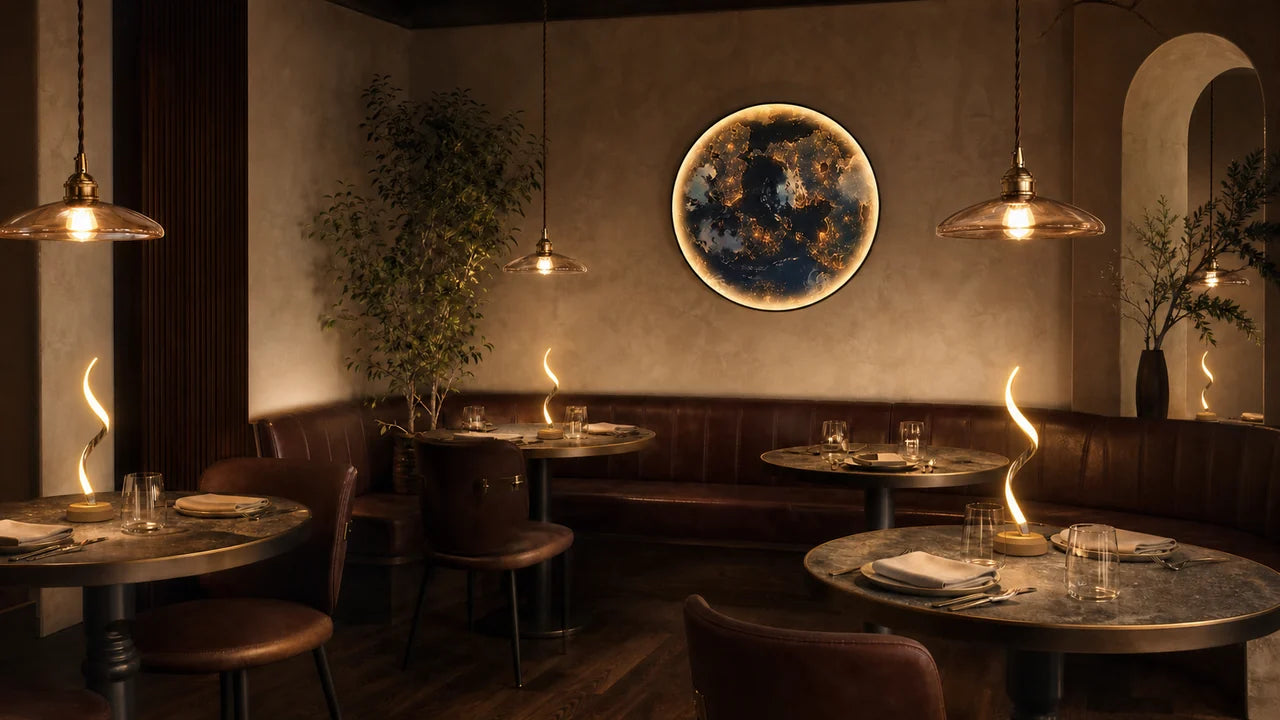
Audit five conditions at the wall
Photograph the wall during service and record these conditions before choosing a material.
Cooking aerosol. Look for existing film on the wall, ledges and nearby fittings. If those surfaces need frequent degreasing, porous or intricately textured art will carry the same maintenance burden.
Cleaning chemicals. Record the actual product, dilution and contact time used by the closing team. A surface described merely as "wipeable" is not necessarily compatible with that routine.
Daylight. Note how many hours the wall receives direct or strong indirect sun. Ask for lightfastness or UV information for the exact print and coating, then plan inspection and replacement where a matched set could fade unevenly.
Contact and failure consequence. Check chairs, coats, trays, queue lines and cleaning equipment. Above a seat or route, consider what happens if the glazing breaks or the whole assembly detaches.
Moisture and temperature change. Dish areas, washrooms, patios and exterior doors can expose art to condensation or repeated damp cycles. Verify that the complete product, including backing and fixings, is intended for the exposure.
The scorecard
Read the table first, then the caveat under it, because the caveat is the honest part.
| Format | Main advantage | Main constraint | Evidence to request | Candidate zone |
|---|---|---|---|---|
| Uncoated stretched canvas | Large image without glazing glare | Porous face is difficult to degrease or scrub | Ink, coating and indoor-care specification | Protected dining or private-room wall |
| Coated canvas | More cleanable face than uncoated canvas | Performance depends entirely on the coating | Approved cleaners, lightfastness and exposure limits | Dining wall with modest touch risk |
| Cut, welded or powder-coated metal | Dimensional and potentially easy to wipe | Finish, edges, corrosion resistance and weight vary widely | Finish system, approved chemicals, installed weight, mounting details | Bar, corridor or protected exterior only if specifically rated |
| Framed print behind glass | Scratch-resistant, clear viewing surface | Weight and sharp-fragment risk if broken | Glazing type, total weight, retention and fixing plan | Protected, low-contact position after risk review |
| Framed print behind acrylic | Lighter glazing with different breakage behaviour | Scratches and may react to unapproved cleaners | Acrylic grade, coating, approved cleaner and retention | Seating wall after full installation review |
| Printed wood panel | Warm, rigid format without glazing | Finish and dimensional stability vary | Sealer, cleaning, moisture and light limits | Dry dining, bar or corridor wall |
| Tapestry or textile | Large visual softness and easy seasonal change | Holds dust and is difficult to clean near grease | Care label, product-specific fire documentation; acoustic report only if performance is claimed | Dry, low-touch wall |
| Vinyl decal | No projecting frame and can be replaced in sections | Adhesion and removal depend on film and wall coating | Surface list, cure requirements, cleaning and removal instructions | Tested smooth wall or glazing |
How to use the table: select a candidate format, then obtain product-specific evidence. A guide comparing dye-sublimated metal prints, for example, does not establish the behaviour of welded steel sculpture. The scorecard diagram below records Resto Glow's editorial screen only; it is not a laboratory result or warranty.

Canvas: strong image scale, limited cleaning options
Canvas offers a large image without a sheet of reflective glazing. That makes it a useful candidate for a protected dining-room wall where low-angle reflections would interfere with framed work.
An uncoated weave is difficult to clean when aerosol or touch deposits build up. Before specifying canvas near a kitchen, request the print maker's coating, approved-cleaner and exposure information. If no cleaning method is documented, plan it as a replaceable decorative item rather than a washable finish.
Three checks narrow the risk. Specify the exact protective coating rather than adding an unknown sealer after purchase. Keep indoor-only canvas out of damp or exterior locations. Avoid queue and shoulder-contact zones unless the supplier provides a repairable, cleanable commercial system.
For the visual mock-up, our African Woman frameless canvas can act as a figurative anchor; the black wildlife canvas print provides a graphic, high-contrast option; and the abstract background painting offers a quieter composition. Verify the delivered construction and care data before assigning a zone.
Metal: durable only when the finish and fixing support it
Metal covers several different products: coated sheet, printed aluminium, raw or patinated steel, welded sculpture and thin tin signs. Their chemical resistance, corrosion behaviour, edges and weight are not interchangeable. The advantage is a rigid, often wipeable surface; the specification work is identifying the exact finish and exposure it can tolerate.
Document the total installed weight, centre of gravity and fixing points, then have the installer select hardware for the verified substrate. Check exposed edges and projections where guests can reach the piece. Finally, view a finish sample under service lighting: a specular face may create distracting glare, while a very dark matte finish can disappear at low light levels.
The full buying decision — geometric versus wrought iron, finishes, sizing, fixing — is its own guide: metal wall art for restaurants. Our geometric metal wall decor is the modern end of that range and the wrought iron silhouette piece is the heritage end.
Framed prints: the glazing decides everything
In a restaurant specification, glazing can govern weight, breakage behaviour, reflections and cleaning even when the print drives the visual choice.
Glass offers scratch resistance and clarity but adds weight and can create sharp fragments if broken. Its suitability depends on glazing type, retention, location and failure consequence. Do not use ordinary picture glass above seating simply because the frame supplier includes it by default.
Acrylic is often considered above seating because it is lighter than comparable glass and has different breakage behaviour. It still needs rated retention and can scratch or react to unapproved chemicals. Specify the grade and cleaning method with the framer.
Open-face and frameless formats remove the glazing decision but introduce different questions about the exposed face, coating, edges and cleaning method.
Include the frame profile in the cleaning review. Deep mouldings, top ledges and joints create more surfaces than a flat panel, and the permitted care method may differ across frame, glazing and print. The full detail—mouldings, mounts, glazing and retention—sits in our framed prints for restaurants guide.
The specialists: wood, textile and vinyl
Wood can provide a warm, rigid surface without glazing. Its suitability turns on the coating, joints and moisture exposure. Request the approved cleaning method and do not assume "sealed" means compatible with the restaurant's degreaser. Our American Retro wooden wall hanging, wooden music-note decor and solid wood frameless artwork are visual candidates; confirm their live finish and care details before using them in a commercial cleaning plan.
Textile adds visible softness and large-area colour, but it holds dust and is difficult to clean near grease. Do not claim an acoustic benefit unless the complete installed assembly has a relevant test report. Our tassel wall tapestry is a visual candidate for a dry, low-touch wall; mounting, care, acoustic evidence and fire review are covered in tapestry wall decor for restaurants.
Vinyl avoids a projecting frame and can be replaced in sections, but adhesion, cleanability and removal depend on the exact film and coating beneath it. Test the intended film on the cured wall and follow the maker's cleaning and removal instructions. Our Morandi dot wall sticker set is one visual option, subject to that preflight.
Tin signs are a lightweight printed-metal format to compare for a bar or casual wall. Confirm the face coating, edge finish, approved cleaner and fixing; the metal substrate alone does not prove chemical or corrosion resistance. See vintage tin signs for restaurants for layout testing—our cocktail tin sign is one visual example.
Zone by zone: what we would hang where
| Zone | Hang this | Avoid this | Why |
|---|---|---|---|
| Dining-room field wall | Canvas, framed print or metal after lighting review | A format without cleaning instructions | Usually lower contact; glare and daylight may still govern |
| Above a booth or banquette | Lightweight frame with assessed glazing, or a low-profile rigid piece | Deep projection or an installation without retention | Failure consequence, reach and route projection govern |
| Bar and back bar | Coated metal, tin or sealed panel with compatible care data | Porous work where spray and citrus contact are likely | Close viewing and frequent cleaning expose finish defects |
| Open-kitchen aerosol path | A smooth product approved for the cleaning routine | Porous textile, uncoated canvas and intricate frames | Existing surface film shows the likely maintenance load |
| Corridor and queue | Low-profile, impact-tolerant product with security fixing | Fragile glazing or exposed sharp edges | Shoulder contact and route width govern |
| Washroom | Product rated for the humidity and approved cleaner | Paper mounts or indoor-only porous materials | Moisture and cleaning cycles govern |
| Covered patio | Product explicitly rated for the actual exterior exposure | Indoor-only canvas, textile or frame assembly | Cover does not eliminate condensation, wind or UV |
| Storefront-facing sunny wall | Lightfast print/coating with a replacement plan | Product with no light-exposure data | Uneven fading can break a matched set |
Two checks cut across every zone. For anything over a seat or route, document the installed weight, substrate, retention and consequence of failure. For anything near food preparation or splash, confirm the material and location with the local health authority; this editorial table is not an approval.
The mixed spec we would actually buy
Do not force one material through the whole building. Build a wall schedule with columns for zone, exposure, contact, cleaning product, artwork size, installed weight, substrate, fixing, fire documentation and replacement route.
A protected dining wall may suit canvas; a high-contact bar wall may suit a coated rigid panel; a seating wall may call for a lightweight retained frame; and a tested smooth wall may suit vinyl. Those are candidates, not automatic answers. Approve one sample of each construction under service lighting and the real cleaning routine before placing a multi-site order. For a full-room rollout, trade projects can work from that zone schedule.
What we reach for
For a protected dining-room field wall, compare a canvas sample with framed and rigid-panel options. Canvas avoids glazing reflections, but its exposed face and coating still need a care plan. See a visual concept in The Amber Dining Room.
For higher-contact zones — corridors, bars and walls nearer cooking — shortlist smooth coated metal or sealed panels only after matching their care and exposure data to the site. The Onyx Chef's Counter is a visual reference, not a performance test.
For rooms that need visual softness, consider tapestry or wood among harder surfaces, subject to care and fire review. Soft & Sculptural collects statement pieces; Warm & Intimate covers evening rooms; After Dark covers bars and night service.
The one piece of tabletop glazing worth naming here, because it comes up constantly: the Nordic wood-and-acrylic display frame is a small tabletop frame rather than a wall format — the right object for a menu card or table number, not a substitute for a wall-hung framed print.
Restaurant wall art material FAQ
Is canvas or metal better for restaurant wall art?
Neither is better in every zone. Canvas offers a low-glare image surface but is difficult to clean when uncoated. Metal can offer a smooth, rigid face, but its finish, corrosion resistance, edges and weight vary. Match the exact product to the wall's aerosol, cleaning, moisture, touch, light and mounting conditions.
Does canvas art absorb kitchen grease and smells?
An uncoated porous face can retain aerosol deposits and may not tolerate scrubbing. A coating may improve cleanability, but only if the print maker documents the approved cleaner and exposure. Inspect the existing wall for film and test a sample before specifying canvas near cooking.
What wall art can you clean with a commercial degreaser?
Only a product whose manufacturer approves that exact chemical, dilution and contact time. "Powder-coated," "sealed" or "wipeable" is not enough information. Record the approved procedure on the cleaning sheet and test a sample before rollout.
Does restaurant wall art fade in a sunny window?
It can. The rate depends on the ink, substrate, coating, glazing and exposure. UV-filtering glazing may slow fading but does not stop it. Ask for product-specific lightfastness information, record the starting condition and plan rotation or replacement for matched sets.
Is glass wall art safe above restaurant seating?
Ordinary picture glass creates weight and sharp-fragment concerns, so do not specify it above seating by default. Ask the framer and installer to assess safety glazing or acrylic, retention, complete weight, substrate and contact risk for the exact position. The frame still needs a rated fixing whichever glazing is chosen.
Pick the material for the wall's exposure and failure consequence, then test the sample under the real day and night scenes. Start with the Amber Dining Room for a protected-wall concept, or read the metal guide for the finish and fixing questions behind dimensional work.
Keep reading

guest-experience
Restaurant Restroom Cleaning Checklist and Inspection Log
Use this restaurant restroom cleaning checklist for opening, service inspections, supplies, fixtures, floors, waste, incidents, and closing records.

dining-room-operations
Restaurant Dining Room Cleaning Checklist: Turn to Close
Use this restaurant dining room cleaning checklist for table turns, high-touch points, spills, service stations, floors, opening, and close.

food-safety
Restaurant Kitchen Cleaning Checklist for Every Shift
Use this restaurant kitchen cleaning checklist to control opening, between-task, four-hour, closing, and weekly work without vague assignments.