
Choosing a Restaurant Lighting Supplier: A Checklist
A neutral buyer's checklist for restaurant lighting suppliers: the five supplier types, eight scoring criteria and ten questions — including the ones to ask us.

Compiled by the Resto Glow Studio team · Last reviewed 5 August 2026
Before anything else, the disclosure: we sell restaurant lighting. You are reading a buyer's guide written by a vendor, which is a reason to read it carefully rather than a reason to stop.
So here is the deal we are proposing. This checklist is written to be used against us. Every criterion below is one any operator should apply to any supplier — a manufacturer, a trade distributor, the rep who takes you to lunch, a marketplace seller, or Resto Glow. If we fail a criterion for the job you are doing, the checklist should tell you that plainly, and further down there is a section that says out loud where a small online specialist is the wrong choice.
A checklist that quietly described only its author would be worthless to you and transparent to everyone else. This one has to survive being pointed back at us.

First: which kind of supplier does this job need?
The most expensive mistake in lighting procurement is not paying too much. It is buying from the wrong kind of supplier — asking a manufacturer for curation, asking a marketplace for a site survey, or routing a four-shade refresh through a design practice.

Manufacturers are the right call for volume of a single fixture, custom sizes, and technical answers straight from the people who built the thing. They are the wrong call for one room with mixed fixtures next month.
Reps and agents are useful precisely because they chase things on your behalf — samples, substitutions, dates. They also carry lines, and the answer to "what should I use?" will come from the lines they carry. That is not dishonesty; it is the job description. Ask which brands they represent before you ask what they recommend.
Trade distributors put lamps, controls, spares and fixtures on one invoice with trade terms. Wide catalogue, thin design help, and nobody in the building has stood in your dining room.
Online specialists — our category — are strongest on decorative and portable pieces, fast samples, refreshes and a coherent curated look. Weakest on engineered scope: anything hung, wired, controlled or requiring a photometric plan.
Designers and design-build firms are the right answer for new builds and full refits, where you want approvals, controls and one accountable party. Overkill for swapping four shades.
Most projects use two or three of these at once, and that is normal. Trouble starts when one supplier is asked to be all of them.
The eight-criterion scorecard
Now score the individual supplier, whatever type they are. Print this, take it to three of them, and compare the sheets rather than the conversations.

1. Documentation on request. Ask for the spec sheet before you ask anything else. What you want is a file you can keep and forward to an electrician — not a description in the body of an email. A supplier who cannot produce documentation for a product they sell is telling you something about how far up their own supply chain they can see.
2. Compliance marks you can verify yourself. Which marks does this product carry, who issued them, and how do you look that up independently? Requirements differ by country, jurisdiction and product type, so the question is not "is it certified" in the abstract — it is "what does my electrical inspector need to see, and can this supplier give me it?" Ask your authority having jurisdiction what applies to your installation, then ask the supplier to meet it in writing.
3. Sample policy, in plain terms. What does one unit cost you, how long do you have, and who pays return freight if the room says no? A supplier who makes sampling easy is a supplier confident in the product.
4. Control and dimming questions answered specifically. "Yes, it dims" is not an answer. The answer names a driver or lamp type and a control, or admits honestly that you should test it. Dimming compatibility is the single most common post-delivery disappointment in decorative lighting.
5. Availability and delivery confirmed in writing. For your quantity, your finish, your address. Not a general statement about typical stock.
6. Spares and continuity. Can you match this fixture in a year when a bulb fitting fails or a shade gets broken by a tray? A decorative item that is discontinued next season means your eventual repair is a whole-room repair.
7. A named contact after the invoice clears. The real test of a supplier happens after payment, when the installer opens the third box and something is wrong. Ask who that person is by name, before you order.
8. What happens when it arrives damaged. Not whether — when. You want a stated procedure and a reporting window, given to you before you need it rather than discovered afterwards.
Nobody scores eight out of eight. What you are looking for is a pattern: a supplier who answers the documentation, control and date questions substantively is usually good at the rest, and a supplier who deflects all three is telling you exactly what the project will be like.
Ten questions, and what a good answer sounds like
The scorecard is what you are judging. These are the sentences that get you there. Judge the shape of the answer, not the enthusiasm behind it.

- "Can I see the full spec sheet?" — a file, not a paragraph.
- "Which marks does it carry, and where do I verify them?" — the mark, the issuing body, and a route for you to check.
- "Will it dim on my existing controls?" — a driver or lamp type and a named control, or an honest "sample it and test".
- "Can I buy one and return it if the room says no?" — a window, a condition, and who pays freight.
- "Is this item continuing, and can I get spares later?" — a lifecycle answer, not "we usually have stock".
- "What is your delivery date for this quantity, in writing?" — a date, a quantity and a person's name on a document.
- "What finish batch is this, and will a reorder match?" — the answer that saves you from a wall of nearly-identical brass.
- "What is this rated for?" — damp locations, enclosed fixtures, outdoor exposure, commercial use. Then confirm the requirement with your own professional, because the product's rating and your jurisdiction's requirement are two separate facts.
- "Who installs it, and what is not included?" — most decorative suppliers, us included, do not install. Know where the scope ends.
- "Who do I call in six months?" — and does that person have a name.
Ask all ten of every supplier. The comparison is more informative than any individual answer.
Red flags — and the things that only look like red flags
Some warning signs are real:
- No documentation, ever. The most reliable signal in the list.
- Certification described vaguely. "Fully certified" without a mark, an issuer or a route to verify is not a claim, it is a mood.
- Dates that only exist verbally. If nobody will put it in an email, it is not a date.
- Deflection on damage and returns. These get harder to ask about after you have paid, which is why you ask before.
- Pressure on quantity before you have sampled anything. A supplier who wants the full order before you have seen one unit in your room is optimising for their week, not your year.
And some things that look alarming and are not:
- "You need an electrician for that." Correct, and the honest answer. Anything hung, wired or controlled is qualified-professional work.
- "I don't know — let me find out." Better than a confident wrong answer, which is the alternative.
- "Test it on your dimmer before you commit." This is what competence sounds like in decorative lighting.
- Being small. A small supplier who answers eight criteria beats a large one who answers three.
Where we fit, and where we do not
The honest version, since we promised it.
Resto Glow is an online specialist retailer. We are a reasonable choice for decorative and portable pieces, for refreshing a room without a construction project, for sampling one item before committing to a set, and for putting together a coherent look rather than a shopping list — that is what the restaurant looks pages exist to do.
We are the wrong supplier for several jobs, and you should not have to work that out after ordering:
- Anything engineered. If your project needs a photometric plan, emergency and egress design, or a controls system specified and commissioned, that is a lighting designer's scope. Start there and let the specifier tell you what to buy.
- Anything requiring a site survey. We have not stood in your room. Where mounting substrate, circuit capacity, ceiling construction or clearances are the deciding factors, you need somebody who has.
- Installation. We supply; we do not install. Wired work belongs to a qualified electrician working to your local requirements.
- Life-safety lighting. Exit, emergency and egress lighting is a regulated matter for professionals and your authority having jurisdiction. Keep it entirely separate from the decorative scope.
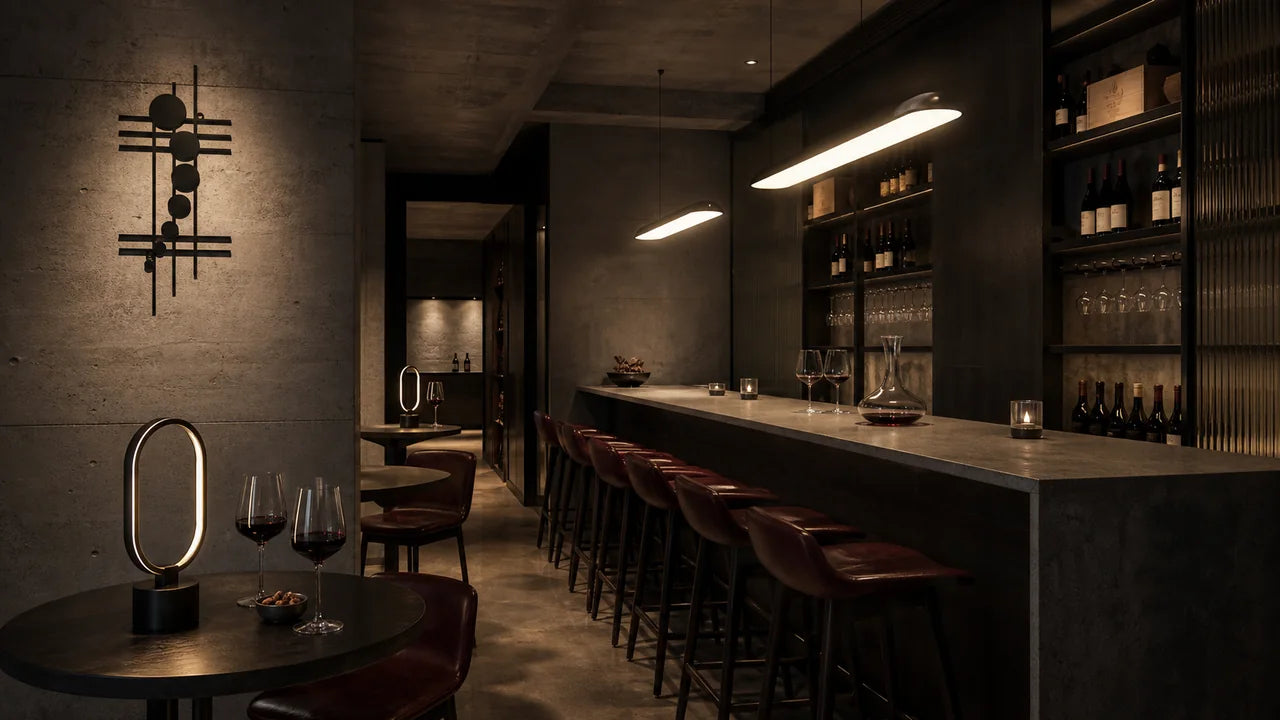
If your project is the second kind, hire the specifier first and buy second. If it is a refresh, a room-by-room improvement, or a fit-out where the decorative pieces are yours to choose, we are happy to be scored on the sheet above. Multi-site or larger scopes can start at trade projects.
Comparing quotes without fooling yourself
Three quotes are only comparable if they are for the same thing, and they usually are not.
Normalise the scope first. One quote includes lamps, one does not. One includes spares, one leaves you to reorder later at whatever the price is then. One is quoting a compatible dimmable driver and one is quoting the version that will not dim on your existing control. Write the scope yourself, in one document, and send the same document to everyone.
Count the whole set, not the fixture. Fixture, lamp, any accessory, spares, shipping, and the cost of the trade time to install it. A cheaper fixture that needs a control change is not cheaper.
Ask what is missing. The most useful question in procurement is "what is not included in this quote that I will need?" Suppliers answer it honestly far more often than you would expect, because it is the question that makes them look competent.
Then weight the answers, not just the totals. A supplier who gave you documentation, a specific control answer, and a written date has already reduced your risk. That is worth something real, even though it does not appear on any line.
Ready to start looking? Restaurant lighting is the umbrella; pendant lights, wall lights, chandeliers and table lamps are the categories most restaurant projects draw from. If you would rather start from a mood than a fixture type: Warm & Intimate, Bright & Social, After Dark and Soft & Sculptural. Installation and care terms are on care & installation.
Restaurant lighting supplier FAQ
How do I find a good restaurant lighting supplier?
Decide which kind of supplier the job needs first — manufacturer, rep, distributor, online specialist or designer — then score two or three of that type on the same eight criteria: documentation, verifiable marks, sample policy, control compatibility, written dates, spares, a named contact and a damage procedure. Compare the sheets rather than the sales conversations.
What should I ask a lighting supplier before ordering?
Ask for the full spec sheet, which marks the product carries and where to verify them, whether it dims on your specific control, the sample and return terms, whether the item is continuing and can be matched later, and a written delivery date for your quantity. Then ask what is not included in the quote.
Should restaurants buy lighting from a manufacturer or a retailer?
It depends on the job. Manufacturers suit volume of one fixture and custom work; retailers and online specialists suit mixed, decorative and portable pieces, fast sampling and refreshes; distributors suit lamps, controls and spares on one invoice. New builds and full refits usually start with a designer who specifies, and the buying follows the specification.
Do I need a lighting designer for my restaurant?
If the project involves photometric planning, controls design, emergency and egress lighting, or approvals, yes — that is professional scope and it should lead the project. If you are replacing decorative fixtures in an existing room with existing circuits, usually not, though installation still belongs to a qualified electrician working to your local requirements.
How do I check a lighting supplier is legitimate?
Ask for documentation and verify the marks with the body that issued them rather than with the seller. Ask your electrical inspector or authority having jurisdiction what your installation actually requires, get delivery commitments in writing with a named person, and place a small sample order before a large one. A supplier who is fine with all four is usually fine.
Next in this series: ordering in the right sequence picks up where this leaves off, at the point where you have chosen someone. Also useful before you buy: is your restaurant too dark? for diagnosing what to fix, measuring your room with a phone honestly, four lighting scenes across the day, and the foot candle chart for the sourced figures.
Keep reading

guest-experience
Restaurant Restroom Cleaning Checklist and Inspection Log
Use this restaurant restroom cleaning checklist for opening, service inspections, supplies, fixtures, floors, waste, incidents, and closing records.

dining-room-operations
Restaurant Dining Room Cleaning Checklist: Turn to Close
Use this restaurant dining room cleaning checklist for table turns, high-touch points, spills, service stations, floors, opening, and close.

food-safety
Restaurant Kitchen Cleaning Checklist for Every Shift
Use this restaurant kitchen cleaning checklist to control opening, between-task, four-hour, closing, and weekly work without vague assignments.