

Compiled by the Resto Glow Studio team · Last reviewed 5 August 2026
There is a free light meter in your pocket, and roughly half the restaurant lighting advice on the internet will tell you to use it. The other half will tell you it is worthless. Both are wrong in an interesting way.
A phone light app is a genuinely useful instrument for one job and a genuinely misleading instrument for another. The job it does well — telling you whether table six is dimmer than table two, whether the scene actually changed when someone pressed the button, whether tonight's room matches last month's room — is the job most operators actually need doing. The job it does badly is producing a number that means anything outside your own phone.
This post is about keeping those two apart. Nothing here will give you a figure to write on a form.
What the sensor was actually built for
The chip your app is reading was not put in the phone for you. It is an ambient light sensor, and its day job is deciding how bright to make the screen so you can read a message on a sunny pavement without being blinded by it in a dark room.
For that job it needs to be roughly right, fast, and cheap. It does not need to be accurate, repeatable between units, or corrected in the two ways a light meter is corrected. It never gets a calibration certificate. Nobody at the factory checks it against a reference lamp before it goes in the box.
Then an app reads it, applies its own conversion, and displays a confident-looking number with a decimal point. The decimal point is the problem. It implies a precision that nothing in the chain supports.
Note the word "uncalibrated" carefully: it does not mean random. An uncalibrated sensor can still be perfectly consistent with itself, which is exactly why the comparison use case works.
Six reasons two phones disagree
Put two handsets flat on the same table and you will often get two different readings. Here is where the disagreement comes from.

Where the sensor is. It sits near the earpiece, at the top of the phone, and it faces whatever the front of the phone faces. Rest the phone on a table and you are measuring light arriving at a point an inch from the edge of the handset — and a hand, a menu or a sleeve can shade it without you noticing.
No cosine correction. A proper meter has a diffusing head that weights light according to the angle it arrives from, so that light coming in at forty-five degrees contributes the way physics says it should. A flat phone sensor behind flat glass does not do this. In a restaurant, where a lot of light arrives from the side — sconces, windows, a neighbouring pendant — that matters more than it would in a lab.
No eye-matching. Meters are corrected so their response follows the sensitivity of human vision across the spectrum. Phone sensors are not. This is why a warm LED, a filament lamp and a candle can read in ways that do not match how the room looks to you.
The case and the glass. A folio flap, a screen protector, a fingerprint, three weeks of service. All of it sits between the room and the sensor.
The operating system in between. Auto-brightness routines, smoothing, and rounding sit between the raw sensor and the value your app is allowed to display. You are reading a processed number, and the processing is not documented for you.
Unit-to-unit spread. Two phones of the same model, running the same app, can disagree before anyone touches a light.
That last point is not folklore. The German lighting institute DIAL ran a comparison of luxmeter apps against a measuring device and found deviations reaching 113 per cent — in one case a handset displaying 1,063 lux where the reference was 500. They also found identical handsets running identical apps producing different results, and they identify the two missing corrections above as the underlying reason. Their published test used the handsets of its day, so treat the specific numbers as illustrative of the scale of error rather than as this year's performance. The structural problem has not gone away, because it was never a software problem.
What the app is genuinely good for
Now the useful half. Every one of those errors is a constant for a given phone in a given position. The sensor is wrong, but it is wrong in the same direction every time — and that is enough to answer a comparison question.

So use it for questions shaped like this:
- Is this table dimmer than that one? Walk the room, one reading per table, same phone, same position on the cloth. The rank order you get is real even though the numbers are not.
- Did the scene actually change? Press the button, read again. Half the "we changed the lighting for dinner" claims in this industry do not survive this test.
- Which zone is the outlier tonight? A lamp fails, a dimmer drifts, a bulb gets replaced with the wrong one. Your log catches it.
- Did this room change between March and August? Same phone, same points, same scene name. If the ratios shifted, something physical changed.
- What does the room do across a service? Take the same points at open, at the daypart change, at peak dinner and at close. That is the shape of your room across a day — see restaurant lighting by daypart for what to do with it.
Do not use it for questions shaped like this: what level is my dining room; does this zone meet the requirement; is my kitchen compliant; is my room brighter than the restaurant down the road. Those all need a real instrument or a real authority, and usually both.
The protocol
If you are going to keep a log, keep it properly. The discipline is what makes it useful, not the app.

1. One phone, one app, one person. The log is comparable to itself and to nothing else. If the phone gets replaced, the log starts again — write the handset and app name on the first page so a future manager knows.
2. Fix the geometry. Case off. Screen up, flat on the surface. The same spot each time — mark it, or photograph it. Nobody standing over it casting a shadow, including you.
3. Fix the room. Name the scene and photograph it. Note the daylight, the blinds, the candles, whether the patio doors are open, and any lamp you know is dead. A reading without its conditions is not data.
4. Read the difference, not the number. Write your findings as comparisons: "table six reads about half of table two", "the bar reads a third of the pass", "after the swap, the corner reads roughly double what it did". These sentences survive a change of phone. A number does not.
5. Escalate when it has to be defended. The moment anyone else will read the result — an inspector, a landlord, a contractor, an insurer — it goes to a calibrated meter, measured at the surface and height the requirement names. The regulated figures and the measurement workflow are in our restaurant lighting foot candle chart, and the requirement itself belongs to your local health authority.
Should you just buy a meter?
Often, yes — and this is the part where most articles get vague, so let us be direct about the decision rather than the price.
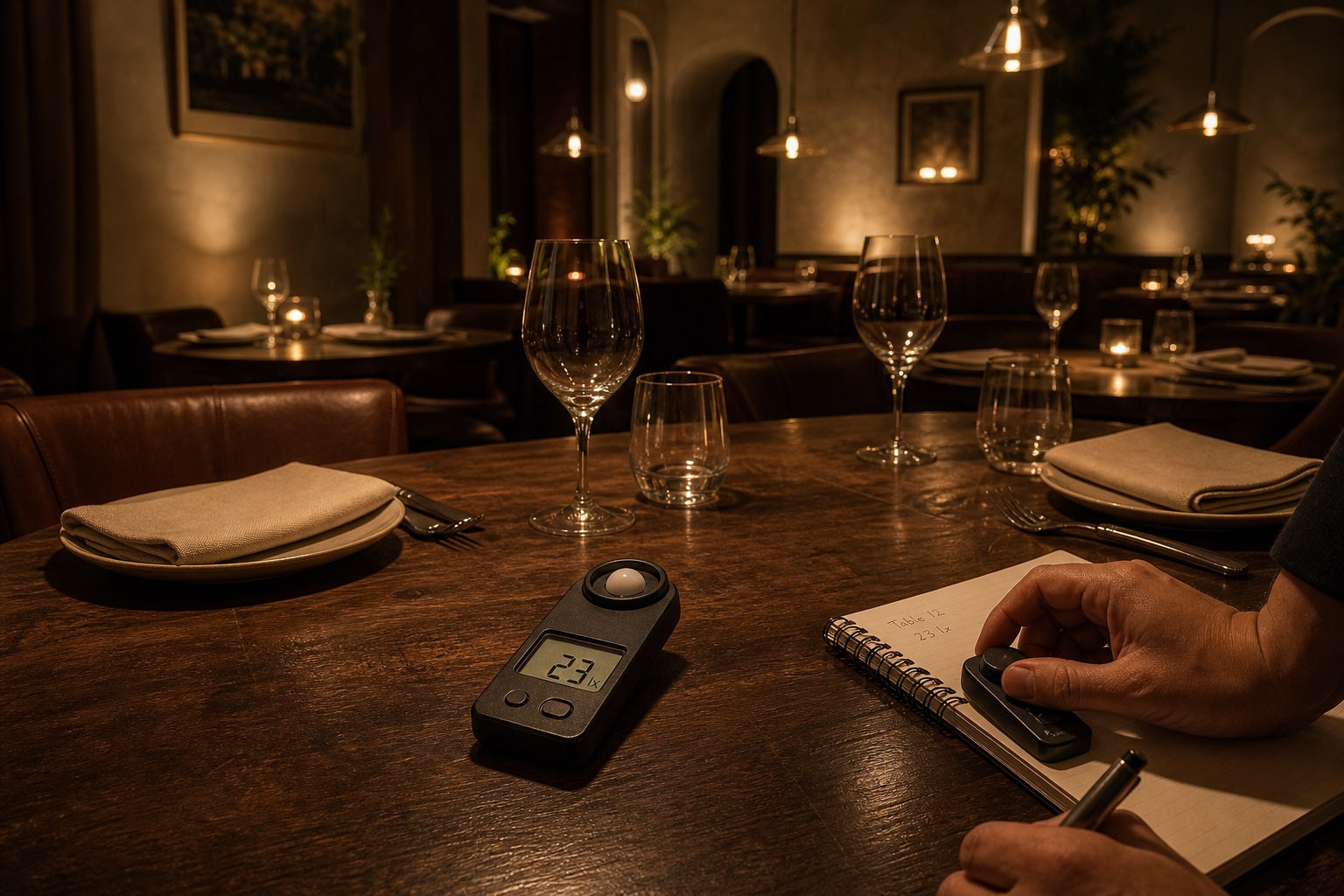
A handheld illuminance meter is worth owning if any of these are true: you are preparing for an inspection, you are signing off a new fit-out, you are in a dispute with a landlord or a contractor about what the space delivers, you operate multiple sites and want readings that mean the same thing across all of them, or you are working with a designer who will hand over a lighting plan you need to verify.
It is not worth owning if what you actually want to know is whether the corner tables are worse than the middle ones. The phone answers that, tonight, for free.
Whichever you use, the discipline is identical: name the surface, name the height, name the scene, and record the conditions. An accurate instrument used carelessly produces confident nonsense faster than a rough instrument used carefully.
If the answer turns out to be that a zone really is too low, the fix is a design question rather than a metrology one. Start with our zone-by-zone room check, then the layering method.
What to do with what you find
A log is only worth keeping if it changes something.
If one table is consistently the dimmest in the room, that is a table-layer problem: a lowered pendant or a lamp at the cover, not a brighter ceiling. Pendant lights and table lamps both solve it, and rechargeable lamps in particular let you test the fix on one table before committing — our rechargeable restaurant table lamps guide covers runtime, charging rotation and the fleet discipline that decides whether they survive a year.
If the whole perimeter reads low while the tables read fine, the room will feel gloomier than it measures. That is wall lights territory.
If everything reads low but the room feels right, leave it alone. A comfortable room that nobody complains about is not a problem waiting to be solved, and your phone is not a good enough reason to change it.
Browse the full range under restaurant lighting, or by mood: Warm & Intimate for low evening rooms, Bright & Social for daytime ones. For a finished low-light reference room, see The Midnight Bar.
Phone light meter FAQ
Are phone light meter apps accurate?
Not in absolute terms. The sensor is uncalibrated, is not cosine-corrected, and is not matched to the eye's spectral response, so the displayed lux value can be substantially wrong — DIAL's published comparison found deviations reaching 113 per cent. They are, however, reasonably consistent with themselves, which makes them useful for comparing one point to another on the same phone.
Can I use a phone app to check restaurant lighting compliance?
No. Any figure that an inspector, landlord, insurer or contractor will read needs a calibrated meter, measured at the surface and height the requirement names. Confirm the requirement itself with your local health department, since jurisdictions adopt and amend codes on their own schedule. Use the phone to find problems, not to prove you do not have one.
How do I measure light levels in my restaurant without a meter?
Use one phone, one app and one person; place it flat and face-up on the same marked spot each time; name and photograph the lighting scene; then record findings as ratios and rank order rather than values. That log will reliably tell you which zones changed and which are outliers, which is what most lighting decisions actually need.
Why do two phones give different light readings?
Because the sensors are components with manufacturing tolerance, sit in different positions behind different glass, and are filtered by different operating-system routines before the app sees them. DIAL's test found identical handsets running identical apps disagreeing with each other. Pick one phone for your log and stay with it.
Is lux or foot-candles better for restaurant lighting?
They measure the same thing in different units — light arriving on a surface, per square metre or per square foot. Use whichever unit your local requirement is written in, and convert only when you have to. Our foot candle chart explains the relationship and lists the sourced figures.
Next in this series: is your restaurant too dark? for the walkthrough behind the readings, four lighting scenes across the day, choosing a lighting supplier, and ordering in the right sequence. Source for the accuracy findings: DIAL, luxmeter app vs. measuring device.
Keep reading

guest-experience
Restaurant Restroom Cleaning Checklist and Inspection Log
Use this restaurant restroom cleaning checklist for opening, service inspections, supplies, fixtures, floors, waste, incidents, and closing records.

dining-room-operations
Restaurant Dining Room Cleaning Checklist: Turn to Close
Use this restaurant dining room cleaning checklist for table turns, high-touch points, spills, service stations, floors, opening, and close.

food-safety
Restaurant Kitchen Cleaning Checklist for Every Shift
Use this restaurant kitchen cleaning checklist to control opening, between-task, four-hour, closing, and weekly work without vague assignments.