

Compiled by the Resto Glow Studio team · Last reviewed 5 August 2026
A restaurant is not one room. It is the same four walls hosting four different businesses in a day, and the lighting that makes one of them work will actively damage another.
Most operators know this. Most rooms are still run on two settings: "on" and "the one the evening manager likes". The gap between those two states is where the trouble lives — the flat grey hour when the sun has gone and nobody has touched the panel, the closing team cleaning in dinner light because that is what was left running, the brunch room fighting its own windows.
This post is about the four scenes a room actually needs, what each one is for, and how to write them down so they outlive the person who set them.
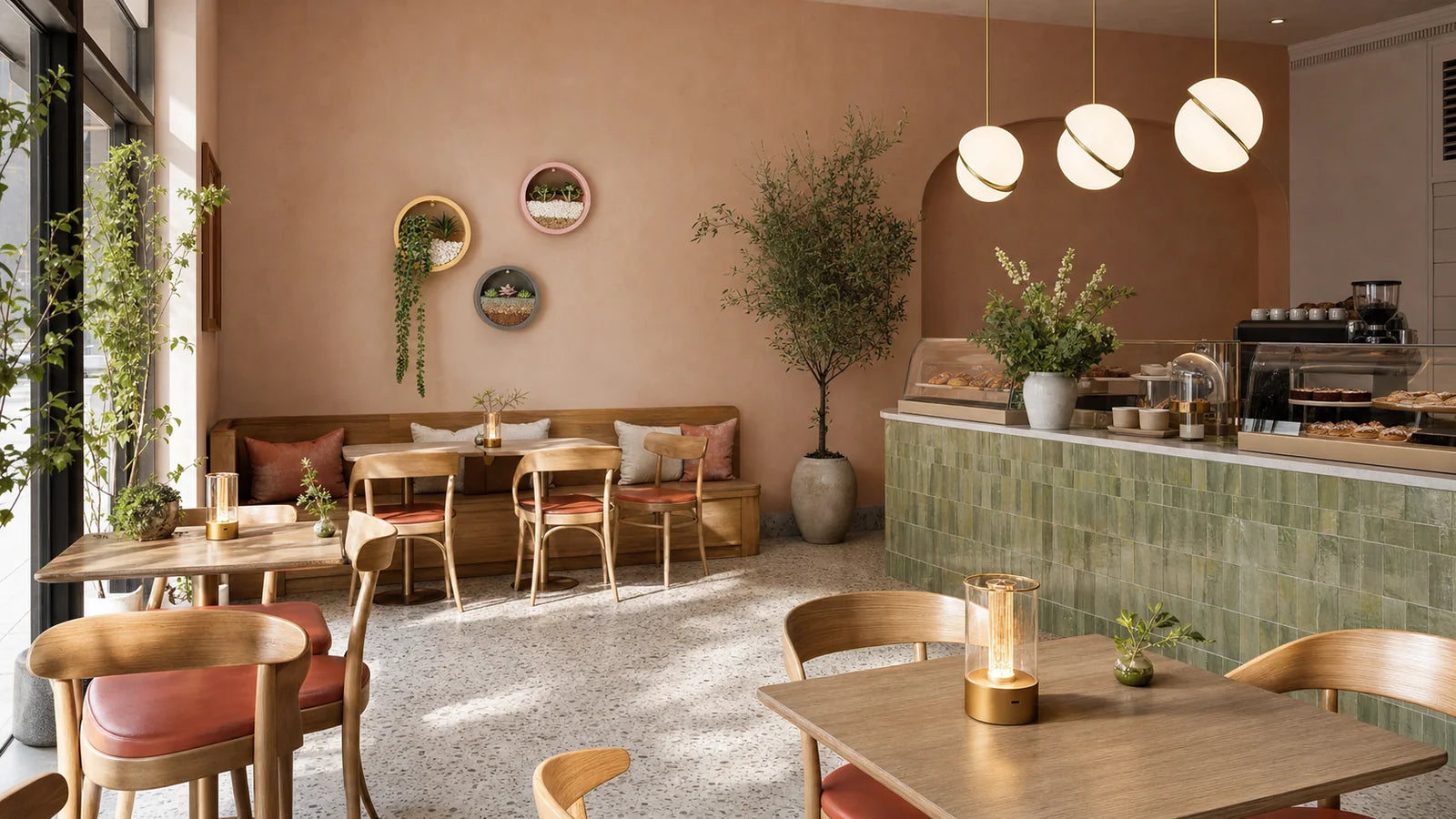
Four scenes, and the one rooms miss
The four are not equal in difficulty. Three of them are obvious enough that most rooms get them roughly right by instinct. The fourth is the one that gets improvised nightly by whoever happens to be nearest the panel.

This is a Resto Glow editorial model, not an industry standard. If your room trades a late-night daypart, a private-event daypart or a mid-afternoon coffee daypart, add scenes and rename them. The principle is the same: every distinct thing your room does deserves a state somebody can select on purpose.
Brunch: daylight is your main fixture
In a daytime room, your largest and least controllable light source is the window. Everything you own is supporting it.
That reframes the job. You are not lighting the room; you are filling in what the window cannot reach — the wall it faces away from, the banquette in the return, the corner table nobody wants at eleven but everybody takes at one. Judge a daytime scene by walking to the worst-lit seat, not by standing in the middle.
Two failures dominate this daypart.
Fighting the window. Cranking every fixture to full to compete with daylight, which cannot be won and looks like a supermarket while you lose. The room gets brighter and less appealing at the same time.
Ignoring the window's schedule. A room facing east is a different room at nine and at two. If your brunch service spans that swing, one saved state cannot cover it, and either your team learns to adjust or half the service happens in the wrong room. Blinds are part of the lighting scene; write them onto the card.
Colour matters more here than most people expect, because daylight sets the reference and any electric light that disagrees with it reads as wrong rather than warm. The Kelvin side of that decision is in our restaurant lighting colour temperature guide — read it before buying lamps for a daylit room.
The transition: the scene nobody saves
Here is the hour that decides how the evening feels, and almost nobody has a state for it.
The sun goes, but it does not go on a schedule that suits you, and it does not go at the same time in March and in August. Meanwhile the room is full of early covers, the bar is busy, and a shift change is happening. Nobody wants to be the person adjusting the lights while people are eating.
So the transition gets handled two ways, both bad. Either nothing happens and the room slides into a flat grey hour where the windows have gone dark, the electric light has not taken over, and everything reads slightly dead. Or somebody grabs the master dimmer and pulls the whole room down at once — which dims the tables along with everything else and produces a room that is darker without being warmer.

The fix is that the layers move at different rates and in different directions.
The perimeter goes up first. Walls, art, shelves, back bar. Lighting the perimeter is what makes a room feel warmer and more enclosed as it gets darker outside. It is the layer that does the emotional work of the transition, and it is the layer most rooms leave static all day.
The table layer comes up next. Pendants dropping into their evening setting, lamps switched on, candles lit. The table has to start leading before the ambient falls away, or there is a stretch where nothing in the room is the brightest thing.
Ambient comes down last, and slowly. This is the layer everyone reaches for first, and it should be the last thing you move.
Accent finishes the picture. Sparkle rather than output.
Do it in that order and guests never notice a transition happened — which is the entire objective. Do it with one master dimmer and they notice every time.
One practical note: run the change between covers, not mid-course. A room that dims while somebody is halfway through a plate reads as a fault, not as an atmosphere. Two or three small moves spread across the hour beat one dramatic one.
Dinner: the table leads, the room follows
The evening scene is the one everybody has an opinion about, and the one where the common error is the simplest to describe: dimming everything equally.
A low room is not a room with all its lights turned down. It is a room where the relationship between layers has inverted — the table is now the brightest thing in the guest's field of view, and everything else recedes around it. That is what reads as intimate. Uniformly dimming a room just makes a dim version of a bright room, which reads as gloomy, and the giveaway is the phone torch coming out at the table.
The zone-by-zone walkthrough behind that judgement is in our room check, and the mechanics of getting the layers to behave are in how to layer restaurant lighting. The short version for this daypart:
- Table layer up relative to everything else.
- Perimeter holding the room together — this is what stops low from becoming gloomy.
- Ambient low, and doing less work than it did at noon.
- Bar and back bar on their own logic entirely, because pouring and reading labels is a task, not a mood. Our bar lighting design guide treats it separately for exactly that reason.
Two more things belong to this scene. The service route still needs to work at a server's pace with full hands — dinner is when adaptation gaps at doorways start causing near-misses. And the restrooms and back of house do not participate. Whatever your dining room does at nine, the task and regulated zones stay where they belong; those levels are a matter for your local health authority and are collected, with sources, in our foot candle chart.

Close: the room becomes a workplace
At some point the last cover leaves and the room stops being a dining room. It becomes a workplace with mops, chemicals, cash and tired people in it.
Almost every restaurant cleans in service lighting out of habit, and it produces two entirely predictable results: things get missed because nobody can see them, and the closing team works in a room designed to hide detail. A close scene is the cheapest quality improvement in this article — it is a control state, not a purchase.
Two cautions. First, the level appropriate for cleaning is not a matter of taste in every zone; food premises codes commonly address lighting during cleaning, and the applicable figures belong to your local health department and are listed with sources in post 001. Second, the close scene is the one most likely to get left on overnight, so it belongs in the close-down checklist next to the doors and the gas.
Write the scenes down
A scene that only exists in a manager's fingers is not a scene. It walks out of the door with them.

Each card carries the same fields: what the scene is called, when it runs, who is allowed to change it, how each layer is set in the panel's own labels, what the windows and blinds are doing, a photograph of the room in that state, and the date it was last checked.
The photograph is the field people skip and the one that earns its keep. It is what tells you, three months later, that a lamp died or somebody nudged a setting — because the room in the photo and the room in front of you are visibly different. Photograph the room from a fixed seat, not the keypad.
Three rules make the cards work in practice. Scene changes happen between covers. One person per shift owns the panel, named on the rota. And the cards get re-checked after any lamp change, fixture swap or control reset — which is also the moment to re-walk the room.
If your controls do not support saved scenes, you can still run this system with a written sequence and a rota. Adding or changing controls is qualified-professional work involving load, compatibility and sometimes approvals — scope it properly rather than treating it as an accessory purchase.
Equipping the scenes
Most rooms find that the two layers they cannot currently move independently are the perimeter and the table. That is where fixtures earn their place.
Wall lights are the perimeter layer, and the one that carries the transition. If you buy one thing for the daypart problem, buy this.
Table lamps give you a table layer you can switch on at a specific hour without touching the ceiling — which is precisely the move the transition needs. Rechargeable models make the change a staff action rather than an electrical project; runtime, charging rotation and fleet discipline are covered in our rechargeable restaurant table lamps guide.
Pendant lights put the evening's leading light directly over the cover, and chandeliers set an ambient floor in tall rooms.
By mood: Bright & Social for the daytime end of the day, Warm & Intimate for the evening end, After Dark for the bar and the last hour. Everything is under restaurant lighting. To see both ends as finished rooms, compare The Pistachio Breakfast Bar with The Midnight Bar.
Restaurant lighting by daypart FAQ
How many lighting scenes does a restaurant need?
At minimum, one for each distinct thing the room does. Four covers most independent restaurants: a daytime scene, a transition scene, an evening scene and a close-down scene. Add scenes for a late-night daypart, private events or a mid-afternoon lull if you trade them. The count matters less than whether each one is written down and owned.
When should a restaurant dim the lights for dinner?
Tie the change to the room and the service, not the clock — the sun sets on a different schedule every week. Start when daylight stops carrying the room, run it in two or three small moves between covers rather than one large one, and bring the perimeter and table layers up before you take the ambient down.
Why does my restaurant look flat in the early evening?
Because the windows have gone dark and the electric layers have not taken over yet. Pulling one master dimmer down makes it worse: the room dims but the tables dim with it, so nothing leads. Raise the perimeter and the table layer first, then let the ambient fall.
Should restaurants clean in full lighting?
Cleaning teams need to see what they are cleaning, so a close-down scene is different from a service scene. In some zones the level during cleaning is addressed by food premises codes rather than left to preference — confirm what applies with your local health department, and see our foot candle chart for the sourced figures.
Who should be allowed to change the lighting during service?
One named person per shift, working from a written scene card. Rooms where three people can reach the panel drift within a month, and nobody can say when or why. The card plus a fixed-position photograph is what makes drift visible.
Next in this series: is your restaurant too dark? for the zone walkthrough, measuring with a phone honestly for logging what your scenes actually do, choosing a lighting supplier, and ordering in the right sequence.
Keep reading

guest-experience
Restaurant Restroom Cleaning Checklist and Inspection Log
Use this restaurant restroom cleaning checklist for opening, service inspections, supplies, fixtures, floors, waste, incidents, and closing records.

dining-room-operations
Restaurant Dining Room Cleaning Checklist: Turn to Close
Use this restaurant dining room cleaning checklist for table turns, high-touch points, spills, service stations, floors, opening, and close.

food-safety
Restaurant Kitchen Cleaning Checklist for Every Shift
Use this restaurant kitchen cleaning checklist to control opening, between-task, four-hour, closing, and weekly work without vague assignments.