

Compiled by the Resto Glow Studio team · Last reviewed 5 August 2026
Nobody asks about restaurant lighting levels in the abstract. They ask because a guest held a menu up to a candle, or a server clipped a table leg carrying three plates, or an inspector stood in the walk-in with a clipboard and a slightly disappointed expression.
Those are three different problems, and only one of them is answered by a number. This post is about the other two: how to walk your own room and tell, honestly, whether each zone is doing its job. It is a judgement guide, not a chart.
The chart already exists. Our restaurant lighting foot candle chart collects the regulated and published figures with every source named and every blank cell left blank on purpose. When this post needs a number, it sends you there — and when a number belongs to a code, it sends you to your local health department, because they are the ones who enforce the edition your jurisdiction actually adopted.
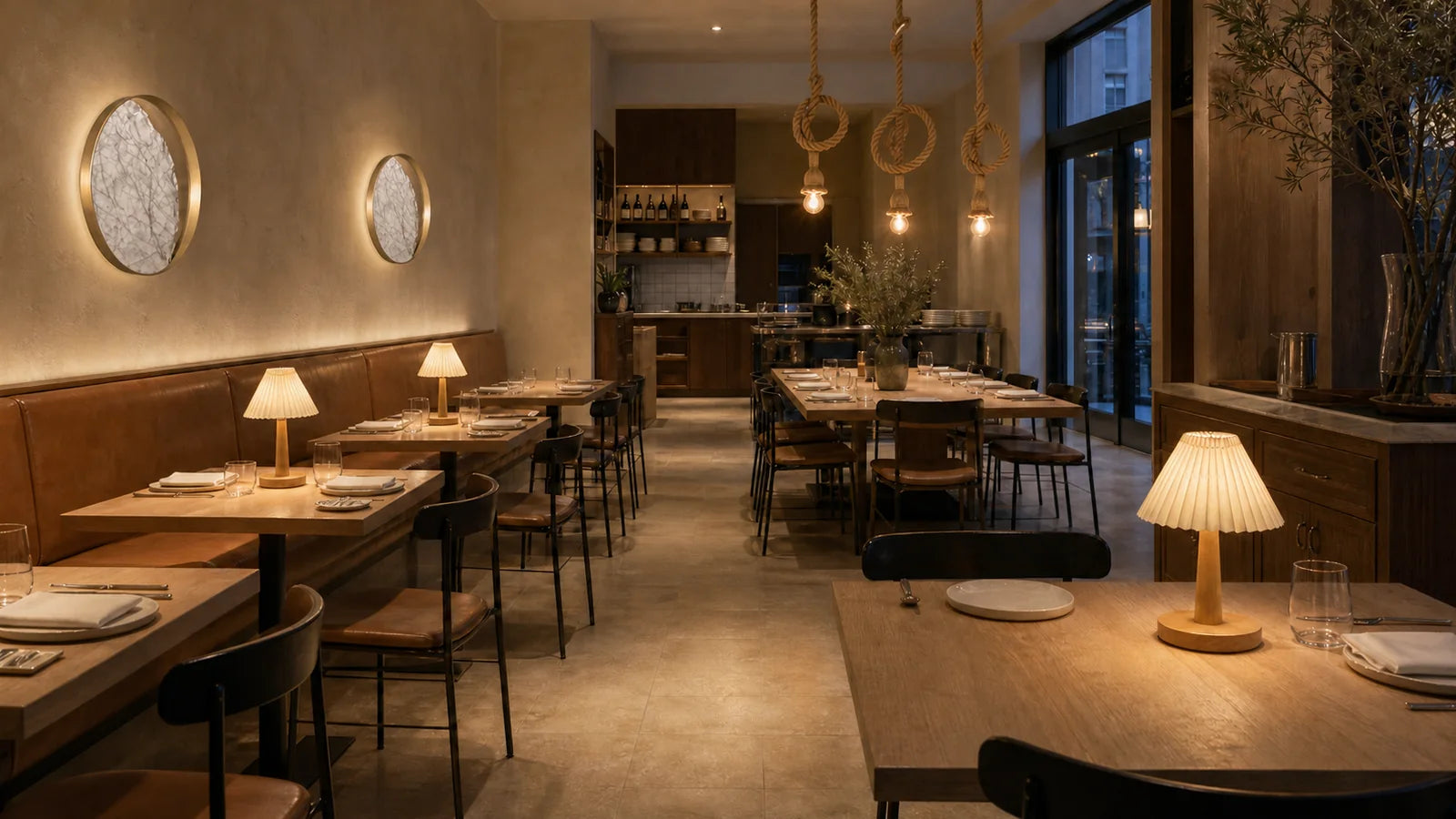
Two questions hide inside "lighting levels"
When an operator says the room feels too dark, they are usually blending two questions that have nothing to do with each other.
"Is this room right for what we're doing tonight?" is a design question. It has no correct answer. A supper club at last seating and a bakery counter at eight in the morning are both correct at wildly different levels, and both would be wrong if you swapped them.
"Is this zone compliant?" is a regulatory question. It has a correct answer, it is written down, and it is not written down by us. Lighting requirements for food premises are typically enforced through your local health authority, and the figures come from whichever edition of the code your jurisdiction has adopted and amended. Egress and exit lighting is a separate matter again — and worth noting that OSHA's exit-route provision sets no figure at all for the route itself, only the requirement that it be adequately lighted for someone with normal vision. Somebody with authority looks at it and decides.
So before you touch a dimmer: separate your zones into the ones where taste decides and the ones where an authority decides. Then never let taste anywhere near the second group. Dimming a restroom to match the dining room's mood is the single most common version of that mistake, and it is entirely self-inflicted.
Rank the zones before you chase a number
Here is the useful thing about a room: it will tell you it is wrong long before a meter will. Not by absolute level, but by order. Almost every dining room that "feels off" has one or two zones sitting in the wrong position relative to the others.
Rank order is also the one judgement you can make tonight, with no equipment, in a room you already know.

Read that map as a sequence, not a scale. The dining core sits lowest because dwell is the product. Prep sits highest because hands and blades are the product. Everything else falls in between, and the ones that trip people up are always the same three:
- The restrooms. They belong near the top of the order with the work zones, not near the bottom with the dining room. This is the zone where designers most often apply a dining-room instinct to a task room.
- The threshold. Entry, patio steps, the change in level nobody mentions until someone finds it. Outdoors especially, the question is not how much light the area has but whether the change is lit.
- The service station and the pass. These are reading, counting and plating surfaces sitting inside a room designed to be dim. They need their own light, close to the work, not a brighter ceiling.
If your order is wrong, fix the order first. It is nearly always cheaper than the alternative, because putting light where the task is costs less than lifting an entire room and then dimming it back down again.
The twenty-minute room check
Do this before service, with the room in its actual service state — not with the house lights up while the team sets tables. A room in cleaning light tells you nothing about a room at seven o'clock.

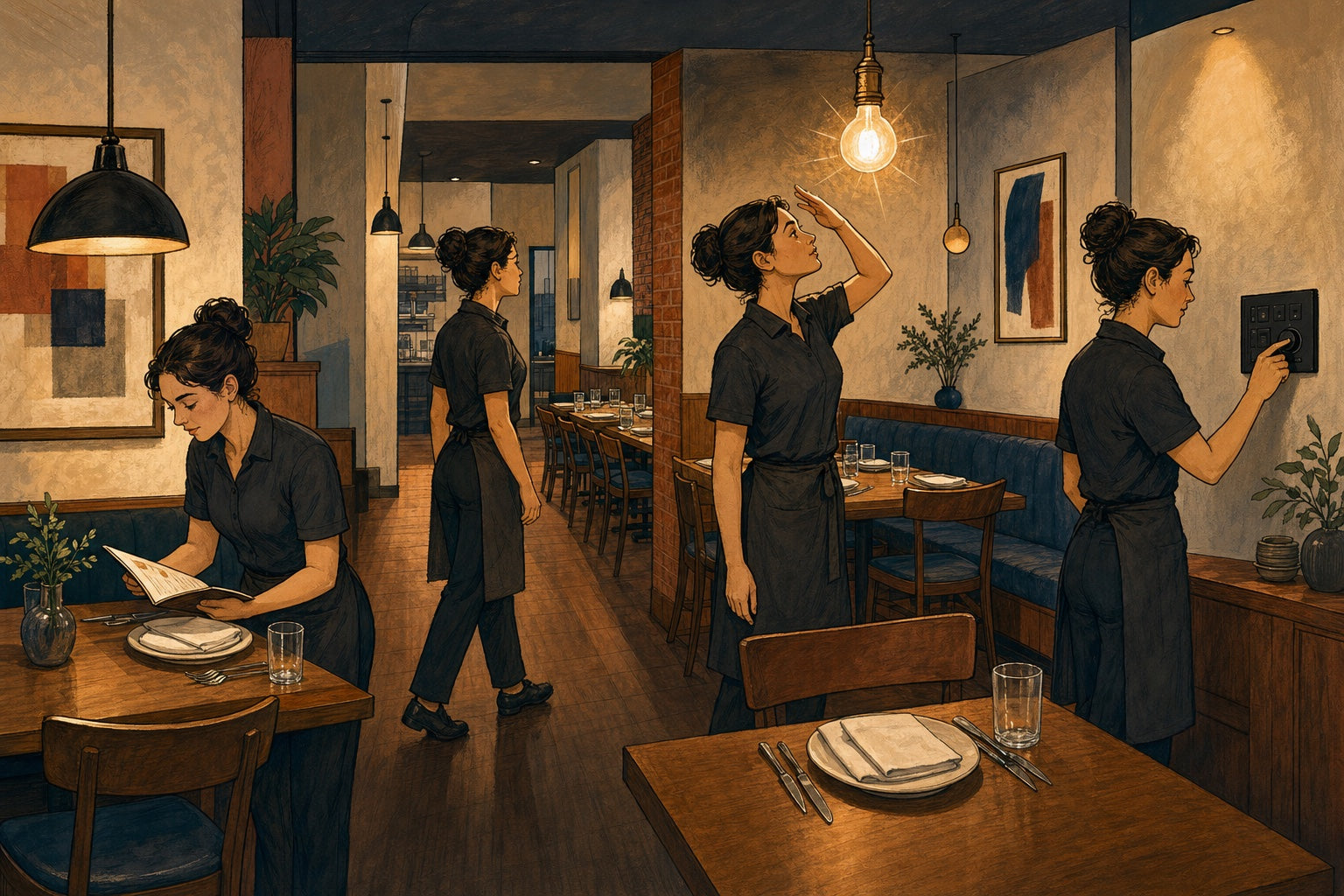
1. Stand in the doorway. Come in from outside, at the time of day you actually open. Eyes adapt slowly, and a room that reads beautifully from inside can read as a black hole from the pavement. If guests hesitate at the threshold, that hesitation is your reading.
2. Stand at the host stand. Somebody works here — reading a book, writing a name, checking a screen at an angle. If they are tilting paper to catch light from somewhere else, the stand has no light of its own.
3. Sit at your worst table. Not your favourite one. The one in the corner, under nothing, next to the dark wall. Read the menu. Look at the person opposite you. Look at a plate of your own food. Three checks, thirty seconds, and the answer is rarely ambiguous.
4. Walk the service route. From pass to table to station to bin, carrying something, at a server's pace. Every step, threshold and level change on that route is a place where a person's eyes have to re-adapt while their hands are full.
5. Walk to the restrooms as a guest. Corridor, door, mirror, hands, floor. Then ask whether you dimmed this room to match the dining room. If the honest answer is yes, that is a decision to revisit with your local health authority's requirements in front of you, not a mood choice.
6. Look at the close-down state. Turn the room into what it becomes at midnight, when it stops being a dining room and becomes a workplace with mops in it. Most rooms clean in service lighting out of pure habit.
Take one photograph at each stop, from the same position, every time. Photos are how you prove that a lamp died, a dimmer drifted, or that the room genuinely has changed since the fit-out — and they cost nothing.
What "too dark" really means at a table
A table can fail in three separate ways, and they need different fixes.
The level is genuinely low. There is not enough light arriving on the tabletop for the tasks happening on it. This is the one people assume, and it is real, but it is not the most common.
The light is there and the surfaces eat it. Dark timber, dark linen, matte black plateware. Light that arrives is absorbed rather than bounced back up toward faces, so the same fixture at the same setting produces a completely different experience depending on what you laid on the table. Post 001 goes into the measured differences between light and dark table surfaces, and they are far larger than most operators expect — worth reading before you buy a fixture to solve a problem your tablecloth created.
The colour is wrong, not the level. Food looks grey, greens go dull, the room reads cold or sallow. Adding output makes this worse, not better, because it is a colour appearance and rendering problem wearing a level problem's clothes. That is a whole subject of its own, and it lives in our restaurant lighting colour temperature guide.
There is a fourth factor nobody controls: your guests' eyes. Older eyes need more light to do the same task, and a room at the same setting is a materially different room for a table of twenty-five-year-olds and a table of seventy-year-olds. If your guest mix skews older, or your lunch and dinner crowds differ sharply, that is a scheduling problem — see restaurant lighting by daypart for how to run the same room at more than one setting.
Symptom, cause, first move
Rooms complain in patterns. Here are the five you will actually see, and the cheapest honest test for each.

Phone torches at the table. The single clearest signal in the business. It almost never means the room is too dark overall; it means the light is on the room rather than on the surface guests are using. Lower or add a table layer before you touch the ceiling.
The room reads gloomy but the tables read fine. Dark walls and a dark ceiling are returning nothing. Perceived brightness comes substantially from surfaces you are not eating off, and lighting the perimeter lifts the feeling of the room without lifting the tables out of intimacy. Wall lights are the most under-used fix in a dim restaurant.
Staff squint at the pass or lean in to read tickets. An ambient wash where a task light belongs. Light at the bench, close to the work.
Servers slow down at a doorway. An adaptation gap — two zones with nothing graduated between them. A lit wall, an intermediate service station, or a small lamp in the transition does more than raising either zone. Tight rooms have this problem worst, and our small restaurant lighting zones guide is written for exactly that footprint.
Food photographs badly. Colour, not level. Check appearance and rendering before adding a single lumen.
When looking stops and measuring starts
Judgement is enough for design. It is not enough for anything you have to defend.
Measure when someone else will read the answer: an inspection, a landlord dispute, a designer handover, a new install being signed off. Measure at the surface and height the requirement names — not at the ceiling, not at eye level — and record the dimmer scene, the failed lamps, and the time of day alongside every reading. A number without its conditions is not evidence, it is a rumour with a decimal point.
The chart, the units, and the measurement workflow are all in post 001. If your instinct is to reach for a phone app, read how to measure restaurant lighting with a phone first — it is genuinely useful for comparing one table to another and genuinely useless for producing a figure anyone should trust.
Fixing a zone that reads wrong
Once you know which zone is out of order, the fix is nearly always local.
Task first. A pendant lowered over the table, an under-shelf strip at a bench, a small lamp on a stand. Light near the surface lifts the surface without lifting the room.
Perimeter second. Lit walls change how bright a room feels more efficiently than lit tables do.
Ambient third. The floor level of the room, and the layer to move last, not first.
Accent last. Sparkle, not output. Decorative bulbs are seen rather than seen-by.
That order is the whole method, and it is covered properly in our guide to layering restaurant lighting. Everything above it is diagnosis; that post is treatment.
When it is time to buy, buy against the zone you diagnosed. Pendant lights raise the table without raising the room. Wall lights are the perimeter fix and the transition fix at once. Table lamps put a small pool directly at the cover, which is often the honest answer to menu legibility in a low room. Chandeliers set an ambient floor in tall spaces where a low pendant over every table would be visual chaos. For a dim, warm evening room start in Warm & Intimate; for a bright daytime room, Bright & Social; everything sits under restaurant lighting, and shop by space is organised the way you just walked the room. Fitting out several sites at once? Trade projects.
If it helps to see the two ends of the range in finished rooms: The Pistachio Breakfast Bar is a bright daytime counter, The Moonstone Supper Club is a low evening room, and both are correct.
Restaurant lighting levels FAQ
How dark is too dark for a restaurant?
There is no single threshold, because the answer depends on the tasks happening at the table and on your guests' eyes. The practical test is behavioural: if guests reach for phone torches, tilt menus toward candles, or ask what a dish is because they cannot see it, the room has answered. Back-of-house and restroom levels are a separate, regulated question for your local health authority.
What lighting level should a restaurant dining room be?
Design judgement sets the dining room, not a code. Fine dining sits low because dwell is the product; a café counter sits high because legibility and turnover are. For the published figures that do exist — including the recommendation at the table itself — see our foot candle chart, where each number carries its source.
How do I know if my restaurant lighting is compliant?
Ask your local health department which code edition and amendments your jurisdiction has adopted, and confirm the required level, the surface and the measuring height for each zone they enforce. Egress and exit lighting is usually a separate authority again. Anything you read online, including our chart, is a starting point for that conversation, not a substitute for it.
Should restaurant restrooms be as dark as the dining room?
No. Restrooms are task rooms — hands, mirror, floor, and cleaning — and they sit near the top of the brightness order with your work zones, not at the bottom with your tables. Dimming them to match the dining room's mood is the most common self-inflicted lighting fault in dim-forward restaurants, and it is also one an inspector will notice.
Do I need a light meter to fix my restaurant lighting?
Not to fix it — to prove it. Rank order, a walkthrough and a set of photographs will find almost every design fault in a dining room. Buy or borrow a meter when a figure has to survive someone else reading it: an inspection, a dispute, a handover, a new install. Then measure at the named surface and record the conditions.
Next in this series: measuring your room with a phone, honestly, running four lighting scenes across the day, how to choose a lighting supplier and ordering lighting in the right sequence. For the numbers themselves, the foot candle chart remains the reference.
Keep reading

guest-experience
Restaurant Restroom Cleaning Checklist and Inspection Log
Use this restaurant restroom cleaning checklist for opening, service inspections, supplies, fixtures, floors, waste, incidents, and closing records.

dining-room-operations
Restaurant Dining Room Cleaning Checklist: Turn to Close
Use this restaurant dining room cleaning checklist for table turns, high-touch points, spills, service stations, floors, opening, and close.

food-safety
Restaurant Kitchen Cleaning Checklist for Every Shift
Use this restaurant kitchen cleaning checklist to control opening, between-task, four-hour, closing, and weekly work without vague assignments.