

Compiled by the Resto Glow Studio team · Last reviewed 5 August 2026
Every operator wants the same sentence: lighting takes X weeks, so order by Y. We are not going to give you that sentence, and you should be suspicious of anyone who does.
Lead time is not a property of lighting. It is a property of a specific item, in a specific finish, in your quantity, from a specific supplier, going to your address, in the season you happen to be ordering — and it moves. The only lead time that matters to your project is the one your supplier will confirm in writing, this week, for this order.
What we can give you is better than a number: a sequence. Projects rarely go wrong because a product was slow. They go wrong because things happened in the wrong order — a room-wide order placed before anyone tested one unit, a fixture chosen before anyone knew which surface was actually underlit, an installation booked before delivery was confirmed. Get the order of operations right and a slow product is an inconvenience. Get it wrong and a fast product still misses your opening.

The sequence
Seven stages, each with a gate. A gate is simply the evidence that lets you move on — and skipping one is how projects acquire their expensive surprises.

Notice what stage one is not. It is not "browse". It is not "get quotes". You cannot ask a supplier a useful question until you can say which surface in your room is wrong and in which scene — and that is a diagnosis, not a purchase. Our zone-by-zone room check is the tool for it, and the sourced figures live in the foot candle chart.
Stages one and two: name the surface, then shortlist on paper
Write the problem in a sentence a stranger could act on. "The four banquette tables read as the dimmest in the room during the evening scene, and guests use phone torches there." That sentence tells a supplier what to propose. "We need nicer lights" does not.
Then shortlist on documents, not photographs. Ask each candidate supplier for the spec sheet and put three of them side by side. You are checking size and projection against the space, mounting method against your ceiling or wall, lamp or driver type against your existing controls, and finish against what is already in the room. Choosing on a styled photograph and discovering the geometry afterwards is the most common way a decorative order fails in a real room.
If you have not chosen a supplier yet, our buyer's checklist for lighting suppliers covers the eight criteria and the ten questions — including the ones to ask us.
Stage three and four: the sample is the whole game
One unit. In your room. In your scenes. Before you commit to anything.
This is the stage operators skip when the calendar is tight, and it is the one that saves the calendar. A sample failure discovered in your dining room costs you one unit and a week of thinking. The same failure discovered after a full delivery costs you the order, the install slot, and the argument about who pays for the return.

Run it through all six:
The dimmer. The whole range, both ends, twice — and stay in the room to watch and listen. Flicker, an abrupt drop-out near the bottom, a low end that never really arrives, or an audible buzz at particular settings are all things you want to discover on one unit.
The sightlines. Sit in every seat at that table. Then stand where a server stands. A bare source at seated eye height is glare, and it is invisible from the position you naturally check from.
Food and faces. A real plate and a real person. Look at greens, at reds, at skin tones, at the linen. Colour appearance and rendering decide more about how a room feels than output does — our colour temperature guide covers what you are looking at.
A whole shift. Heat, handling, a wipe-down, a tray going past, a child reaching. Then ask the closing team what annoyed them. They will tell you things you cannot see from a chair.
The neighbours. Switch on everything around it. Two warm whites that do not quite match read as a fault to every guest who walks in, and this is only visible in company.
The reset. Can a closing manager put the room back without calling anyone? If not, the sample failed — not the manager.
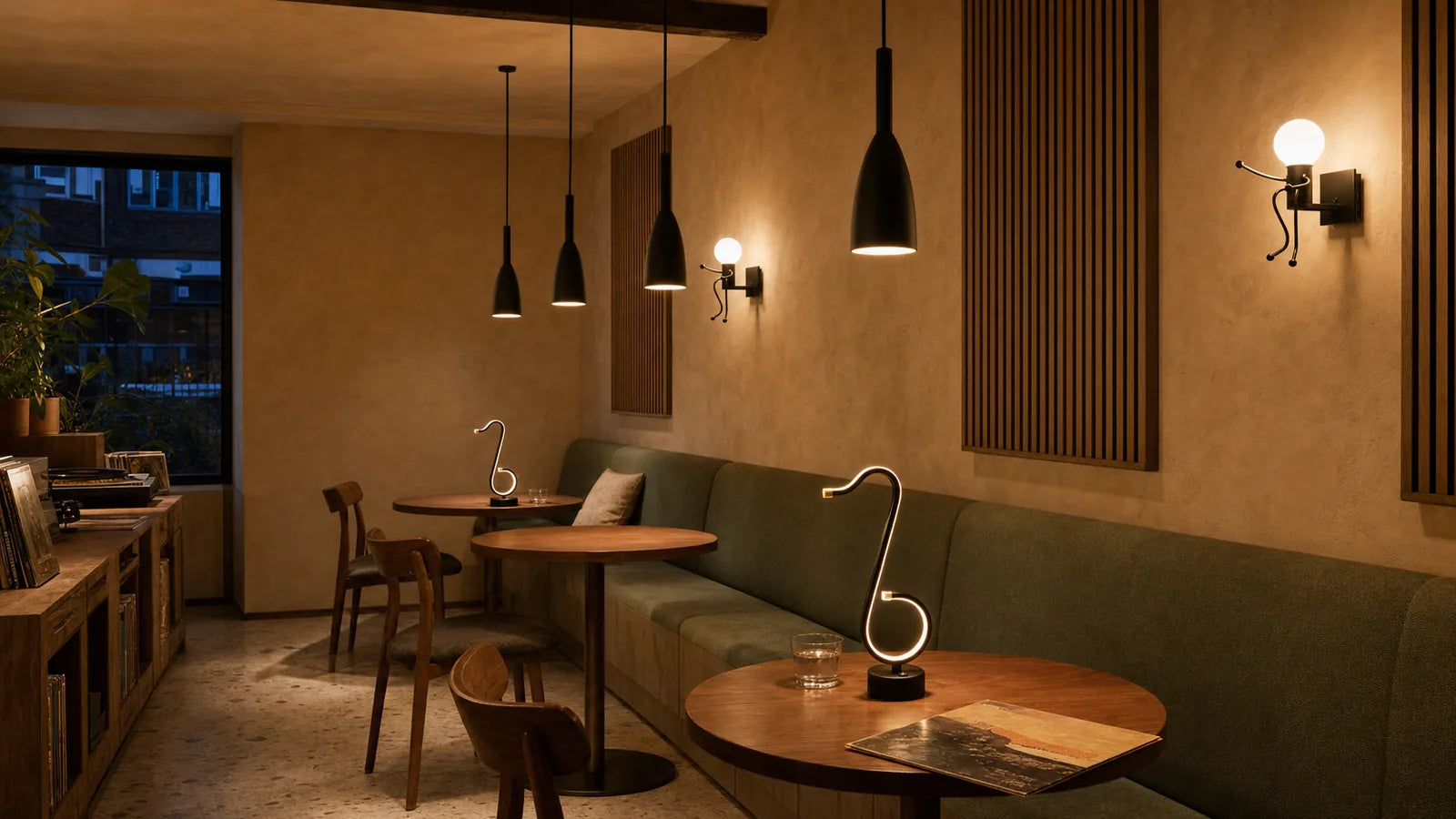
Stage five: what to confirm in writing before you commit
Not because anyone is dishonest. Because verbal answers cannot be checked when a date slips, and the person you spoke to may not be the person you speak to next month.

Send it as one email with numbered lines and ask for a written reply:
- The exact item identifier — the code, not the product name. Names repeat across ranges and seasons; codes do not.
- The quantity available now, and a separate date for the balance if the order will be split.
- A confirmed delivery date for your quantity, your finish and your address, with the name of the person confirming it.
- Control, lamp and driver compatibility, answered against your actual dimmer rather than in general.
- Finish batch, and whether a reorder later will still match.
- Spares, ordered in the same run so they come from the same batch.
- The damage and shortage procedure, including how many days you have to report a problem.
- Return terms for the sample and for the bulk order — they are often different.
- Who carries the cost if the installer opens the boxes and finds a mismatch.
Nine lines. Keep the reply. It is the difference between a conversation and an agreement.
Quantity, spares and the finish problem
Two things bite operators after delivery, and both are decided at the ordering stage.
Spares are not optional in a commercial room. Trays hit shades. A fitting fails. A guest's umbrella takes out a pendant on a wet Friday. If the item is discontinued when that happens, your repair is not one fixture — it is the whole run, because a single mismatched piece in a row of six is more visible than all six being different. Count spares from the positions that matter: the ones over guest tables, the ones at the height of a passing tray, the ones a replacement would have to match exactly.
Finish batches drift. Brass, bronze, aged metals and painted finishes vary between production runs, and two items with the same colour name from the same supplier can be visibly different side by side. If matching matters — and in a row of pendants it always does — order the full set in one go, ask about batch, and keep the spares from that batch rather than planning to buy more later.
The same logic applies to lamps. If the visible bulb is part of the look, buy the lamps in one batch too, and keep a note of the exact item you used. Nothing undermines a carefully lit room like six pendants running four different bulbs.
What actually slips, and the checkpoint that catches it
A Resto Glow editorial risk register, built from the pattern of things that go wrong rather than from any dataset.
| What slips | Why it slips | The checkpoint that catches it |
|---|---|---|
| The item is not the item | Ordered by name, not code | Confirm the identifier in writing before payment |
| Half the order arrives | Available quantity was not the same as your quantity | Ask for quantity available now, and the date for the balance |
| It will not dim | Compatibility answered in general, not against your control | Test the sample on your actual dimmer |
| The finishes do not match | Split orders across batches or dates | One order, one batch, spares included |
| Nobody can install it in time | Trades booked before delivery was confirmed | Book installation against a written delivery date |
| It arrives damaged and the window has closed | Procedure discovered after the fact | Get the damage procedure before you order |
| The room is never documented | Everyone moves on to the next job | Photograph every scene at handover |
None of these are lead-time problems. All of them look like lead-time problems when they happen.
Stage six and seven: order, install, document
When you order, order the whole set together — fixtures, lamps, accessories and spares — so the batch and the date are single facts rather than four.
Then book installation against the confirmed delivery date, not against your hoped-for one, and build in slack between delivery and the day the room has to work. That slack is not padding; it is where you inspect what arrived, count it, plug in and test one, and discover any problem while there is still time to solve it.
Everything hung, wired, mounted or controlled is qualified-professional work, subject to your local requirements. That includes control changes, which are often treated as an accessory purchase and are not.
Finally: document the room before the installer leaves. Photograph every saved scene from a fixed position, record the item codes and where the spares are stored, and write down which scene runs when. Our daypart scenes guide has the card format. A room nobody documented is a room that drifts, and in twelve months nobody will be able to say what the original state even was.
Working backwards from the day the room has to work
Take the date the room must be finished — opening, reopening, an event, an inspection — and walk backwards through the stages: documentation, then handover, then installation, then delivery, then the order, then written confirmation, then the sample test, then the sample order, then the shortlist, then the diagnosis.
Every one of those steps takes time that belongs to you, not to your supplier. In most projects that we see go badly, the supplier's actual delivery was never the binding constraint — the four weeks spent deciding what to buy, or the sample that nobody got round to testing, was.
If your deadline is a seasonal one, the same sequence applies with more discipline: our holiday lighting plan ordered by dependency works the same method against an event calendar.
When you are ready to shortlist, start at restaurant lighting, or narrow by type: pendant lights, wall lights, chandeliers, table lamps. Portable and rechargeable pieces are the fastest thing to pilot on one table, which makes them a useful first sample — see the rechargeable table lamps guide. Care and installation terms are on care & installation, and multi-site scopes start at trade projects.
Restaurant lighting ordering FAQ
How long does restaurant lighting take to arrive?
It depends on the item, the finish, the quantity, the supplier and the season, and it changes — which is why no honest figure can be published here. Ask your supplier to confirm a delivery date in writing for your specific quantity and address, get a separate date for any balance, and build your schedule backwards from the day the room has to work.
When should I order lighting for a restaurant opening?
Early enough to complete the sequence: diagnose the problem, shortlist on documents, order and test one sample in the real room, confirm terms in writing, order the full set with spares, then install and document. Book trades against the confirmed delivery date, and leave slack between delivery and opening for inspection and testing.
Should I order a lighting sample before buying?
Almost always. One unit in your room, on your dimmer, through a real service, seen from every seat, will tell you more than any specification. Agree the return terms before it ships. The sample stage is what turns a full-order failure into a single-unit inconvenience.
How many spare light fixtures should a restaurant order?
Count from the positions that matter — over guest tables, at tray height, and anywhere a mismatched replacement would be obvious — and order them in the same run so they come from the same finish batch. The risk you are covering is not breakage; it is breakage after the item is discontinued.
What should I confirm with a lighting supplier before ordering?
The exact item code, the quantity available now and a date for the balance, a written delivery date with a named person, compatibility with your actual controls, the finish batch and whether reorders will match, spares in the same run, the damage and shortage procedure with its reporting window, return terms for sample and bulk, and who pays if the installer finds a mismatch.
Next in this series: choosing a lighting supplier if you have not picked one yet, is your restaurant too dark? for the diagnosis that should come first, measuring with a phone honestly, and four lighting scenes across the day for what to document at handover.
Keep reading

guest-experience
Restaurant Restroom Cleaning Checklist and Inspection Log
Use this restaurant restroom cleaning checklist for opening, service inspections, supplies, fixtures, floors, waste, incidents, and closing records.

dining-room-operations
Restaurant Dining Room Cleaning Checklist: Turn to Close
Use this restaurant dining room cleaning checklist for table turns, high-touch points, spills, service stations, floors, opening, and close.

food-safety
Restaurant Kitchen Cleaning Checklist for Every Shift
Use this restaurant kitchen cleaning checklist to control opening, between-task, four-hour, closing, and weekly work without vague assignments.