
Restaurant Patio Decor: A 10-Point Suitability Audit (2026)
A practical patio decor audit covering exposure, routes, stability, textile care, mounting, storage and a repeatable service-ready tabletop reset.

By Kamrul Hasan Rayhan · Published 3 August 2026 · Last updated 3 August 2026
If the patio structure is already in place, the most practical improvements are at the edges, entrance, and tables. Those layers can be tested without moving every table or starting a construction project.
Use this list as an August audit for late-summer and early-fall service. Check the perimeter and route first, standardize one tabletop kit, then buy only after wind, weather exposure, storage, and closing responsibilities are clear. Supplier availability and the length of the remaining season vary, so confirm both before ordering a full par.
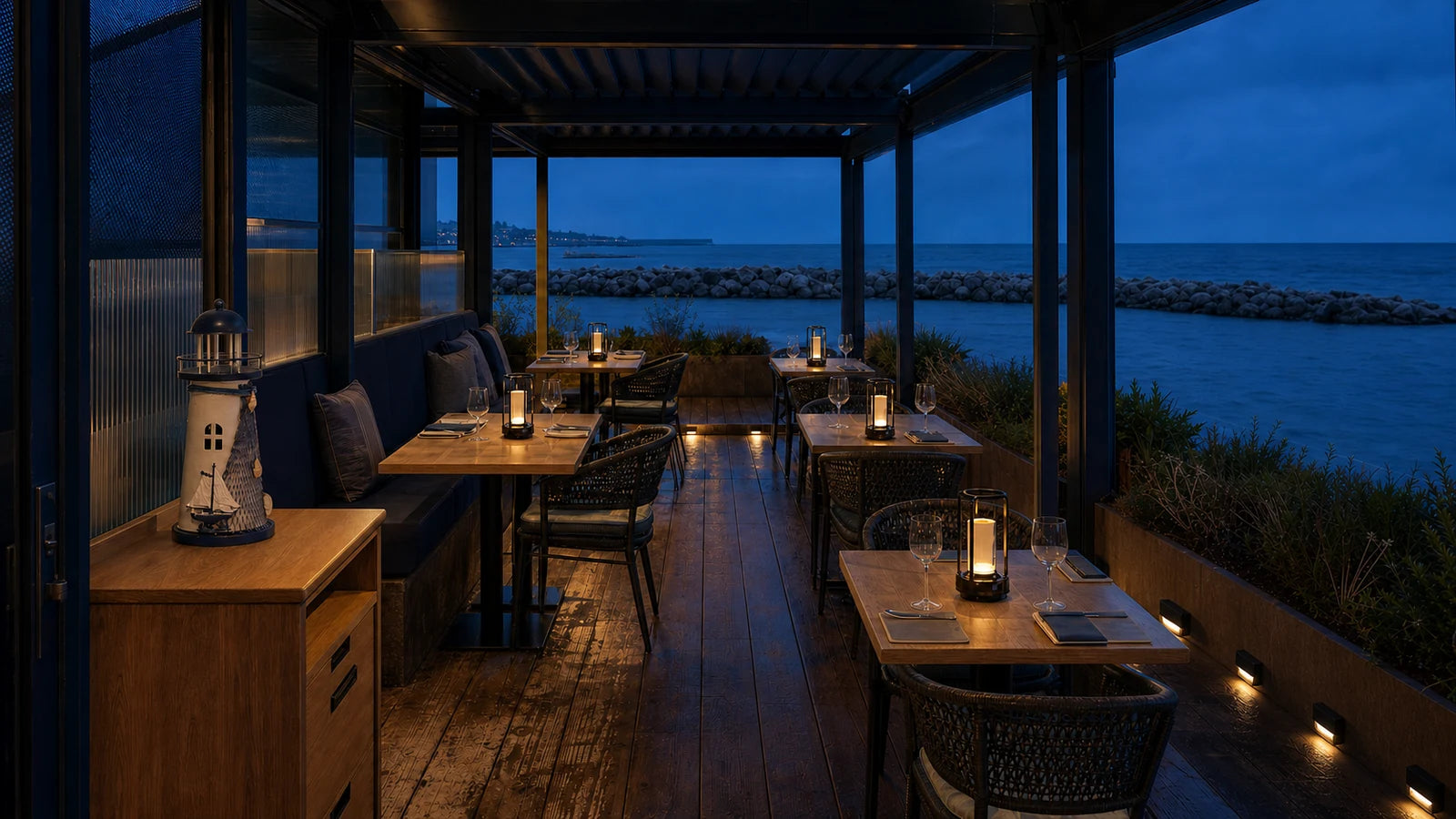
The 10 ideas at a glance
- Define the edge before you decorate the middle.
- Commit to one colour story for the whole patio.
- Treat the table lamp as the centrepiece, not the lighting plan.
- Stability-test the complete vessel and arrangement.
- Mock up one vertical green zone before adding more pots.
- Treat shade as infrastructure with a colour decision.
- Make the patio arrival easy to understand.
- Test textiles against exposure, laundry and storage.
- Build a repeatable kit for each table type.
- Photograph the actual service window before ordering.
This guide covers styling, greenery, textiles, tabletop, screening, and zoning. For fixtures, mounting, glare, and exposure, use Top 10 Patio Lighting Ideas Before Summer Ends and the restaurant patio lighting guide. For the seasonal changeover, use Top 10 Ways to Transition Your Patio to Fall.
1. Define the edge before you decorate the middle
Start at the boundary a guest sees from the sidewalk. If it is unclear where the patio begins or where to enter, styling the middle will not solve the arrival problem.
Mock up repeated planters or vessels with full-size paper outlines before buying. Record clear route width, door swing, queue space, server turns and the position of each table. The object must remain within the approved footprint under the site's expected wind and contact conditions.
Do not improvise ballast inside a decorative vessel unless the manufacturer or a qualified specialist approves the method; added material can overload a base, trap moisture or become a loose hazard. Walk the route under realistic service conditions and check the local right-of-way, fire and accessibility requirements. The US baseline is the 2010 ADA Standards. The Breakwater Terrace is an AI-generated layout reference, not a compliance example.
2. Commit to one colour story for the whole patio
A limited palette can make inherited or mixed furniture read as one scheme. Choose a base, a neutral, and one accent, then use the written palette when selecting textiles, vessels, and florals.
The palette lands in cotton-linen tablecloths with tassels, in the glaze of your vessels, in the tone of your artificial flower arrangements, and — on any wall you have under cover — in canvas art and tapestries. It does not land in paint, which is a capital project, or in furniture you already own and are not replacing this year.
Build one complete sample and inspect it in daylight and during the actual evening service state. Ask suppliers about batch or dye-lot consistency when close matching matters, but do not assume one order guarantees it. Record approved item IDs, colour names and a reference photograph.
3. Treat the table lamp as the centrepiece, not the lighting plan
A rechargeable touch table lamp is both a light source and an object occupying service space. Use it only where the lighting audit finds a table-level gap.
Pilot the lamp through a full service on each table type. Verify the manufacturer's permitted environment, usable runtime at the chosen setting, stability, glare from every seat, cleanability, battery instructions and the space left for plates. Test any sensor product in its exact location; a rail or ledge still needs an approved attachment, exposure and service-impact review.
If candles are being considered, ask the local fire authority and insurer. Flame-free products still need documentation, placement and maintenance checks. For fleet sizing, runtime and charging, see our rechargeable table lamps guide and browse table lamps; for overhead work, use the patio lighting audit.
4. Stability-test the complete vessel and arrangement
Outdoor suitability belongs to the complete assembly in its exact position. Material labels and empty-vessel weight do not establish stability.
Shortlist from products whose supplier documentation supports the intended location, then test the full vessel, insert and stems. Check movement during the site's approved wind-response test, a realistic table bump, water or drainage behavior, breakage consequences, loose parts, cleanability and the usable route or table area.
Ask for the specific product's UV, moisture, temperature and care information instead of inferring performance from ceramic, glass, metal or “artificial” as categories. Compare fresh and artificial arrangements using the venue's purchase, labour, cleaning, storage, replacement and disposal costs. The seasonal recheck is covered in the fall transition post.
5. Mock up one vertical green zone before adding more pots
A concentrated green zone can screen an unwanted view or give a table a visual back, but it also adds wind area, weight, irrigation and maintenance.
Mock up the full outline of a trellis or planted screen and review sightlines, wind exposure, total saturated weight, drainage, irrigation, pest management, accessible circulation and emergency access. Choose live species with a local horticultural professional for the site's sun, climate and care capacity; an editorial plant list cannot establish survival.
Do not attach to a rail, wall, canopy or public barrier until the owner or landlord, structural information and local approvals support it. Our low-maintenance restaurant plants guide helps build the care brief; verify the final species locally.
6. Treat shade as infrastructure with a colour decision
Umbrellas and canopies affect the visual palette, but their first job is structural and environmental. Use a qualified shade or awning supplier to resolve wind rating, anchorage, drainage, fire performance, operation and local requirements before selecting fabric colour.
A covered bay may allow a different décor shortlist, but it does not become an indoor room. Map wind-driven rain, condensation, sun, temperature, cleaning, guest contact and storage at each proposed position. Check every product listing against that actual exposure.
Wall sconces, fans, hardwired light, wall-mounted displays and overhead objects require appropriate environmental ratings, mounts, electrical or structural review and professional installation. The Courtyard Supper Club is an AI-generated styling reference, not an exposure or installation specification.
7. Make the patio arrival easy to understand
An arrival point should help a first-time guest find the host, understand whether to wait and enter without crossing a server route.
Walk the approach with the queue at its normal peak. Mark door and gate swing, host workspace, accessible circulation, menu display, sign visibility, egress and the hand-off to a table. Mock up any vessel or sign at full size and stability-test it without narrowing those functions.
Observe the arrival in daylight and the evening service state. Required wayfinding, steps, door hardware and faces should remain visible without glare. Decorative portable light is not a substitute for required exterior, emergency or egress lighting. The front-of-house sequence is in our restaurant entrance design guide.
8. Test textiles against exposure, laundry and storage
Patio textiles face light, moisture, wind, food soil, laundering and repeated setup. The product and care system must be evaluated together.
Test one cloth on each table type. Check drape, movement in the site's wind-response trial, clips or restraints approved for the table, snag risk, water behavior, staining, laundering instructions, drying time and the reset. Ask the supplier about batch consistency if close matching matters.
Build the par from pieces used per service, laundry turnaround, reserve stock and documented loss. Assign removal, inspection, cleaning, complete drying and dry ventilated storage; do not seal damp goods in a bin. The seasonal change is covered in the patio fall transition guide.
9. Build a repeatable kit for each table type
Build a candidate kit for each materially different table type. A two-top, communal table and accessible position may need different objects or no décor at all.
Set the table with the complete service. Check sightlines, reach, plate and shared-dish space, stability, cleaning, wind response and the server's approach. Remove any item that is repeatedly moved by guests or staff.
Time several real resets and record the median rather than claiming an instant setup. Photograph the approved kit, assign storage positions, count components at close and log damage or loss. Review after the first busy service. Tabletop composition is covered in our restaurant table decor guide.

10. Photograph the actual service window before ordering
Clock time and sunset vary by date and location. Photograph the patio during the service condition you need to improve, then repeat the view in daylight.
Use fixed viewpoints: arrival, priority table, far end, one tabletop close-up and one wide shot. Mark dark routes, glare, reflections, unreadable signs, objects that disappear and clutter that blocks the view. Do not relamp a run based on a photograph alone; first verify fixture and control compatibility and inspect the result in person.
Keep the dated photographs with the proposed change and its outcome. The next review can then compare the same views instead of relying on memory.
Build an evidence-and-service-test matrix
Material names do not establish outdoor suitability or lifetime. Use this matrix to decide what evidence to request and what to test before setting a par.
| Candidate | Evidence to request | Service test | Close-down decision |
|---|---|---|---|
| Vessel and arrangement | Intended environment, care, material and any temperature or UV limits | Complete-assembly stability, breakage consequence, cleanability, route and table space | Named position, removal trigger, dry storage and damage log |
| Artificial stems or greenery | Intended exposure, UV or moisture information, care and warranty | Fading reference, loose parts, soil buildup, stability and cleaning time | Inspect, clean, dry and store according to instructions |
| Table textiles | Fibre, finish, care, laundering and any performance documentation | Wind response, snagging, stains, drying time, colour change and reset labour | Remove, inspect, launder, dry fully and store ventilated |
| Art, signs and wall display | Intended environment, mount requirements, weight and finish care | Glare, fading reference, wind exposure, guest contact and mounting review | Bring in unless the complete approved installation supports continued exposure |
| Rechargeable lamps | Permitted environment, charging and battery instructions, runtime and care | Stability, glare, runtime at chosen setting, cleaning and temperature or moisture exposure | Count, inspect, clean, charge and quarantine damaged units |
| Hardwired or overhead items | Environmental listing, installation instructions, load, controls and approvals | Professional commissioning, glare, clearances, egress and service view | Inspect under the venue's facilities and maintenance program |
Set replacement timing from documented condition, supplier information and the venue's own failure history—not an editorial promise of “one season” or “years.”
Product picks from Resto Glow
The perimeter. Mock up repeated vessel forms at full size, then shortlist only products whose documentation supports the intended exposure. Stability-test the complete arrangement and keep the approved route clear.
The table. Test a rechargeable touch table lamp on each table type that reads dark, and use that result to size the fleet and charging rotation. Add a hand-sweep induction lamp only where the sensor and exposure test work. Keep vessels low and stable. Build textile par from tables in use, service changes, laundry turnaround, and reserve; confirm dye-lot availability if close colour matching matters.
The covered wall. Map the real exposure before shortlisting wall lights, art, display or a ceiling fan. Obtain the appropriate environmental, structural, electrical, landlord and local approvals; “covered” is not an outdoor rating.
The arrival. Mock up one sign or planted vessel while preserving host workspace, sightlines, accessible circulation, egress and required lighting.
Browse the evening mood in Warm & Intimate, the full range in restaurant lighting, or use The Breakwater Terrace and The Courtyard Supper Club as AI-labelled visual references. Styling several patios at once? Start with trade projects.
Restaurant patio decor FAQ
How do you decorate a restaurant patio?
Start with the operational map: boundary, accessible route, egress, host point, table types, exposure and nightly storage. Mock up the edge and one complete table, test them in service, then set the quantity. A limited palette can unify the approved pieces.
What decor holds up outdoors in wind and rain?
No material category guarantees performance in wind and rain. Match the specific product documentation to the mapped exposure, then test the complete assembly for stability, breakage consequence, cleanability and removal. Even covered positions may receive wind-driven rain and condensation.
How do you make an outdoor dining area feel cozy?
Use a limited palette, a clear edge and a table-level layer only where the lighting audit shows a need. Test textiles, a green screen or a portable lamp in one zone while preserving routes, task visibility and service space. Ask the local fire authority and insurer about open flame; flame-free products still require suitability and maintenance checks.
What should go on a restaurant patio table?
Build the smallest kit that works for each table type; some tables may need no décor. Set the complete service, then test sightlines, place-setting space, stability, exposure, cleaning and reset labour. Photograph and count the approved version.
How much does it cost to decorate a restaurant patio?
Price the full system: samples, products, freight, tax, approvals, professional installation, staff setup, nightly removal, cleaning, laundry, dry storage, replacement and disposal. Divide that total by the number of services or covers actually delivered during the measured period; do not assume a generic product lifetime.
Next in this series: Top 10 Patio Lighting Ideas Before Summer Ends for the fixtures, Top 10 Ways to Transition Your Patio to Fall for the changeover calendar, Top 10 September Decor Swaps to Prep in August for the rooms inside, and Top 10 Fall Ambiance Lighting Ideas for the autumn argument.
Keep reading

guest-experience
Restaurant Restroom Cleaning Checklist and Inspection Log
Use this restaurant restroom cleaning checklist for opening, service inspections, supplies, fixtures, floors, waste, incidents, and closing records.

dining-room-operations
Restaurant Dining Room Cleaning Checklist: Turn to Close
Use this restaurant dining room cleaning checklist for table turns, high-touch points, spills, service stations, floors, opening, and close.

food-safety
Restaurant Kitchen Cleaning Checklist for Every Shift
Use this restaurant kitchen cleaning checklist to control opening, between-task, four-hour, closing, and weekly work without vague assignments.